- Animals
- ›Arthropods
- ›Chelicerates
- ›Arachnids
- ›Spiders
- ›Typical Spiders
- ›Haplogyne Spiders
- ›Synspermiatid Spiders
- ›Goblin Spiders and Allies
- ›Tunnel Spiders
- ›Segestriinae
- ›Segestria
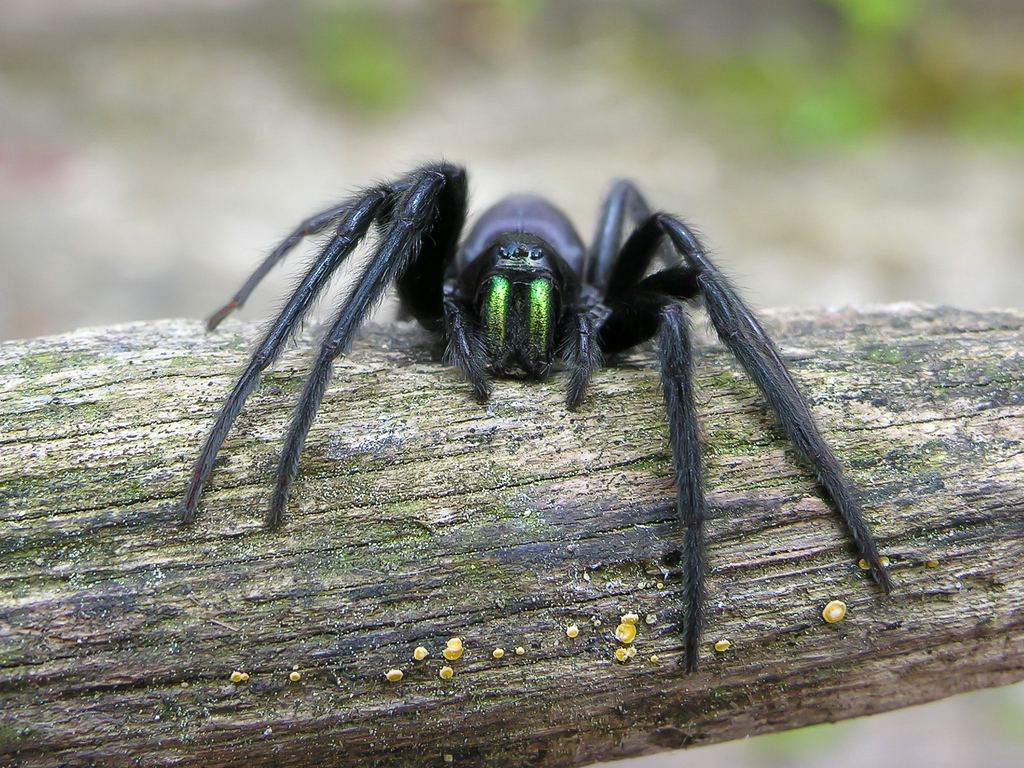
Tube-dwelling Spider
Segestria florentina
Segestria florentina is the largest European segestriid spider. Some vernacular names are green-fanged tube web spider and cellar spider, although the latter is not exclusive to this species.
From the article Segestria florentina on Wikipedia (CC BY-SA), quoted section by section
Description
Females can reach a body length of 22 mm, males up to 15 mm. This species is much darker than others of the same genus. While subadult spiders have a greyish opisthosoma with a marking similar to Segestria senoculata, adults are of a uniform black, sometimes with a green iridescent shine, especially on the chelicerae, which reflect with a striking green. The sexes are similar. Adults occur from June to November.
Range & habitat
Originally a species of the Mediterranean region as far east as Georgia, it can now be found in many towns in southern Britain, where they were probably introduced via seaports at least since 1845. It has been found in several places in Cornwall, South Molton (North Devon), Shaftesbury, Torbay, Bradninch (Mid Devon), Jersey, Plymouth, Bristol, North Somerset, Swindon, Bovingdon, Gloucester, Ashford, Folkestone, Deal, Dover, Hayes, Southampton, Salisbury, Whitstable, Canterbury, South East London, Vinters Park, Maidstone, Portsmouth, Exeter, Sittingbourne, Isle of Sheppey, Essex, Faversham, Tonbridge, Hitchin, Sheffield, Bridgwater and Newport, where it prefers south-facing walls. Specimens have been found in Exeter Cathedral as far back as 1890. In 2023, it was reported that a population was established in Limerick in western Ireland. It has also been found in Argentina, Australia and several Atlantic islands, where it was probably also introduced. One specimen has also been observed in Leiden, The Netherlands. Many specimens inhabit Westminster Abbey in an isolated population group that has been proposed as a new subspecies due to their fangs being brighter green and their size being significantly smaller to other European populations. Egg-laying females are known to prefer the habitation of brick structured buildings. …
Wikipedia: “Distribution”
Where it lives
Recorded sightings
—
geo-referenced records in GBIF, from museums, herbaria and field observers.
Drag the globe to turn it. Dots are where records exist, not a range map; darker means more records.
In the stacks
Searching the stacks…
Every page naming Segestria florentina in the Biodiversity Heritage Library →
This page is assembled live from iNaturalist, GBIF, Wikipedia, the Source Library and the Internet Archive. It is not yet part of the hand-edited codex. iNaturalist taxon 320827.