- Animals
- ›Arthropods
- ›Crustaceans
- ›Typical Crustaceans
- ›Malacostracans
- ›Decapods, Isopods, and allies
- ›Decapods and Krill
- ›Decapods
- ›Crabs, Lobsters, Shrimps, and Allies
- ›True Crabs
- ›Eubrachyuran Crabs
- ›Heterotrematan Crabs
- ›Spider Crabs and Decorator Crabs
- ›Kelp Crabs
- ›Pisinae
- ›Libinia
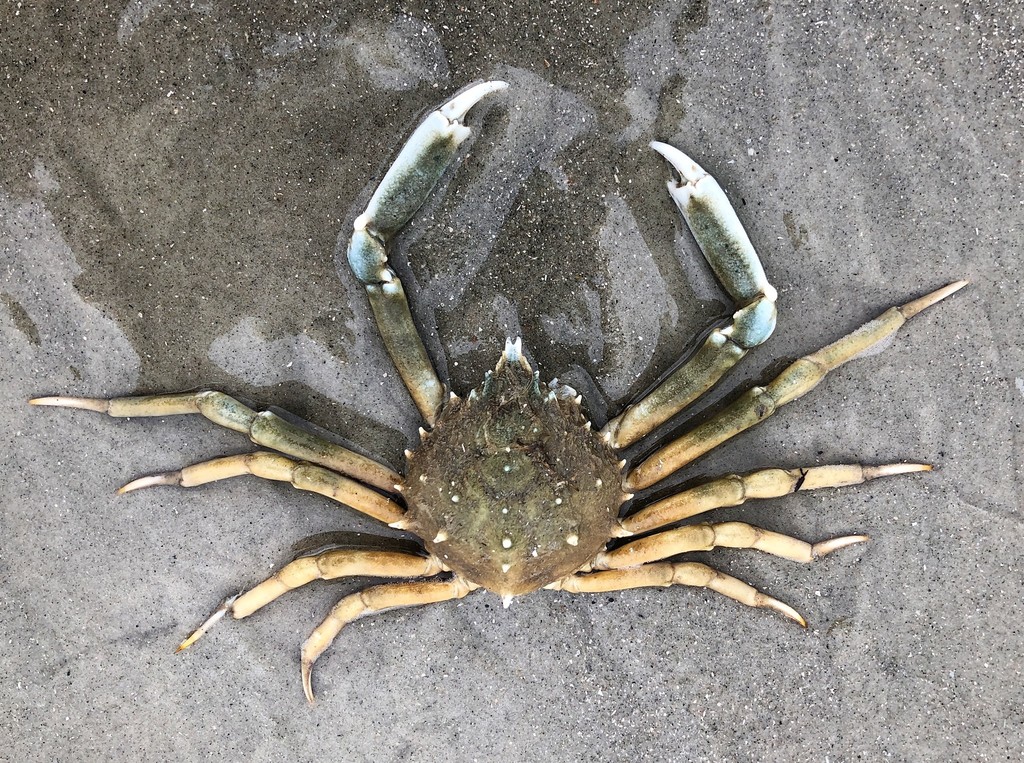
Longnose Spider Crab
Libinia dubia
Libinia dubia, the longnose spider crab, is a species of crab in the family Epialtidae. It is found in shallow waters on the eastern coast of North America.
From the article Libinia dubia on Wikipedia (CC BY-SA), quoted section by section
Description
The carapace of the longnose spider crab is nearly circular in outline. The shell grows to an average diameter of 6 to 10 centimetres (2.4 to 3.9 in) with the males being larger than the females. There are about six spiny protuberances on each edge of the shell and another six down the midline. The upper surface is covered with short setae (bristles) which are hooked and resemble velcro. To these the crab sticks pieces of seaweed and other organisms as camouflage. There are two small stalked eyes and between these the carapace extends forward in a forked rostrum. There are five pairs of long, thin, jointed walking legs. The front pair end in rather small pincers and the terminal joint of the others legs is a curved claw. The longnose spider crab may be confused with the portly spider crab, Libinia emarginata, but that species usually has nine spines on the margin at each side of the shell.
Range & habitat
The longnose spider crab is found on the eastern seaboard of the United States at depths down to about 50 metres (160 ft). The range is from Cape Cod to southern Texas, including Cuba and the Bahamas. In the Indian River Lagoon, adults are found on sandy bottoms and juveniles in seagrass meadows. In the late 1900s this crab was identified off the coast of Tunisia, but by what means it had managed to cross the Atlantic Ocean is unclear.
Wikipedia: “Distribution”
What it does
When breeding, the male transfers bundles of sperm called spermatophores to the female. Fertilisation is internal and afterwards the female broods the eggs under her abdomen until they hatch. The larvae then become part of the zooplankton, having two zoeal stages and one megalopal or post-larval stage. After that the larvae settle on the sea bed and undergo metamorphosis into juvenile crabs.
Wikipedia: “Reproduction”
Where it lives
Recorded sightings
—
geo-referenced records in GBIF, from museums, herbaria and field observers.
Drag the globe to turn it. Dots are where records exist, not a range map; darker means more records.
In the stacks
Searching the stacks…
Every page naming Libinia dubia in the Biodiversity Heritage Library →
This page is assembled live from iNaturalist, GBIF, Wikipedia, the Source Library and the Internet Archive. It is not yet part of the hand-edited codex. iNaturalist taxon 295474.