- Animals
- ›Arthropods
- ›Crustaceans
- ›Typical Crustaceans
- ›Malacostracans
- ›Decapods, Isopods, and allies
- ›Decapods and Krill
- ›Decapods
- ›Crabs, Lobsters, Shrimps, and Allies
- ›True Crabs
- ›Eubrachyuran Crabs
- ›Thoracotrematan Crabs
- ›Ghost, Fiddler, Sand Bubbler Crabs and Allies
- ›Ghost and Fiddler Crabs
- ›Mangrove Ghost Crabs
- ›Ucides
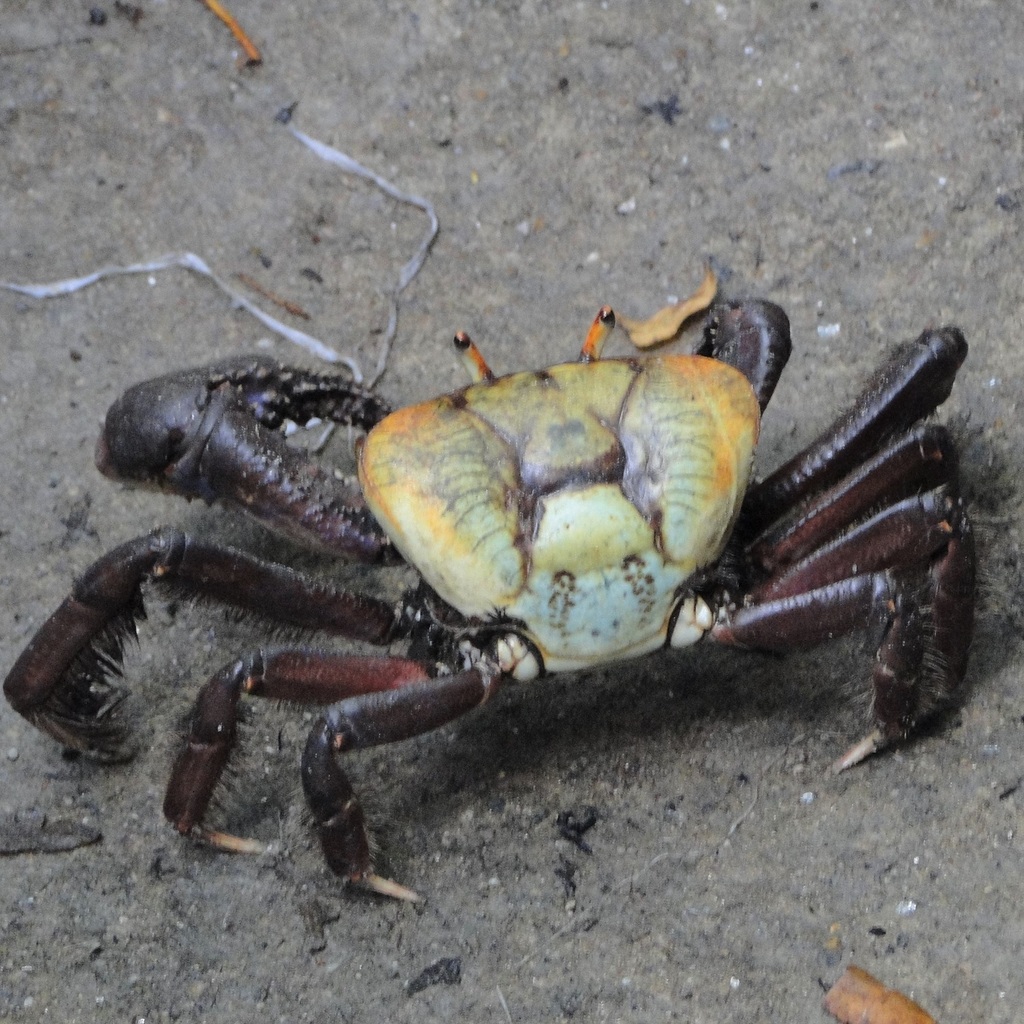
Atlantic Mangrove Ghost Crab
Ucides cordatus
Ucides cordatus, the swamp ghost crab (or caranguejo-uçá in Portuguese), is one of two species of crabs in the genus Ucides. This species of crab is native to many coasts off of the western Atlantic Ocean. It has been found to be native to areas as far north as Florida and to as south as Uruguay. U. cordatus is especially noteworthy in Brazil as it plays important roles in the economy and food resources at Brazil's Atlantic borders.
Like most other crabs, U. cordatus has two distinct pinchers for different uses. Its left sharp pincher functions to cut and feed; its right pincher is much larger and is used to crush objects. It has an oval back with a unique color scheme. U. cordatus is one of many animals that have sexual dimorphism. Most noticeably, female crabs are larger than males. Males have a flatter oval shaped back with a distinct light blue in the middle with a beige white encompassing its back. On the other hand, females have much larger, bulbous backs. Their carapaces are a dull dark green with dark purple. Both genders' legs are also a dark reddish purple.
From the article Ucides cordatus on Wikipedia (CC BY-SA), quoted section by section
Range & habitat
Ucides cordatus is from the mangrove crab genus and are primarily found in mangrove forests. They are largely terrestrial, and they will create their homes at the bases of trees in the form of burrows. These burrows have been seen to be as deep as 1.6 meters down. Their burrows have been found to play an important role in balancing carbon dioxide in mangrove forests. The increase in sedimentary surface area allows for a greater area for oxidation to occur especially during the rain season. While it has been documented to eat animal remains, U. cordatus is primarily a herbivore. The diet of U. cordatus largely consists of mangrove litter (ie. leaves, bark, roots etc.). During the early months of its life, the species feeds on polychaete worms and microorganisms found in sediments. They purposely ingest sediments that they collect outside their burrows. It has been noted that U. cordatus prefers certain mangrove species; it has been found to prefer Rhizophora mangle over Avicennia germinans, but the reasons for this preference is unknown. U. cordatus has few predators. Animals known to hunt U. cordatus include, but are not limited: coati, monkeys, and hawks. With such few predators, populations of U. cordatus tend to grow quite well because of this. However, populations of U. cordatus are also greatly exploited by locals primarily in Brazil. The overall U. …
Wikipedia: “Habitat”
What it does
Like many other crabs, U. cordatus will migrate during mating season, which occurs during the months of November to January. They will leave their burrows to reach the ocean coast. In doing so, they create the migration phenomenon known as "a andada", which is Portuguese for 'the walking'. At the coast, the crabs will mate then lay their eggs, after which they will return to their origin.
Wikipedia: “Behavior”
Where it lives
Recorded sightings
—
geo-referenced records in GBIF, from museums, herbaria and field observers.
Drag the globe to turn it. Dots are where records exist, not a range map; darker means more records.
In the stacks
Searching the stacks…
Every page naming Ucides cordatus in the Biodiversity Heritage Library →
This page is assembled live from iNaturalist, GBIF, Wikipedia, the Source Library and the Internet Archive. It is not yet part of the hand-edited codex. iNaturalist taxon 295362.