- Animals
- ›Arthropods
- ›Crustaceans
- ›Typical Crustaceans
- ›Malacostracans
- ›Decapods, Isopods, and allies
- ›Decapods and Krill
- ›Decapods
- ›Crabs, Lobsters, Shrimps, and Allies
- ›True Crabs
- ›Eubrachyuran Crabs
- ›Heterotrematan Crabs
- ›Xanthoid Crabs
- ›Mud Crabs
- ›Dyspanopeus
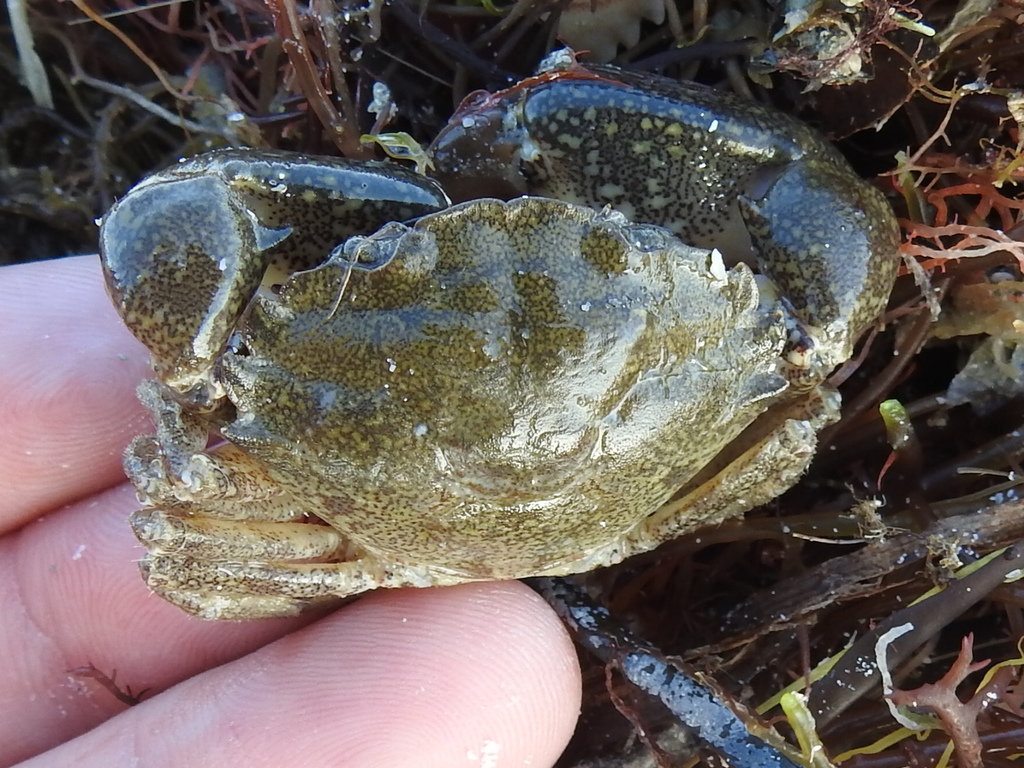
Gulf Grassflat Crab
Dyspanopeus texanus
Dyspanopeus texanus (formerly Panopeus texanus or Neopanope texana) is a species of crab known as the Texas mud crab.
From the article Dyspanopeus texanus on Wikipedia (CC BY-SA), quoted section by section
Range & habitat
The Dyspanopeus texanus are also one of the most abundant and dominant crab species in the coastal lagoons of southwestern Gulf of Mexico, including Términos, Tamiahua, and Madre. The Texas Mud Crabs are also known as euryhaline species, which means that they can adapt to wide ranges of salinity, which is why they have been historically found living on macroalgae, seagrasses, and submerged aquatic vegetation. In a study using different Carbon isotopes to determine the trophic levels of different xanthoid crabs, it found that D. texanus occupy the higher trophic levels in these ecosystems, meaning their diets are likely to consist of mostly primary producers like zooplankton and red algae.
Wikipedia: “Distribution”
What it does
Knowledge of the reproduction of xanthoid crabs is quite sparse. The only information that could be acquired of the D. texanus, as observed in the Laguna de Términos, was that they are sexually mature at sizes as small as five millimeters wide. That’s a little more than an eighth of an inch on a ruler, barely a thumbnail’s width. For another Xanthid crab called Neopanope sayi, there is a bit more information on the matter. For the males of their species, the reproductive system consists of the tests, vasa deferentia, penes, and pleopods. “Nonmotile spermatozoa” leave the testes as individual cells, which are encapsulated within the anterior vasa deferentia. The spermatophores that result are transparent, delicate sphere about 0.2 millimeters in diameter. Spermatophores contain several hundred gametes that are stored in the median vasa deferentia until the males release them to fertilize a female’s egg. The females of the Neopanope sayi have a vagina, vulva, and two-lobed ovaries: one extending above their hepatopancreas and the other along the side of their digestive tract. Just before the females begin releasing their eggs into the water (spawning), their ovaries contain a large number of dark green eggs. …
Wikipedia: “Reproduction”
Where it lives
Recorded sightings
—
geo-referenced records in GBIF, from museums, herbaria and field observers.
Drag the globe to turn it. Dots are where records exist, not a range map; darker means more records.
In the stacks
Searching the stacks…
Every page naming Dyspanopeus texanus in the Biodiversity Heritage Library →
This page is assembled live from iNaturalist, GBIF, Wikipedia, the Source Library and the Internet Archive. It is not yet part of the hand-edited codex. iNaturalist taxon 295313.