- Animals
- ›Molluscs
- ›Gastropods
- ›Heterobranchs
- ›Euthyneura
- ›Tectipleura
- ›Sacoglossans
- ›Plakobranchoidea
- ›Plakobranchidae
- ›Elysia
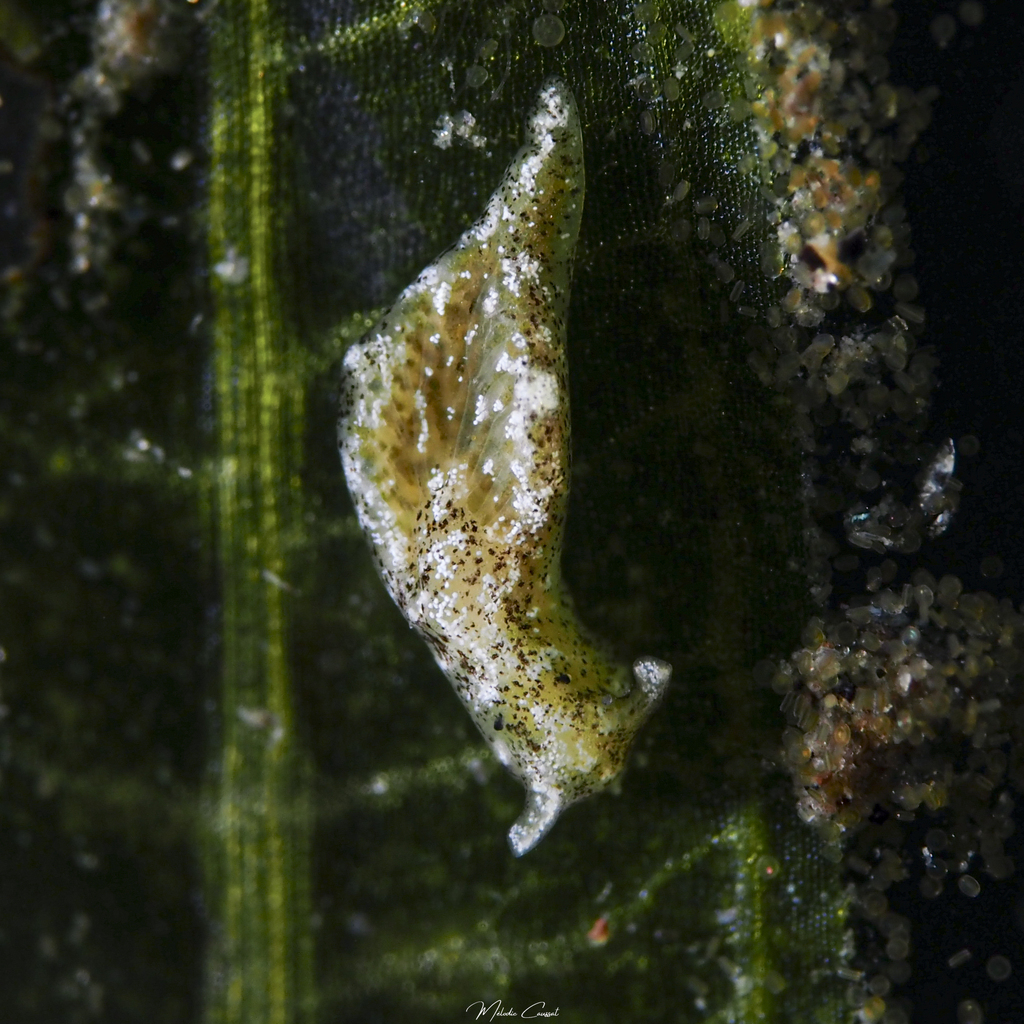
Seagrass Elysia
Elysia serca
Elysia serca, the seagrass elysia or Caribbean seagrass elysia, is a species of sea slug, a marine gastropod mollusc in the family Plakobranchidae. Although this sea slug resembles a nudibranch, it is not a nudibranch; it belongs to the clade, Sacoglossa, the "sap-sucking" sea slugs. It was first described by Marcus in 1955 from specimens found in Brazil.
From the article Elysia serca on Wikipedia (CC BY-SA), quoted section by section
Description
Elysia serca is a small, slender sea slug with a maximum length of 8 millimetres (0.31 in). The parapodia are less well developed than is the case in many other Elysia species and Elysia serca has a relatively large head. The characteristic radular teeth have the cusps bent at right angles to their bases. The base colour is some shade of brown or olive with many small patches of white and three larger white patches, two on the parapodia and one on the back near the heart.
Range & habitat
Elysia serca is found in shallow waters in the western Atlantic from Florida south to Brazil. It was originally described from the southern end of its range, where it was found on brown algae and the green alga Ulva, on which it was presumably feeding. In Florida however it feeds on seagrasses including Halophila engelmannii, Halodule wrightii and Thalassia at depths of up to a few metres. Elysia catulus on the other hand, feeds on the seagrass Zostera and is found on the North American coast between South Carolina and Nova Scotia.
Wikipedia: “Distribution and habitat”
Where it lives
Recorded sightings
—
geo-referenced records in GBIF, from museums, herbaria and field observers.
Drag the globe to turn it. Dots are where records exist, not a range map; darker means more records.
In the stacks
Searching the stacks…
Every page naming Elysia serca in the Biodiversity Heritage Library →
This page is assembled live from iNaturalist, GBIF, Wikipedia, the Source Library and the Internet Archive. It is not yet part of the hand-edited codex. iNaturalist taxon 255212.