- Animals
- ›Molluscs
- ›Gastropods
- ›Caenogastropods
- ›Littorinimorpha
- ›Tonnoid Snails
- ›Helmet and Bonnet Snails
- ›Cassinae
- ›Cassis
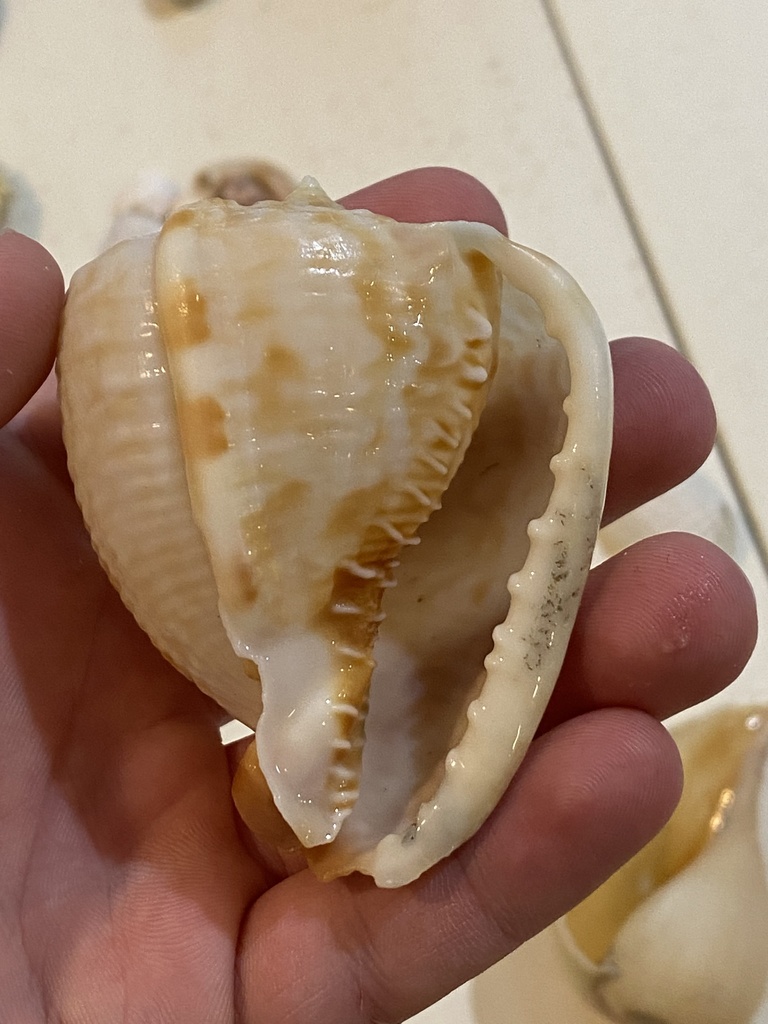
Emperor Helmet Snail
Cassis madagascariensis
Cassis madagascariensis, (queen helmet, emperor helmet, or cameo helmet), is a marine gastropod mollusc in the family Cassidae, the helmet shells and bonnet shells. It is known as the largest species of its family in the Atlantic Ocean.
From the article Cassis madagascariensis on Wikipedia (CC BY-SA), quoted section by section
Description
The maximum recorded shell length is 409 mm. The organism has no vertebra. It has a large, heavy shell, with a short spire. This shell typically has three rows of blunt knobs and smaller lines of spiral folds. It has an elongated aperture with folds on both sides of the inner aperture. This shell color varies from white to tan and may have brown markings and blotches. The species of Cassis Madagascariensis (Queen Helmet Mollusk) can be distinguished by their size and the number of spines on their shell. C. Madagascariensis Lamark can be identified more easily. This is because it has fewer and larger spines than most other species. The topmost spine is notably larger than the rest of the spines.
Range & habitat
This species inhabits the tropical Western Atlantic, the Gulf of Mexico and the Caribbean Sea. The name "madagascarensis" means "of Madagascar", but this was a misunderstanding of the type locality by the original author.
Wikipedia: “Distribution”
At the table
Shells are used in jewellery to make cameos. In the Maldives the shell is boiled and the boiled water is used as a traditional remedy for flu and fever.
Wikipedia: “Human uses”
Where it lives
Recorded sightings
—
geo-referenced records in GBIF, from museums, herbaria and field observers.
Drag the globe to turn it. Dots are where records exist, not a range map; darker means more records.
In the stacks
Searching the stacks…
Every page naming Cassis madagascariensis in the Biodiversity Heritage Library →
This page is assembled live from iNaturalist, GBIF, Wikipedia, the Source Library and the Internet Archive. It is not yet part of the hand-edited codex. iNaturalist taxon 253536.