- Animals
- ›Arthropods
- ›Chelicerates
- ›Arachnids
- ›Spiders
- ›Typical Spiders
- ›Entelegyne Spiders
- ›Flatmesh Weavers and Two-Tailed Spiders
- ›Flatmesh Weavers
- ›Oecobiinae
- ›Oecobius
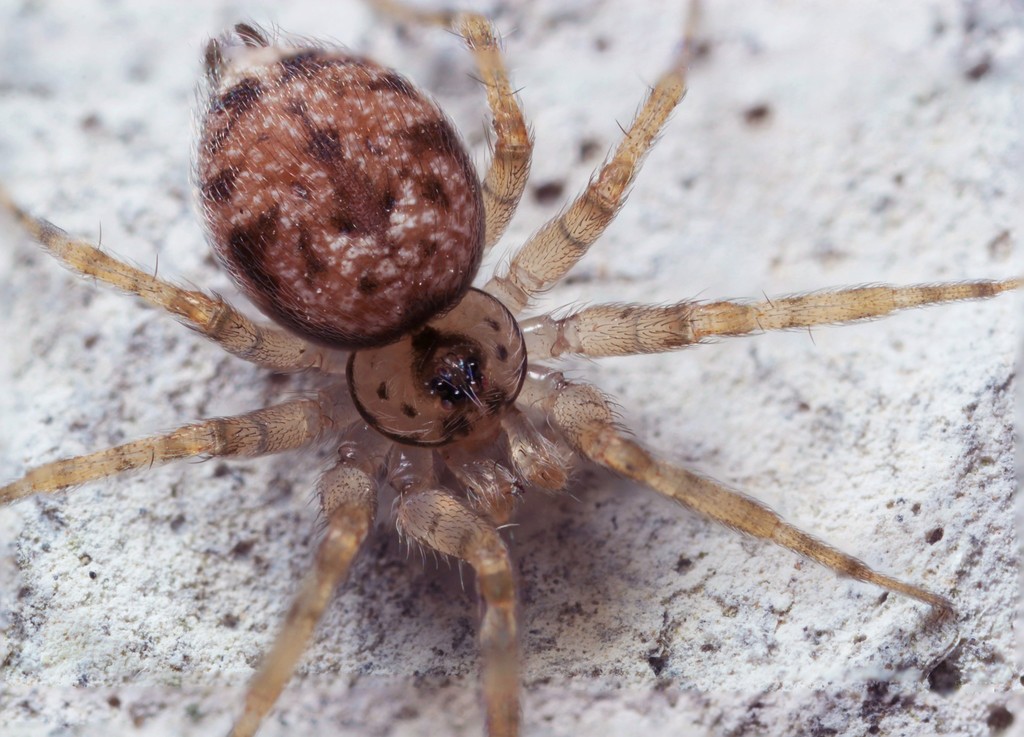
Wall Spider
Oecobius navus
Oecobius navus is a small cosmopolitan cribellate spider species of about 2-3mm. It is light grey with darkly annulated legs. It builds flat webs with lateral openings with a diameter of about 3 cm under rocks, on ceilings and along the corners of walls with protruding signaling threads.
From the article Oecobius navus on Wikipedia (CC BY-SA), quoted section by section
Description
Both adult males and females are approximately the same size, with a body length of 2–2.5 mm (0.08–0.10 in). The carapace is almost circular, pale brown, with a dark patch in the centre which sometimes extends to the ocular region, and a thin black marginal line. The abdomen is coloured a yellowish brown, with black spots over smaller white flecking. Their posterior spinnerets are long, with a tubule between them. The legs are short, and coloured as the carapace; they vary from being unmarked to having distinct, dark annulations. They have eight eyes, however the posterior median eyes are reduced to being flat, irregular silver patches. The other six eyes are grouped into two pairs of three.
Range & habitat
Oecobius navus is native to Europe and Northern Africa, however it has also been introduced to South Africa, China, Korea, Japan, New Zealand, and the Americas. It builds flat webs with lateral openings with a diameter of about 3 cm under rocks, on ceilings and along the corners of walls with protruding signaling threads.
Wikipedia: “Distribution and habitat”
What it does
Prior to copulation, the male constructs a tubular mating web above the female's retreat. He then attempts to entice the female inside; if she joins him inside, they mate. As with many spider species, the female may cannibalize the male during or after copulation. The female spins several small egg sacs, each containing 3–10 eggs, and abandons them.
Wikipedia: “Reproduction”
Where it lives
Recorded sightings
—
geo-referenced records in GBIF, from museums, herbaria and field observers.
Drag the globe to turn it. Dots are where records exist, not a range map; darker means more records.
In the old herbals & bestiaries

In the stacks
Searching the stacks…
Every page naming Oecobius navus in the Biodiversity Heritage Library →
This page is assembled live from iNaturalist, GBIF, Wikipedia, the Source Library and the Internet Archive. It is not yet part of the hand-edited codex. iNaturalist taxon 226250.