- Animals
- ›Arthropods
- ›Chelicerates
- ›Arachnids
- ›Spiders
- ›Typical Spiders
- ›Entelegyne Spiders
- ›Orbweavers and Allies
- ›Orbweavers
- ›Bolas Spiders
- ›Mastophora
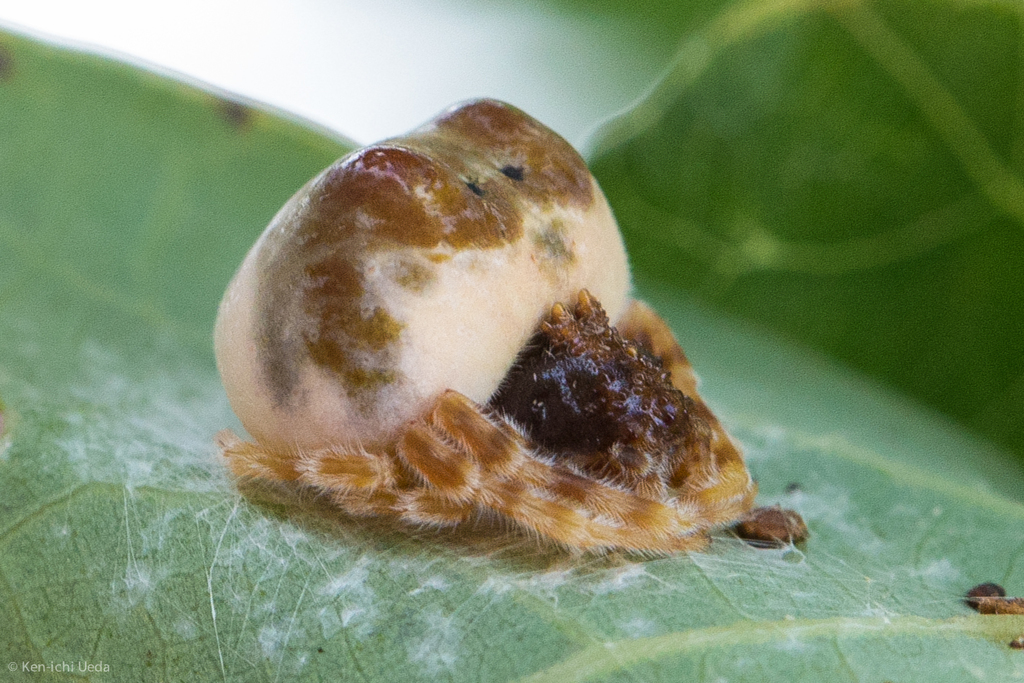
Cornfield Bolas Spider
Mastophora hutchinsoni
Mastophora hutchinsoni, also known as the American bolas spider, is a species of orb weaver in the genus Mastophora. The genus is distributed extensively throughout various subtropical geographical areas including Australia, South Africa, Oriental Asia, and the Americas and is not found in Europe. The hunting behavior of adult female M. hutchinsoni is unusual because they are bolas spiders. They mimic moth pheromones to attract male moths, and female M. hutchinsoni have evolved to alter their chemical release to target different moths. They then capture their prey with a sticky drop on the end of a silk line, resembling a bolas.
From the article Mastophora hutchinsoni on Wikipedia (CC BY-SA), quoted section by section
Description
The female spiders have a large spherical abdomen with a milky white base often covered in darker brown patterns and a smaller brown carapace. There is a clear distinction between the two sexes as extreme sexual dimorphism results in much larger females. Although both sexes hatch with their cephalothorax range being around 0.5 mm, the female develops into a significantly larger specimen than her male counterpart. The size difference coheres with the divergence of their respective hunting behaviors. While female bolas spiders hang from a horizontal thread waiting to swing her bolas or sticky orb towards her nearby prey (typically moths), the males do not use a bolas but implement hunting tactics reminiscent of early-instar spiders.
Range & habitat
Mastophora are widely distributed throughout the world in temperate climates except for Euro Asia and South Africa. The M. hutchinsoni primarily reside in the northeastern regions of North America near areas of a more temperate climate. The range of locations in North America are from Minnesota to New Hampshire.
Wikipedia: “Distribution”
What it does
As a result of a highly specialized hunting technique that mimics the disparate chemical compositions of its prey, the hunting range for the M. hutchinsoni is limited to a couple families of male moths. The females typically hunt either Noctuidae moths consisting of the bristly cut-worm, bronzed cutworm, and smoky tetanolita or the bluegrass worm of the Pyralidae family during prime activity hours in the evening, which results in nocturnal hunting patterns. In particular, the Lacinipolia renigera (bristly cut-worm) constitutes two-thirds of total prey biomass and, together with the Tetanolita mynesalis (smoky tetanolita), makes up to ninety percent of the overall diet of M. hutchinsoni. Adult females will often capture more than one moth per night.
Wikipedia: “Adult female diet”
Where it lives
Recorded sightings
—
geo-referenced records in GBIF, from museums, herbaria and field observers.
Drag the globe to turn it. Dots are where records exist, not a range map; darker means more records.
In the stacks
Searching the stacks…
Every page naming Mastophora hutchinsoni in the Biodiversity Heritage Library →
This page is assembled live from iNaturalist, GBIF, Wikipedia, the Source Library and the Internet Archive. It is not yet part of the hand-edited codex. iNaturalist taxon 224472.