- Animals
- ›Arthropods
- ›Crustaceans
- ›Typical Crustaceans
- ›Malacostracans
- ›Decapods, Isopods, and allies
- ›Decapods and Krill
- ›Decapods
- ›Crabs, Lobsters, Shrimps, and Allies
- ›Anomurans
- ›Hermit Crabs
- ›Left-handed Hermit Crabs
- ›Clibanarius
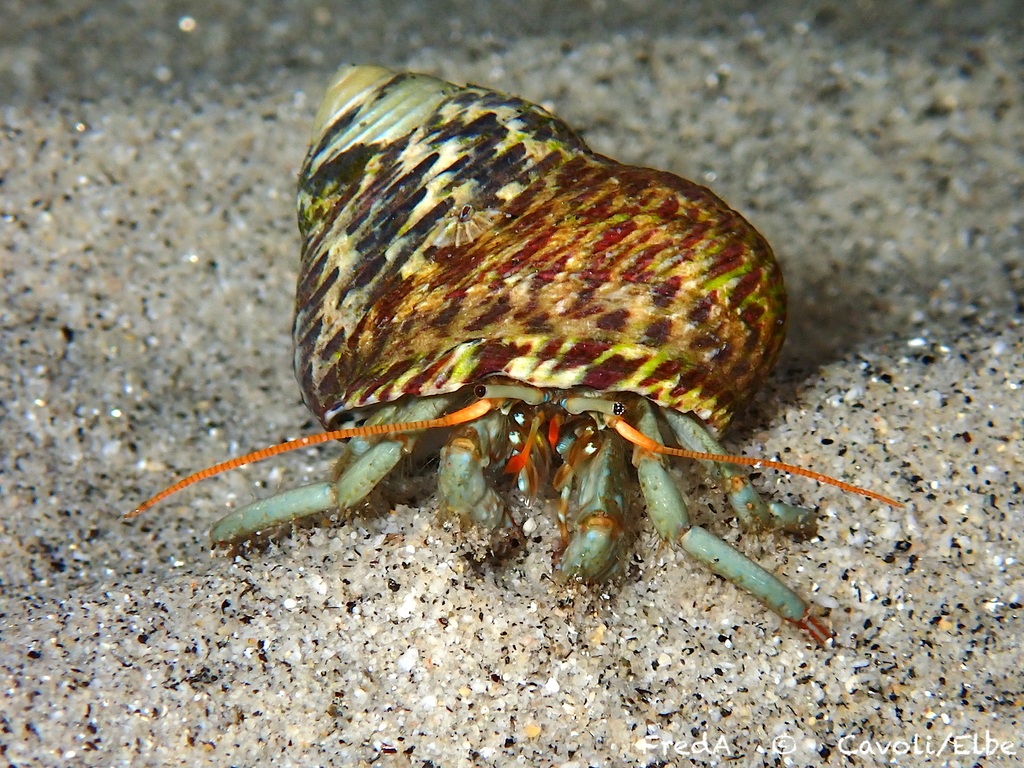
Saint Piran's Hermit Crab
Clibanarius erythropus
Clibanarius erythropus is a species of hermit crab that lives in rockpools and sublittoral waters. It is found in the Mediterranean Sea, Black Sea and eastern Atlantic Ocean from the Azores to Brittany, the Channel Islands and as far north as the south Cornwall coast. Individuals may grow up to a carapace length of 15 millimetres (0.6 in).
From the article Clibanarius erythropus on Wikipedia (CC BY-SA), quoted section by section
What it does
A variety of different gastropod shells are used by C. erythropus, the most frequent being Littorina striata, Mitra, Nassarius incrassatus and Stramonita haemastoma, which collectively account for 85% of all the individuals studied in the Azores; in the Mediterranean, shells of Cerithium, Alvania montagui and Pisania maculosa are most used by C. erythropus. Like other hermit crabs, C. erythropus feeds on "organic debris, decayed and fresh macro-algae with associated fauna and epiphytic algal flora, small invertebrates, and macroscopic pieces of dead and live animal tissues". It has been shown that C. erythropus individuals select substrates where they can cover large distances, and that globose shells allow them greater mobility than elongate ones.
Wikipedia: “Ecology”
In human culture
In 2016 the BBC Springwatch programme highlighted C. erythropus and ran a competition to provide a vernacular name. The winning name was St Piran's crab, a process supported by National Trust West Cornwall and the Cornwall Wildlife Trust. Saint Piran is generally regarded as the patron saint of Cornwall, and was a hermit who survived being thrown into the sea.
== References ==
Wikipedia: “In popular culture”
Where it lives
Recorded sightings
—
geo-referenced records in GBIF, from museums, herbaria and field observers.
Drag the globe to turn it. Dots are where records exist, not a range map; darker means more records.
In the stacks
Searching the stacks…
Every page naming Clibanarius erythropus in the Biodiversity Heritage Library →
This page is assembled live from iNaturalist, GBIF, Wikipedia, the Source Library and the Internet Archive. It is not yet part of the hand-edited codex. iNaturalist taxon 210291.