- Animals
- ›Arthropods
- ›Chelicerates
- ›Arachnids
- ›Spiders
- ›Typical Spiders
- ›Entelegyne Spiders
- ›Salticoid Spiders
- ›Jumping Spiders
- ›Typical Jumping Spiders
- ›Dendryphantini
- ›Dendryphantina
- ›Macaroeris
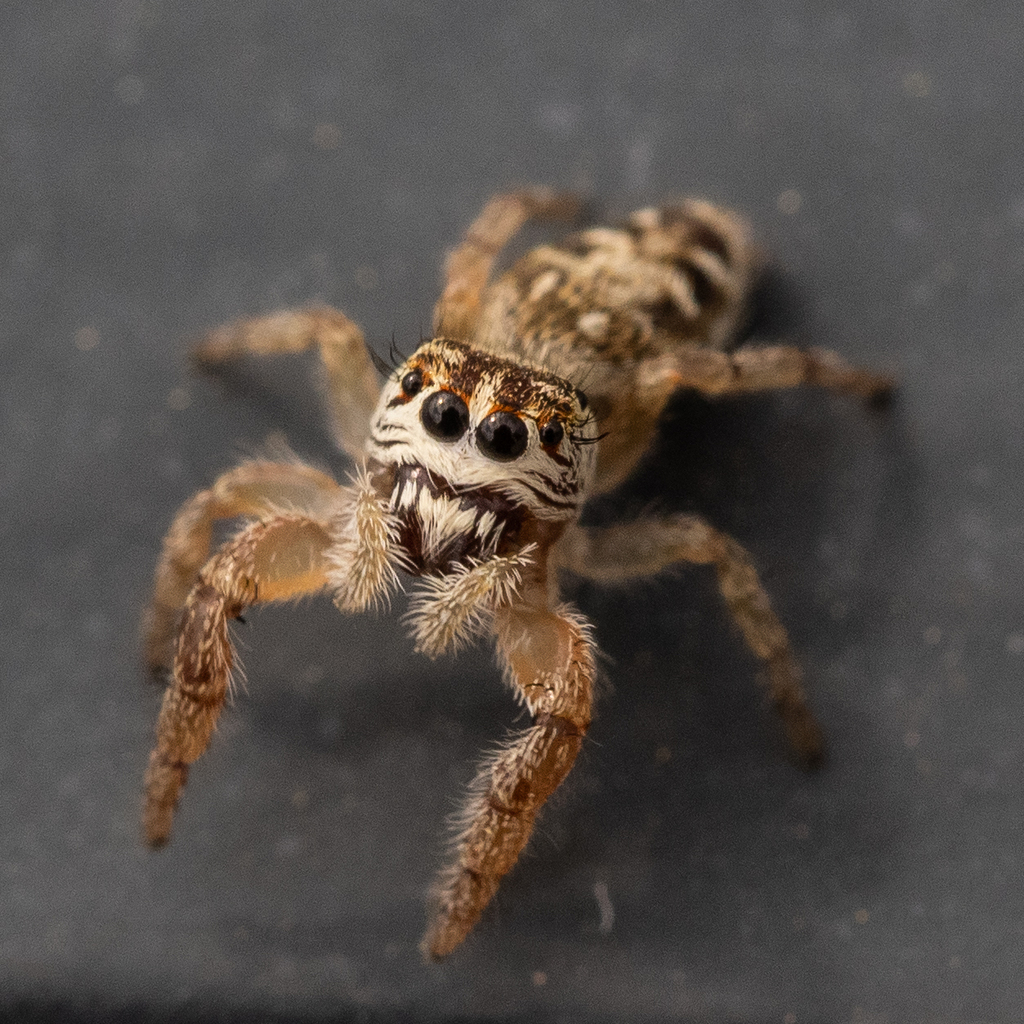
Mile End Jumping Spider
Macaroeris nidicolens
Macaroeris nidicolens is a species of jumping spider that occurs from Europe to Central Asia.
From the article Macaroeris nidicolens on Wikipedia (CC BY-SA), quoted section by section
Description
Males reach a body length of 4–6 mm (0.16–0.24 in), females of 5–7 mm (0.20–0.28 in). The male has reddish brown hairs surrounding its frontal eyes. Two white stripes reach along the prosoma towards the opisthosoma (abdomen). Several white spots cover the top of the prosoma, one bigger each behind the posterior lateral eyes. A white arch covers the anterior end of the abdomen, with pairs of white specks further down, four of which form a slanted cross near the posterior end. The female is colored much lighter than the male. A white triangle sits in the middle of the prosoma, while the abdomen matches the male's. Color and patterning can vary strongly in this species. Both sexes have black, curves tufts of hair on the sides behind the anterior lateral eyes.
Range & habitat
The species is found from Europe to Central Asia. In Germany it was found first in 1995 (Cologne), and seems to expand its area further.
Wikipedia: “Distribution”
Where it lives
Recorded sightings
—
geo-referenced records in GBIF, from museums, herbaria and field observers.
Drag the globe to turn it. Dots are where records exist, not a range map; darker means more records.
In the stacks
Searching the stacks…
Every page naming Macaroeris nidicolens in the Biodiversity Heritage Library →
This page is assembled live from iNaturalist, GBIF, Wikipedia, the Source Library and the Internet Archive. It is not yet part of the hand-edited codex. iNaturalist taxon 204888.