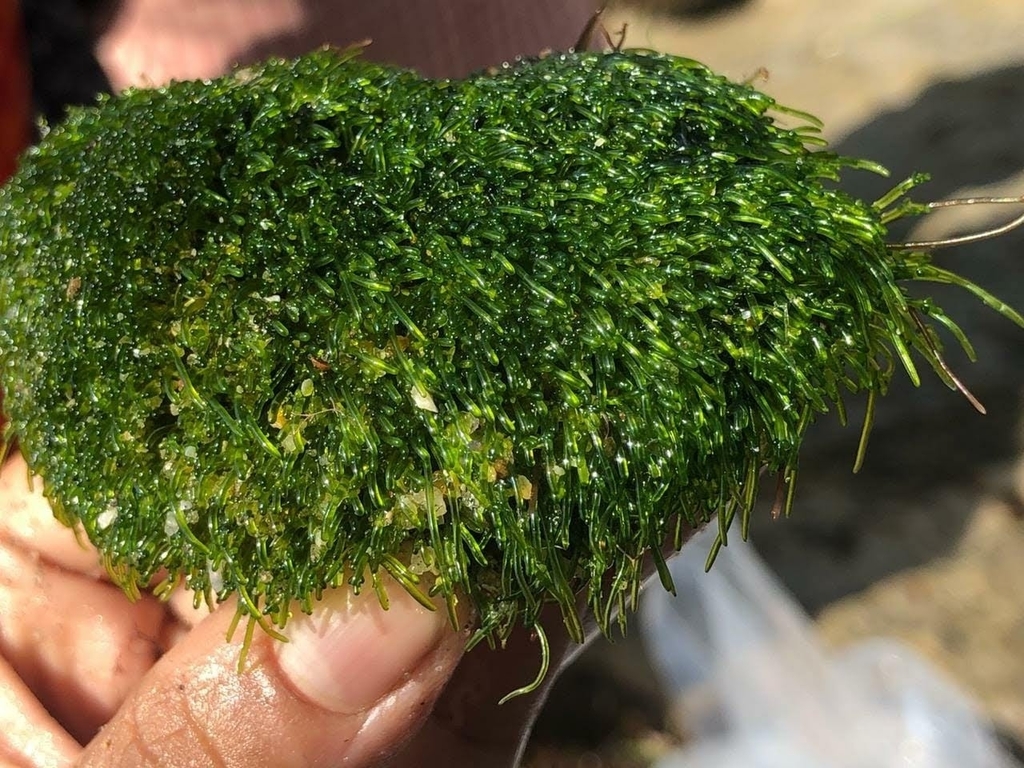
Ulva prolifera
Ulva prolifera (previously Enteromorpha prolifera), also known as the branched string lettuce, is a species of seaweed algae in the family Ulvaceae that can be found worldwide.
From the article Ulva prolifera on Wikipedia (CC BY-SA), quoted section by section
Description
U. prolifera is visually filamentous and intertwined together by accumulation after an algae bloom. However, the species is actually in tubular form and can grow to half to several meters in length. Typically its diameter does not exceed 5 mm, the actual growth parameters of Ulva prolifera depend on the magnitude of the algal bloom that it is associated with. Its color spans from light green to the color of grass. The species can be found at the coastline after being carried onto the seashore after low tides as it floats along the movements of the seawater.
Range & habitat
In Europe, it can be found in such countries as Bulgaria, France, Great Britain, Greece, Ireland, Portugal, Romania, Slovenia, Spain and on Lolland island of Denmark. It is also common on African islands such as Canary and Madeira islands, and in the US states such as Alaska, California, Florida, Texas and Washington. Besides the states, Africa and Europe, it is common in Central American countries such as Costa Rica, El Salvador, Panama, and Cuba, with Mexico occasionally getting them on the Pacific side. The species mostly occurs as wild algae, although some are cultivated in Japan, Korea, China and other countries. China had its largest recorded bloom of the algae in 2013, in the Yellow Sea off the coast of Qingdao.
Wikipedia: “Distribution”
Where it lives
Recorded sightings
—
geo-referenced records in GBIF, from museums, herbaria and field observers.
Drag the globe to turn it. Dots are where records exist, not a range map; darker means more records.
In the stacks
Searching the stacks…
Every page naming Ulva prolifera in the Biodiversity Heritage Library →
This page is assembled live from iNaturalist, GBIF, Wikipedia, the Source Library and the Internet Archive. It is not yet part of the hand-edited codex. iNaturalist taxon 203716.