- Animals
- ›Arthropods
- ›Chelicerates
- ›Arachnids
- ›Spiders
- ›Typical Spiders
- ›Entelegyne Spiders
- ›Orbweavers and Allies
- ›Orbweavers
- ›Gasteracanthinae
- ›Gasteracantha
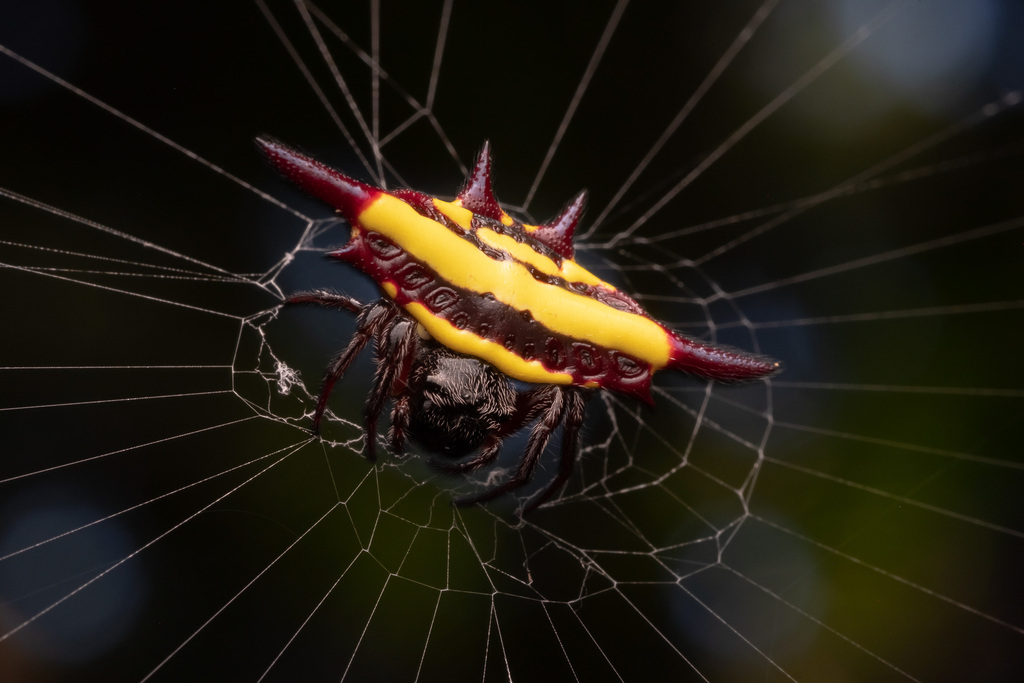
Northern Jewelled Spider
Gasteracantha fornicata
Gasteracantha fornicata (northern jewelled spider) is a species of spiny orb-weavers (family Araneidae) found in Queensland Australia. It is similar in shape to Austracantha minax which was originally described as Gasteracantha minax. It was described by Johan Christian Fabricius in 1775, the first Australian species of spider to be named and classified.
One of the synonyms of the species is Gasteracantha vittata, a name given to it by Ludwig Carl Christian Koch in 1871. However, it was later discovered that Fabricius had described the species earlier, and according to taxonomic rules, the earlier name has precedence and is the only one that should be used. Also, there are other species that were identified G. vittata at times, namely Gasteracantha irradiata (by Thorell, 1859), Gasteracantha sanguinolenta (by Keyserling, 1877) and Gasteracantha transversa (as subspecies G. v. longicornis by Strand, 1907), further complicating the issue.
From the article Gasteracantha fornicata on Wikipedia (CC BY-SA), quoted section by section
Description
Gasteracantha fornicata is a small spider that displays multiple morphs in size and colour. It has exoskeletal spines across its dorsal side. The wide cephalothorax structure of Gasteracantha may prevent it from being as mobile compared to spiders of similar size. Males are typically two millimeters while females grow up to twelve millimeters. Females have distinct stripes across the dorsal region that are known to attract prey. These yellow/white bands starkly contrast with the spider's dark coloured body. Like other orb-weaving spiders the bright colouration of the spider has been shown to help attract prey. On the ventral side, the body is darker and has small yellow spots. Like other spiny spiders, Gasteracantha fornicata has a hard exoskeleton with spines along the dorsal side for predatorial protection. The bright colouration of the spiders have been suggested to signal to predators that they are not ideal prey. Female Gasteracantha fornicata spiders have two different morphs, one with bright yellow bands, and another with white bands (spectral curves at 447 nanometers and 496 nanometers). Although the spider can have white-coloured stripes, it does not possess the same UV properties as the closely related Gasteracanthra cancriformis. Different coloured morphs inhabit different regions of the rainforest habitat with varying frequencies. …
Range & habitat
Gasteracantha fornicata originates from the Northeastern Australian rainforest. This spider has been found strictly in the rainforest, specifically at the border of the tree line as a microhabitat. Variations in cloud coverage and sunny clearing within the habitat have been found to impact the colouration frequencies of female spiders. In addition, long periods of rainfall within the region render their webs ineffective.
Wikipedia: “Habitat and distribution”
What it does
The diet of Gasteracantha fornicata is largely consistent with that of other spiders in the genus. This includes small dipterans (flies), small hymenopterans (members of the bee family), Orthoptera, Odonata, and Lepidoptera. The range of prey species does not vary with spider colour. Building a web is the main foraging cost of this species. Gasteracantha fornicata orients itself and its web to take advantage of light and dark patches in the vegetation. The light and dark bands mimic the environment and serve to attract prey as a part of the colour-as-prey-attraction hypothesis. These spiders effectively utilize their colouration to have the best web visibility and attractiveness within their habitat. Prey typically mistaken the light patches as forager or mating sites, serving as a strategy for Gasteracantha fornicata. This strategy has varying effects on the capture environment of yellow striped spiders versus the white striped spiders. Yellow striped spiders have been found to have the largest number of prey-capture events when it stood in greatest chromatic contrast with the surrounding area (the yellow stripes stand out the most when compared to other colours in the environment). White striped spiders best capture prey when in achromatic contrast with the surrounding area (the brightness of the white stands out the most when compared to the luminescence of the environment). …
Wikipedia: “Predatory feeding”
Where it lives
Recorded sightings
—
geo-referenced records in GBIF, from museums, herbaria and field observers.
Drag the globe to turn it. Dots are where records exist, not a range map; darker means more records.
In the stacks
Searching the stacks…
Every page naming Gasteracantha fornicata in the Biodiversity Heritage Library →
This page is assembled live from iNaturalist, GBIF, Wikipedia, the Source Library and the Internet Archive. It is not yet part of the hand-edited codex. iNaturalist taxon 201614.