- Animals
- ›Arthropods
- ›Chelicerates
- ›Arachnids
- ›Spiders
- ›Typical Spiders
- ›Entelegyne Spiders
- ›Salticoid Spiders
- ›Jumping Spiders
- ›Typical Jumping Spiders
- ›Astiini
- ›Helpis
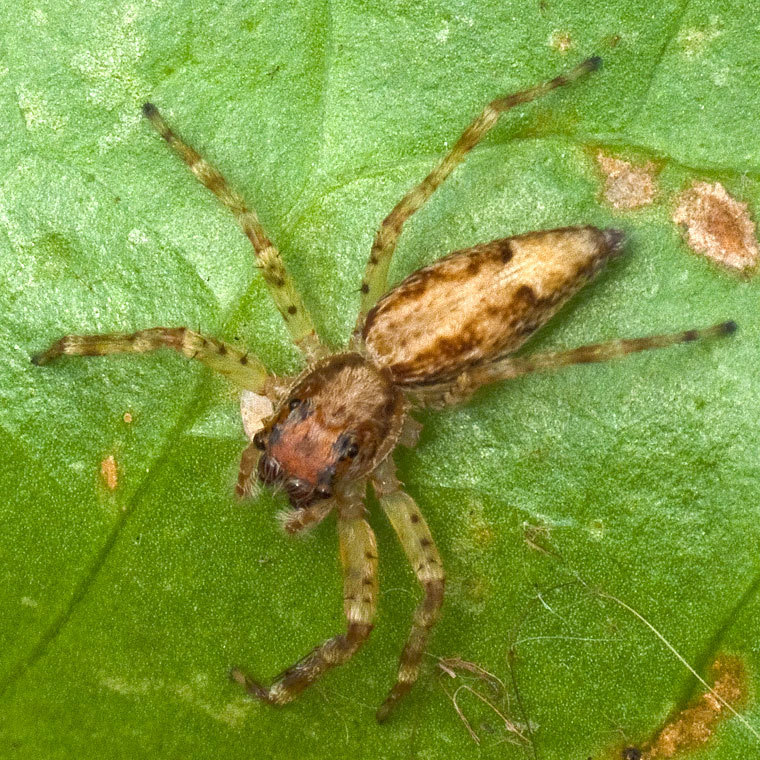
Bronze Hopper
Helpis minitabunda
Helpis minitabunda is a species of jumping spider in the family Salticidae, widespread throughout Australia, New Zealand, and Papua New Guinea. These spiders are typically found amongst foliage in moist areas.
From the article Helpis minitabunda on Wikipedia (CC BY-SA), quoted section by section
Description
Unlike most spiders, males are larger than females; males can grow up to 10 mm in body length, whereas mature females may be up to 8 mm long. H. mintabunda, like other Saticidae (and most Arachnids), exhibit sexual dimorphism, both physically and behaviourally: in particular, the front pair of legs are characteristically longer and darker in colour in males than in females, and the male's head – or "caput" – is noticeably flat-topped and covered in creamy white hairs, which continue onto the upper surface of their large and more prominent chelicerae – a feature unique to males. Males are more active and aggressive hunters, noted for their speed and agility, often preying on smaller spiders, while females are more cryptic. The pre-mating courtship dance between males and females of the species has been observed to last between two and three hours.
Wikipedia: “Appearance, behaviour and mating”
Range & habitat
H. mintabunda are commonly observed in the East and Southeastern regions of Australia, while they are listed as an invasive species in New Zealand.
== References ==
Wikipedia: “Distribution”
In human culture
Common names for H. mintabunda include the threatening jumping spider and bronze jumping spider. The specific Latin epithet, minitabunda – meaning "threatening" – refers to defensive behaviours exhibited by males of the species when approached or attacked.
Wikipedia: “Etymology and common names”
Where it lives
Recorded sightings
—
geo-referenced records in GBIF, from museums, herbaria and field observers.
Drag the globe to turn it. Dots are where records exist, not a range map; darker means more records.
In the stacks
Searching the stacks…
Every page naming Helpis minitabunda in the Biodiversity Heritage Library →
This page is assembled live from iNaturalist, GBIF, Wikipedia, the Source Library and the Internet Archive. It is not yet part of the hand-edited codex. iNaturalist taxon 199167.