- Animals
- ›Arthropods
- ›Chelicerates
- ›Arachnids
- ›Mites and Ticks
- ›Acariformes
- ›Trombidiform Mites
- ›Prostigs
- ›Parasitengona
- ›Velvet Mites, Chiggers, and Relatives
- ›Velvet Mites
- ›True Velvet Mites
- ›Trombidiinae
- ›Trombidium
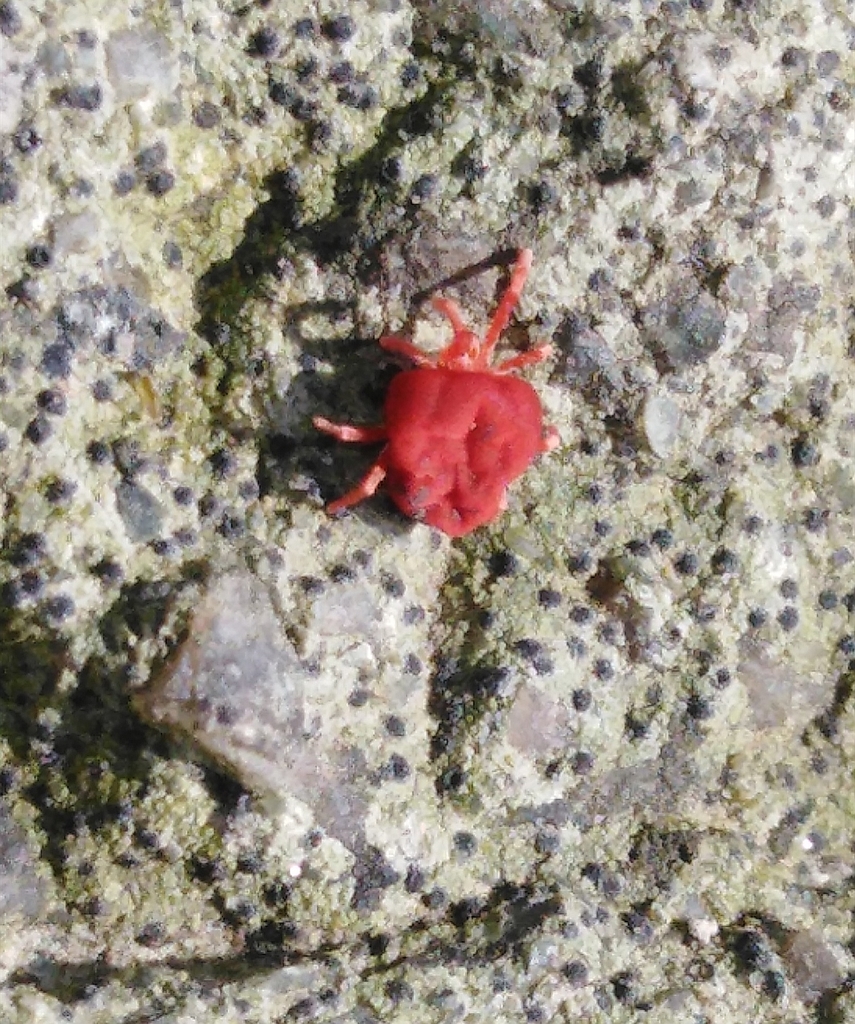
Trombidium grandissimum
Trombidium grandissimum, commonly known as the giant red velvet mite, is a species of mite in the genus Trombidium in the family Trombidiidae. This common mite is endemic to northern and central India, especially in the central plateau, and it primarily inhabits arid regions. T. grandissimum live on the ground and often hidden among soil, but is commonly seen during the rainy season or after recent rain events, and therefore (along with some other red velvet mite species) has the nickname of "rain bug".
From the article Trombidium grandissimum on Wikipedia (CC BY-SA), quoted section by section
Description
Trombidium grandissimum is one of the largest species of red velvet mite, with adults typically being about 1.2 cm (0.5 in) long. It is bright red and has a soft cushioning skin covered with fine hairs. A study of another species, the spider mite Tetranychus urticae, showed that the red color was caused by carotene, which was beneficial for their hibernation. T. grandissimum, belonging to the same order as spider mites, spend an extensive period of time in hibernation under the soil. This might be the reason why they also depend on red pigmentation, by which their haemolymph is usually coloured.
Microscopy. The mites were observed under stereo microscope for the detailed classification and analysis of different parts of their body, and structural samples were processed using ESEM and FESEM. The FESEM images of the front leg sensilla hairs and claws at the tip usually measured around 500 μm. Stalked eyes pointed with white arrows measured around 1 mm. White arrows magnified by ESEM were measured around 400 μm. The red velvet skin is shown to be covered by sensitive hairs. The whole body hairs showing the branches and arrangement measured around 50 μm in size.
What it does
Trombidium grandissimum appears to be diurnal and will move into light, rather than darkness, if given the choice. They feed on tiny animal prey, like insects and their eggs. In the larval stage, T. grandissimum attach themselves to insects, most commonly crickets, and suck their fluids; they may occasionally even suck fluids from adults of their own species. In their natural habitat, they were found to move on a horizontal plane. They seemed to be reluctant to climb up against the gravitational force which may be due to their bulky body size and shorter legs. They can easily wriggle their bodies through small openings and thus can easily get inside the burrows of ants and other insects to feed on their eggs. Males and females of Trombidiidae mites perform encircling dances, after which they pair for mating. A dead mite was found to be surrounded by ants, suggesting that they are non-toxic to other species and their cannibalistic nature suggests the same.
Wikipedia: “Behavior”
Where it lives
Recorded sightings
—
geo-referenced records in GBIF, from museums, herbaria and field observers.
Drag the globe to turn it. Dots are where records exist, not a range map; darker means more records.
In the stacks
Searching the stacks…
Every page naming Trombidium grandissimum in the Biodiversity Heritage Library →
This page is assembled live from iNaturalist, GBIF, Wikipedia, the Source Library and the Internet Archive. It is not yet part of the hand-edited codex. iNaturalist taxon 197144.