- Animals
- ›Arthropods
- ›Crustaceans
- ›Typical Crustaceans
- ›Barnacles and Copepods
- ›Barnacles and Allies
- ›Barnacles
- ›Normal Barnacles
- ›Thoracican Barnacles
- ›Symmetrical Sessile Barnacles
- ›Balanoidea
- ›Balanidae
- ›Balanus
Triangle Barnacle
Balanus trigonus
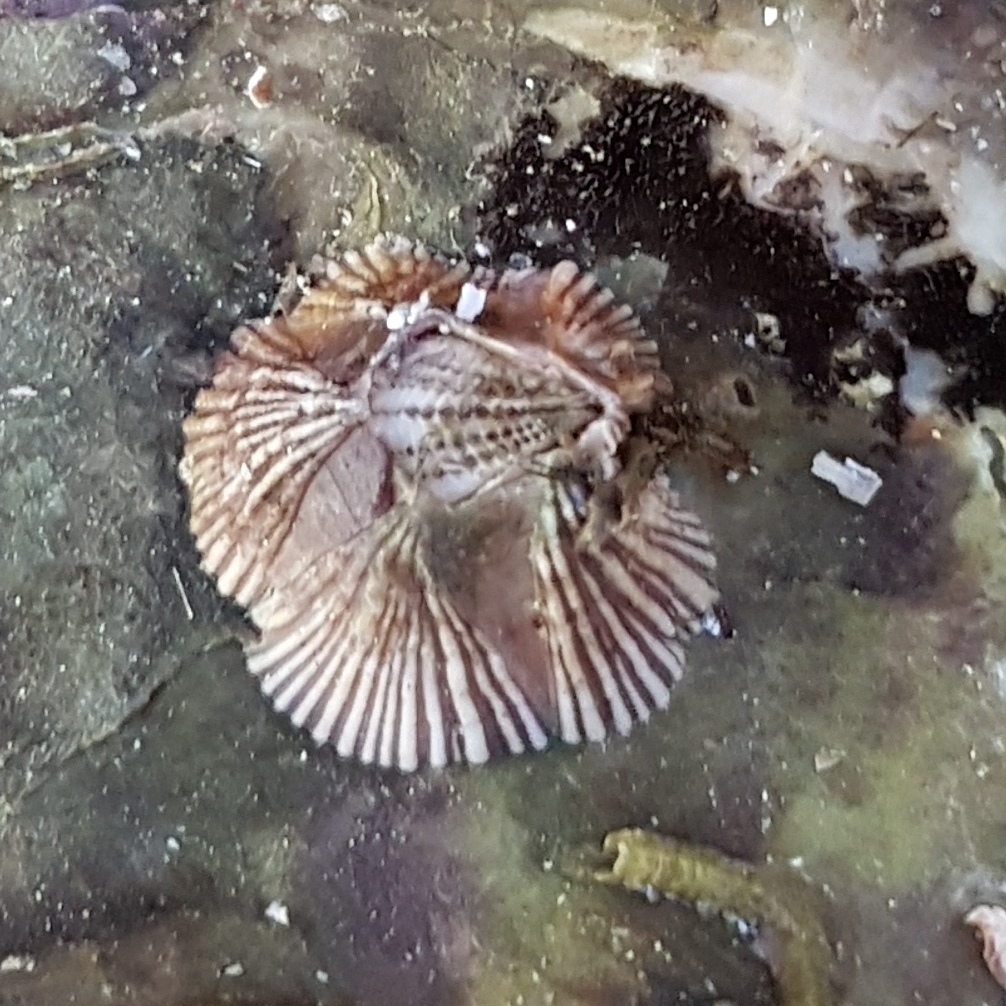
Balanus trigonus, the triangle barnacle, is a species of barnacle in the family Balanidae. They are steep-sided, conical creatures, have six shell plates and are dark pink in colour. Originally found only in the Indo-Pacific and along the eastern Pacific coast, they were likely introduced to the Atlantic Ocean in the 19th century through human activity and now has a global distribution. Usually living on subtidal rocks and shells, they are also foulers of ships and dock infrastructure, and, in areas where they are invasive, may compete with native species for living room. The species was first described in the genus Balanus by Charles Darwin. It has since had its mitochondrial genome sequenced twice, with slightly differing results, leaving its phylogenetic position unsolved.
From the article Balanus trigonus on Wikipedia (CC BY-SA), quoted section by section
Range & habitat
Triangle barnacles are originally native to the Indian and Pacific oceans, but now have a cosmopolitan distribution. Darwin, in his original description, said the species was "widely distributed and where found seems to be common". He gave the species' range as including New Zealand, Sydney, the island of Java, the East Indian Archipelago, Peru, California, and what he called "West Columbia". Triangle barnacles are also native to the waters around Korea and the south of Japan but its presence in the north Sea of Japan is likely due to human activity. Triangle barnacles are also known from the Persian Gulf and the adjacent Gulf of Oman, around the Indian subcontinent, and along the east coast of Africa. However, all triangle barnacle presence in the Atlantic Ocean is introduced, which was once not believed to be true.
Presence in the Atlantic. Today, triangle barnacles are found in the Atlantic in an area drawn from False Bay, northwest to Rio Grande do Sul, north to North Carolina, and east to the Azores. The species is also abundant in the Mediterranean Sea. The triangle barnacle's invasion started in 1867 in southern Brazil when a species since synonymized with B. trigonus was reported from Florianópolis. In the subsequent decades, triangle barnacles were reported from elsewhere in Brazil and in Madeira, the Azores, Guinea, and the Congolese coast.By 1877, B. …
Wikipedia: “Distribution”
What it does
Barnacles are sessile as adults but have motile larval stages, first the nauplii, and then the cyprids, which do not eat but attach themselves to a substrate and metamorphosed into adults. The adults reproduce year-round, and individuals only a month old may do so as well. A given barnacle may also produce multiple broods each year.
Larvae and metamorphosis. The front half of the nauplii is relatively wide and circular, giving the nauplii a "teardrop"-like appearance. Nauplii have six stages, with distinctive characteristics in each, and their size grows from stage to stage. In the first stage, laboratory-raised specimens measured no more than 240 micrometres (9.4 mils), with some variation; by the third stage they measured 480 micrometres (19 mils), give or take 18 μm (0.71 mils). In the sixth stage the nauplius larvae measured 880 μm (35 mils). The nauplii have spines, horns, and maxillules which help identify them; in the final stage of their development, the nauplii have a pair of compound eyes and the primordia of some cyprid appendages. The subsequent cyprid larvae also have compound eyes. A 1990 study revealed that on average, in 20 °C conditions, it took an average of eleven days for the barnacles to grow from a newborn nauplius to the cyprid stage. …
Wikipedia: “Reproduction and growth”
Where it lives
Recorded sightings
—
geo-referenced records in GBIF, from museums, herbaria and field observers.
Drag the globe to turn it. Dots are where records exist, not a range map; darker means more records.
In the stacks
Searching the stacks…
Every page naming Balanus trigonus in the Biodiversity Heritage Library →
This page is assembled live from iNaturalist, GBIF, Wikipedia, the Source Library and the Internet Archive. It is not yet part of the hand-edited codex. iNaturalist taxon 195043.