- Animals
- ›Arthropods
- ›Crustaceans
- ›Typical Crustaceans
- ›Malacostracans
- ›Decapods, Isopods, and allies
- ›Decapods and Krill
- ›Decapods
- ›Crabs, Lobsters, Shrimps, and Allies
- ›True Crabs
- ›Eubrachyuran Crabs
- ›Heterotrematan Crabs
- ›Xanthoid Crabs
- ›Mud Crabs
- ›Dyspanopeus
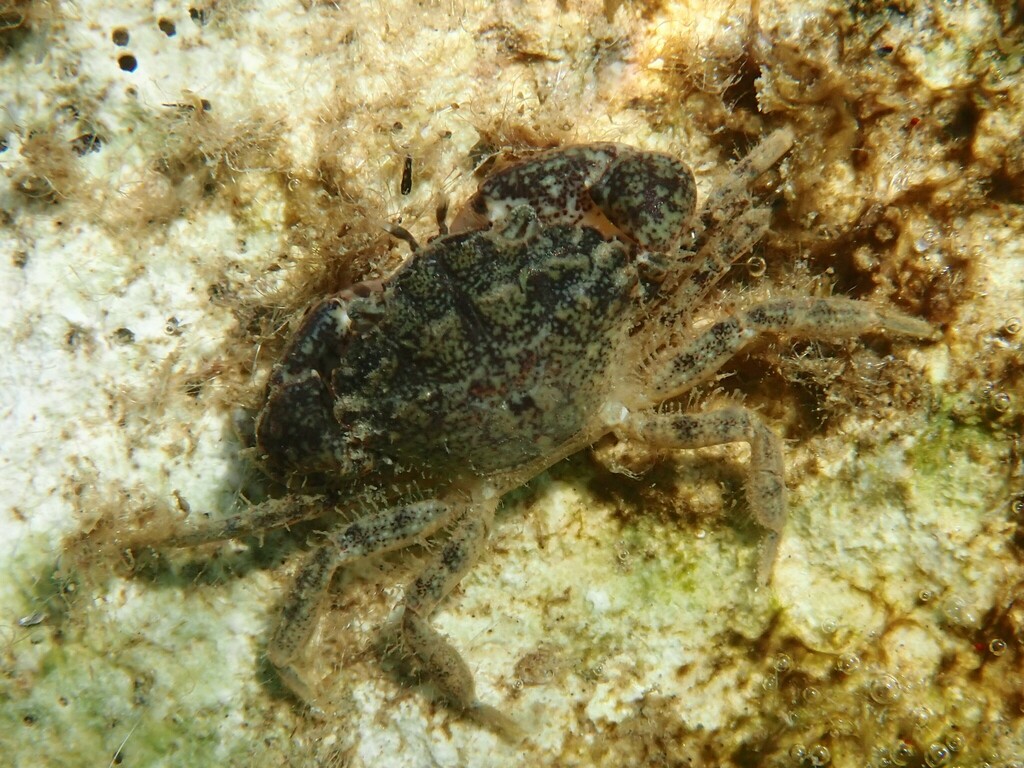
Small Mud Crab
Dyspanopeus sayi
Dyspanopeus sayi is a species of mud crab that is native to the Atlantic coast of North America. It has also become established outside its native range, living in Swansea Docks since 1960, the Mediterranean Sea since the 1970s, the North Sea since 2007, and the Black Sea since 2010. It can reach a carapace width of 20 mm (0.8 in) and has black tips to its unequal claws. It feeds on bivalves and barnacles, and it is in turn eaten by predators including the Atlantic blue crab, Callinectes sapidus. Eggs are produced from spring to autumn, the offspring reach sexual maturity the following summer, and individuals can live for up to two years. The closest relative of D. sayi is D. texanus, which lives in the Gulf of Mexico; the two species differ in subtle features of the genitalia and the last pair of walking legs.
From the article Dyspanopeus sayi on Wikipedia (CC BY-SA), quoted section by section
Description
Dyspanopeus sayi is a small crab, similar in appearance to Eurypanopeus depressus. It reaches a maximum carapace width of 20 millimetres (0.8 in), with sexually mature females having a carapace 6.1 millimetres (0.24 in) or more across. The carapace is roughly hexagonal, about 1.3–1.4 times as wide as long and strongly convex. It has a finely granular surface, and has a light covering of hair, especially towards the front and sides. The chelae (claws) are unequal: the right chela is stouter, and the left is narrower. The carapace is olive-green to brown, but the tips of the claws are black.
Range & habitat
The natural range of Dyspanopeus sayi extends from the Baie des Chaleurs in eastern Canada to the Florida Keys in the southeastern United States. It lives from the intertidal zone to depths of 46 metres (151 ft) and tolerates a wide range of temperatures and salinities. D. sayi has also been recorded from a number of locations in Europe. The first sighting was in Swansea Docks in south Wales in 1960 – the species having been introduced accidentally through trans-Atlantic shipping. The first record from the Mediterranean Sea was made in 1993 when it was discovered in the Venetian Lagoon (north-eastern Italy), although it is thought to have been living there since the late 1970s. In 2007, D. sayi was recorded from the North Sea coast of the Netherlands. It was discovered in the Black Sea in 2010, living in Constanța harbour (Romania), and in the Ebro delta of the Balearic Sea (western Mediterranean Sea) in 2012.
Wikipedia: “Distribution”
What it does
Dyspanopeus sayi lives predominantly on muddy bottoms, where it is a predator of bivalve molluscs. In its native environment, it hides among colonies of polychaetes to avoid being preyed on by the Atlantic blue crab, Callinectes sapidus. It is an important predator of the quahog, Mercenaria mercenaria, in Narragansett Bay, and of the barnacle Balanus improvisus in Delaware Bay. In the Adriatic Sea, it has been observed to feed on the striped venus clam, Chamelea gallina, and the introduced Asian date mussel, Arcuatula senhousia.
Wikipedia: “Ecology”
Where it lives
Recorded sightings
—
geo-referenced records in GBIF, from museums, herbaria and field observers.
Drag the globe to turn it. Dots are where records exist, not a range map; darker means more records.
In the stacks
Searching the stacks…
Every page naming Dyspanopeus sayi in the Biodiversity Heritage Library →
This page is assembled live from iNaturalist, GBIF, Wikipedia, the Source Library and the Internet Archive. It is not yet part of the hand-edited codex. iNaturalist taxon 194084.