- Animals
- ›Arthropods
- ›Chelicerates
- ›Arachnids
- ›Spiders
- ›Typical Spiders
- ›Entelegyne Spiders
- ›Orbweavers and Allies
- ›Comb-footed Spiders
- ›Latrodectinae
- ›Latrodectus
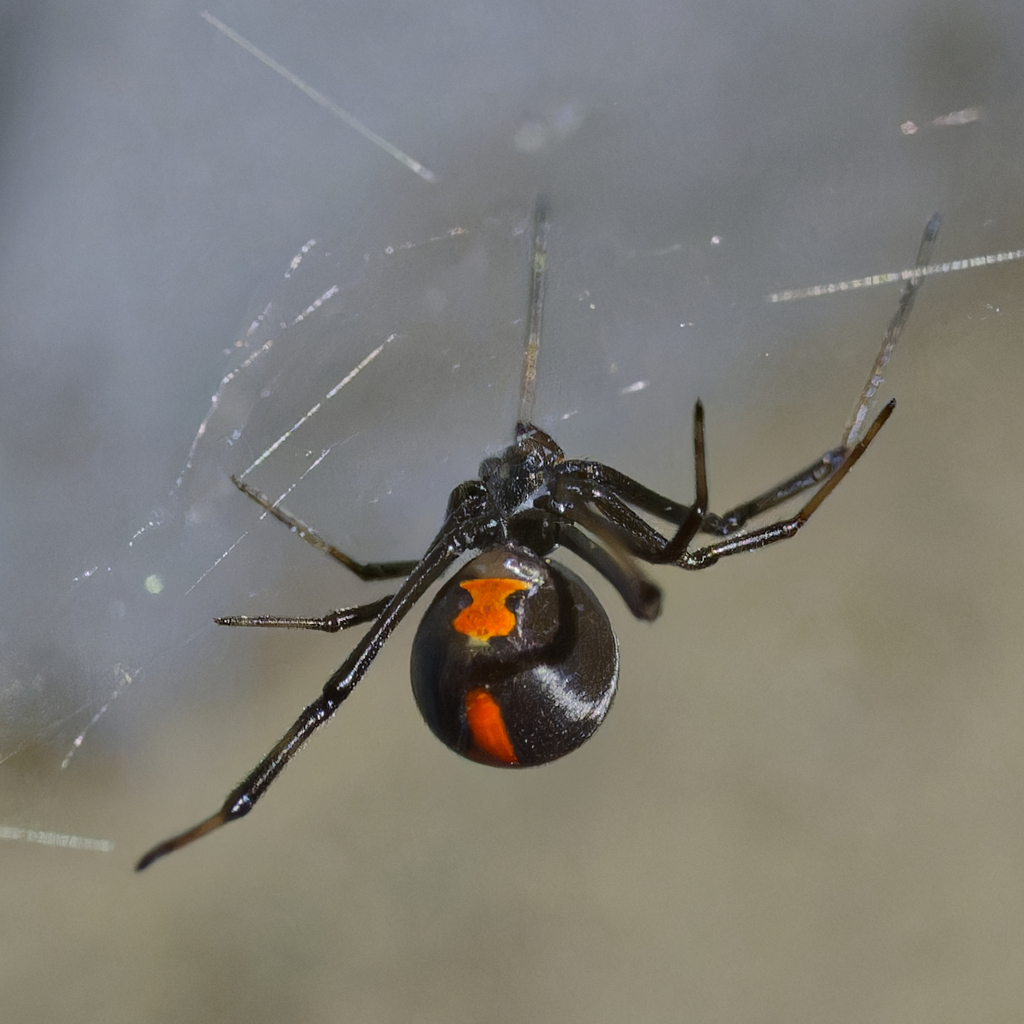
Redback Spider
Latrodectus hasselti
The redback spider (Latrodectus hasselti), also known as the Australian black widow, is a species of highly venomous spider believed to originate in Australia, but which is now found in Southeast Asia, Japan and New Zealand. It has also been found in packing crates in the United States with colonies elsewhere outside Australia. It is a member of the cosmopolitan genus Latrodectus, the widow spiders. The adult female is easily recognised by her spherical black body with a prominent red stripe on the upper side of her abdomen and an hourglass-shaped red/orange streak on the underside. Females usually have a body length of about 10 millimetres (0.4 in), while the male is much smaller, being only 3–4 mm (0.12–0.16 in) long.
Mainly nocturnal, the female redback lives in an untidy web in a warm sheltered location, commonly near or inside human residences. It preys on insects, spiders and small vertebrates that become ensnared in its web. It kills its prey by injecting a complex venom through its two fangs when it bites, before wrapping them in silk and sucking out the liquefied insides. Often, it first squirts its victim with what resembles 'superglue' from its spinnerets, immobilising the prey by sticking the victim's limbs and appendages to its own body. The redback spider then trusses the victim with silk. Once its prey is restrained, it is bitten repeatedly on the head, body and leg segments and is then hauled back to the redback spider's retreat. Sometimes a potentially dangerous victim can be left to struggle for hours until it is exhausted enough to approach safely.
From the article Redback spider on Wikipedia (CC BY-SA), quoted section by section
Description
The adult female redback has a body around 1 centimetre (0.4 in) long, with slender legs, the first pair of which are longer than the rest. The round abdomen is a deep black (occasionally brownish), with a red (sometimes orange) longitudinal stripe on the upper surface and an hourglass-shaped scarlet streak on the underside. Females with incomplete markings or all-black abdomens occasionally occur. The cephalothorax is much smaller than the abdomen, and is black. Redback spiderlings are grey with dark spots, and become darker with each moult. Juvenile females have additional white markings on the abdomen. The bright scarlet red colours may serve as a warning to potential predators. Each spider has a pair of venom glands, one attached to each of its chelicerae with very small fangs. Small compared to the female, the male redback is 3–4 mm (0.12–0.16 in) long and is light brown, with white markings on the upper side of the abdomen and a pale hourglass marking on the underside. Another species in Australia with a similar physique, Steatoda capensis, has been termed the "false redback spider", but it is uniformly black (or plum), and does not display the red stripe.
Range & habitat
The redback spider is widespread across Australia. The current distribution reported by the World Spider Catalogue includes Southeast Asia and New Zealand. Colonies and individuals have been found elsewhere, including Japan, England, Belgium, the United Arab Emirates and Iran. It was believed at one time that the redback may have been introduced to Australia, because when it was first formally described in 1870, it appeared to be concentrated around sea ports. However, an earlier informal description (1850) from the Adelaide Hills is now known, and names in Australian Aboriginal languages also show that it was present well before European settlement. Its original range is thought to be a relatively small arid part of South Australia and Western Australia. Its spread has been inadvertently aided by modern buildings, which often provide habitats conducive to redback populations. The close relationship between the redback and the New Zealand katipō also supports the native status of both in their respective countries. Outside urban areas, the redback is more often found in drier habitats ranging from sclerophyll forest to desert, even as harsh as the Simpson Desert. It became much more common in urban areas in the early decades of the 20th century, and is now found in all but the most inhospitable environments in Australia and its cities. …
Wikipedia: “Distribution and habitat”
What it does
Spiderlings hatch from their eggs after about 8 days and can emerge from the egg sac as early as 11 days after being laid, although cooler temperatures can significantly slow their development so that emergence does not occur for months. After hatching they spend about a week inside the egg sac, feeding on the yolk and molting once. Baby spiders appear from September to January (spring to early summer). Male spiders mature through five instars in about 45–90 days. Females mature through seven–eight instars in about 75–120 days. Males live for up to six or seven months, while females may live between two and three years. Laboratory tests have shown that redbacks may survive for an average of 100 days, and sometimes over 300 days without any food, those starved at 10 °C (50 °F) faring better than those kept without food at 25 °C (77 °F). Spiders are known to reduce their metabolic rates in response to starvation, and can distend their abdomens to store large amounts of food. Redbacks can survive temperatures from below freezing point to 40 °C (104 °F), though they do need relatively warm summers, with temperatures of 15 to 25 °C (59 to 77 °F) for two to three months, to survive and breed. Redback spiderlings cohabit on the maternal web for several days to a week, during which time sibling cannibalism is often observed. They then leave by being carried on the wind. …
Wikipedia: “Life cycle”
Toxicity
The redback and its relatives in the genus Latrodectus are considered dangerous, alongside funnel-web spiders (Atrax and Hadronyche), mouse spiders (Missulena), wandering spiders (Phoneutria) and recluse spiders (Loxosceles). Venom is produced by holocrine glands in the spider's chelicerae (mouth parts). Venom accumulates in the lumen of the glands and passes through paired ducts into the spider's two hollow fangs. The venom of the redback spider is thought to be similar to that of the other Latrodectus spiders. It contains a complex mixture of cellular constituents, enzymes and a number of high-molecular-weight toxins, including insect toxins and a vertebrate neurotoxin called alpha-latrotoxin, which causes intense pain in humans. In vertebrates, alpha-latrotoxin produces its effect through destabilisation of cell membranes and degranulation of nerve terminals, resulting in excessive release of neurotransmitters, namely acetylcholine, norepinephrine and GABA. Excess neurotransmitter activity leads to clinical manifestations of envenomation, although the precise mechanisms are not well understood. Acetylcholine release accounts for neuromuscular manifestations, and norepinephrine release accounts for the cardiovascular manifestations. …
Wikipedia: “Venom”
In human culture
Before DNA analysis, the taxonomy of the widow spider genus Latrodectus had been unclear—changes in the number of species reflect the difficulty of using morphology to determine subdivisions within the genus. Substantial interest in their systematics was most likely prompted by the medical importance of these venomous spiders. Swedish arachnologist Tamerlan Thorell described the redback spider in 1870 from specimens collected in Rockhampton and Bowen in central Queensland. He named it Latrodectus hasseltii in honour of colleague A.W.M. van Hasselt. In the same paper, he named a female from Cape York with an all-black abdomen L. scelio, now regarded as the same species. These specimens are in the Naturhistoriska Riksmuseet in Stockholm. Between 1872 and 1972, all subsequent authors spelled the species name as hasselti, and that altered spelling is maintained today. German arachnologist Friedrich Dahl revised the genus in 1902 and named L. ancorifer from New Guinea, which was later regarded as a subspecies of the redback. Another subspecies, L. h. aruensis, was described by Norwegian entomologist Embrik Strand in 1911. Subspecies indica (of L. scelio) had been described by Eugène Simon in 1897, but its origin is unclear. …
Wikipedia: “History”
Where it lives
Recorded sightings
—
geo-referenced records in GBIF, from museums, herbaria and field observers.
Drag the globe to turn it. Dots are where records exist, not a range map; darker means more records.
In the stacks
Searching the stacks…
Every page naming Latrodectus hasselti in the Biodiversity Heritage Library →
This page is assembled live from iNaturalist, GBIF, Wikipedia, the Source Library and the Internet Archive. It is not yet part of the hand-edited codex. iNaturalist taxon 146765.