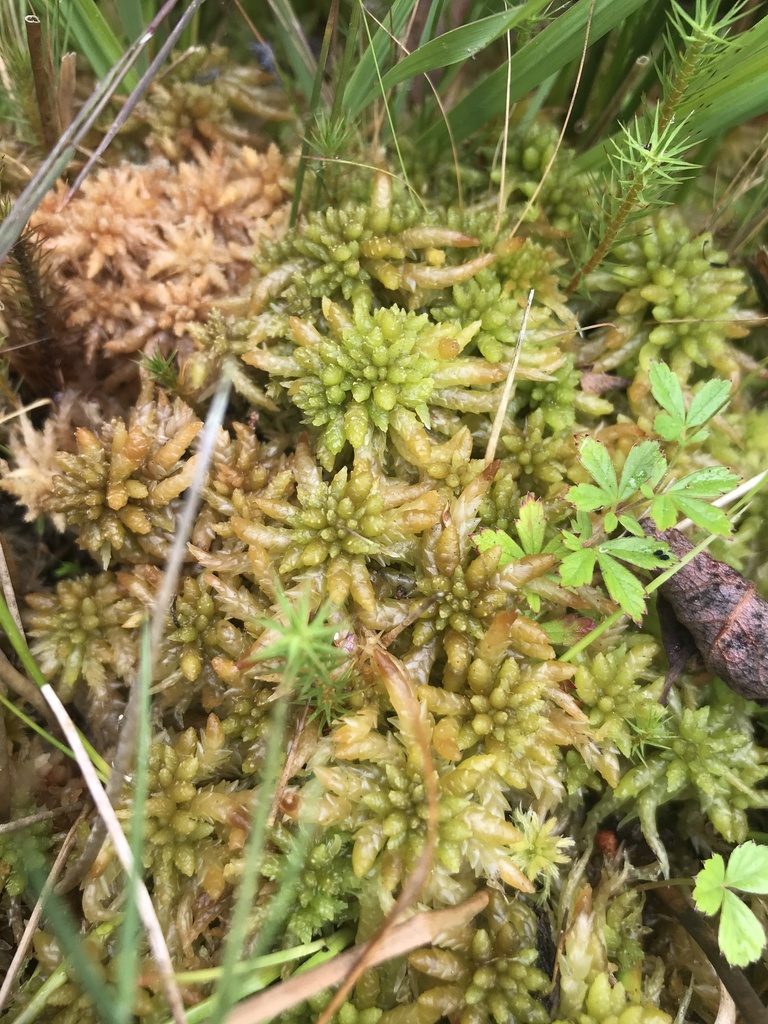
Papillose Peatmoss
Sphagnum papillosum
Sphagnum papillosum, the papillose peatmoss, is a species of peat moss distributed throughout the northern hemisphere. Although sometimes confused with Sphagnum imbricatum and Sphagnum palustre, it is distinguished by its yellow-green to brown short, blunt branches and papillose chlorophyllose cells.
From the article Sphagnum papillosum on Wikipedia (CC BY-SA), quoted section by section
Description
S. papillosum is distinguished by its robust, golden brown capitulum. It usually has 4 branches: 2 short and blunt divergent (spreading) branches and 2, sometimes 3, short pendent branches. The central cylinder or “wood” of the stem is usually dark brown to almost black in colour and sometimes green. The stem leaves are approximately 1.3 mm long and 0.7 mm wide, usually rectangular or spatulate in shape with a resorbed or fringed abaxial surface, inconspicuous on the adaxial surface. The branch leaves are spreading and can be up to 2 mm long and 1 mm wide. They are ovate to broadly ovate in shape and usually strongly concave. S. papillosum possesses a pectin-like polysaccharide called Sphagnan, Sphagnum acid, and phenolic compounds in its leaves that have been observed to contribute to known antimicrobial and preservative properties of Sphagnum mosses.
Wikipedia: “Morphology”
Range & habitat
S. papillosum is widely distributed throughout North America, Europe, and Asia. It is especially common in western and northern Europe and can extend as far south as the Himalaya mountains.
Wikipedia: “Distribution”
What it does
S. papillosum is oligo-mesotrophic, commonly found in shaded, nutrient-poor fen habitats to open, acidic peatlands. Tends to form hummocks and dense carpets. It can also be found at low to mid-elevations near streams, flushes or transitional mires. These types of habitats are mainly supplied by precipitation; therefore, nutrients such as nitrogen are particularly low and water availability is dependent on rates of rainfall, which both limits the growth and productivity of S. papillosum. Although S. papillosum favours habitats with consistent precipitation, it is relatively tolerant to water stress. Like other Sphagnum mosses, S. papillosum is sensitive to minerals and nutrients in the water and has been observed to bioaccumulate metals such as cadmium, chromium, and zinc in its tissues. The metal concentrations in S. papillosum has been observed to be a direct reflection of concentrations in its natural waters; therefore, it presents itself as an effective bioindicator of metal concentrations present in the environment.
Wikipedia: “Habitat and ecology”
At the table
S. papillosum is a major peat-forming moss, dominant in peatlands that are mined for horticultural purposes, as peat is a popular growing medium for ornamental plants. An alternative to peat mining is Sphagnum farming, which is the commercial practice of cultivating and harvesting Sphagnum moss. In particular, S. papillosum has been observed to establish well on restored bog grasslands that could potentially be used for Sphagnum farming. S. papillosum has also been observed to regenerate after cutting when tested for harvesting techniques; therefore, it may provide a potentially renewable and environmentally friendly alternative to peat mining.
Wikipedia: “Uses and economic importance”
Where it lives
Recorded sightings
—
geo-referenced records in GBIF, from museums, herbaria and field observers.
Drag the globe to turn it. Dots are where records exist, not a range map; darker means more records.
In the stacks
Searching the stacks…
Every page naming Sphagnum papillosum in the Biodiversity Heritage Library →
This page is assembled live from iNaturalist, GBIF, Wikipedia, the Source Library and the Internet Archive. It is not yet part of the hand-edited codex. iNaturalist taxon 143516.