- Animals
- ›Arthropods
- ›Chelicerates
- ›Arachnids
- ›Spiders
- ›Typical Spiders
- ›Entelegyne Spiders
- ›Orbweavers and Allies
- ›Orbweavers
- ›Typical Orbweavers
- ›Cyclosa
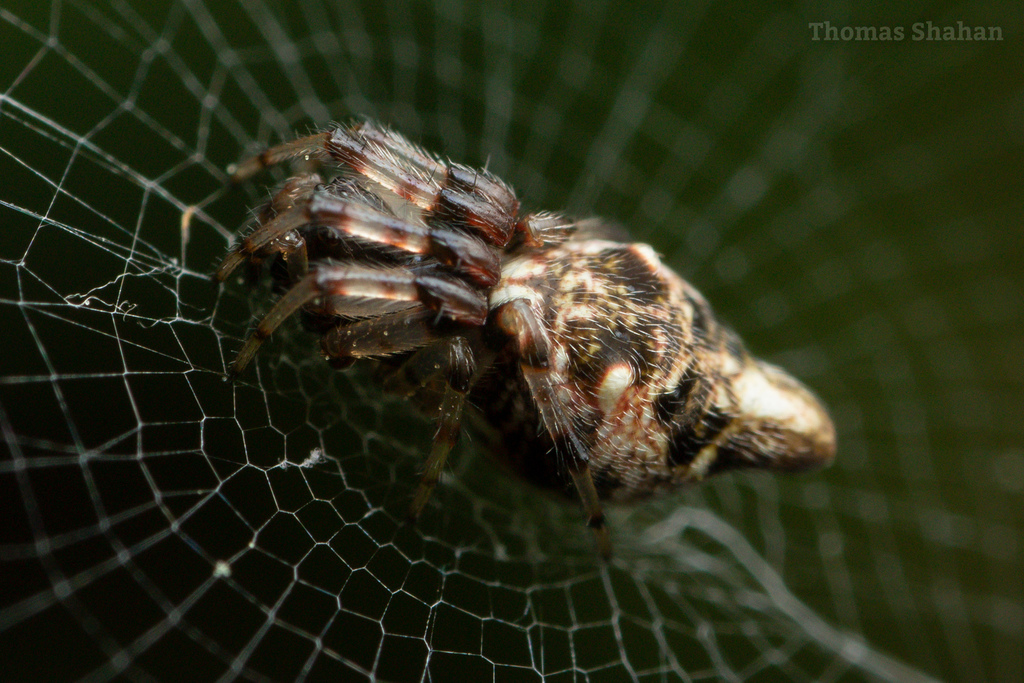
Humped Trashline Orbweaver
Cyclosa turbinata
Cyclosa turbinata is a species of orb weaver belonging to the family of spiders known as Araneidae. It is found in a range from the United States to Panama, West Indies, Galapagos Islands, and has been introduced into Hawaii.
From the article Cyclosa turbinata on Wikipedia (CC BY-SA), quoted section by section
Description
Cyclosa turbinata is a relatively small species with sizes about 4– 7 mm in length. Their color is a mix of browns, blacks, and whites, and their abdomen tapers to a rounded point, hence their given name. Females are typically within 3.3 and 5.2 mm in body length, while males are on average 2.5 mm long. Males are most active from March to September, while females are more active from March to October. Females of Cyclosa turbinata can be differentiated from females of Cyclosa conica, a very similar species, by their smaller size and the presence of two anterior dorsal humps.
Mangora gibberosa, otherwise known as the lined orbweaver, is also commonly misidentified as C. turbinata due to its similar appearance and orb-style webs.
Range & habitat
The spider is native to the continental United States, and Mexico, but has been introduced and found in places across Hawaii, the Caribbean, Middle, and South America, the Galapagos Islands, and even Oceania. Its large geographic range is likely due to its ability to travel through the wind using its silk to catch the current. Five species of Cyclosa occur in the continental United States.
Wikipedia: “Geographic distribution”
What it does
Experimental results have shown that when Cyclosa turbinata is confronted with a predator stimulus, the species shows thanatosis behavior more frequently, and for longer durations during the day. Some experts believe that increased thanatosis behavior during the daytime may correspond to an increased fitness cost associated with fleeing the web hub during the nighttime when prey is most abundant. It is believed that C. turbinata does not sacrifice predator vigilance for increased foraging efforts because the period of highest foraging aggression coincides with the period during which C. turbinata is most likely to leave the foraging area because of predators.
Wikipedia: “Protective behaviors”
In human culture
The specific name is derived from the Latin word turbo, meaning spinning top, in reference to the spider's top-shaped body and its wheel-shaped webs.
Wikipedia: “Etymology”
Where it lives
Recorded sightings
—
geo-referenced records in GBIF, from museums, herbaria and field observers.
Drag the globe to turn it. Dots are where records exist, not a range map; darker means more records.
In the stacks
Searching the stacks…
Every page naming Cyclosa turbinata in the Biodiversity Heritage Library →
This page is assembled live from iNaturalist, GBIF, Wikipedia, the Source Library and the Internet Archive. It is not yet part of the hand-edited codex. iNaturalist taxon 133963.