- Plants
- ›Mosses
- ›Peat mosses and allies
- ›Peat mosses and allies
- ›peat moss family
- ›Sphagnum
- ›Acutifolia
- ›Acutifolia
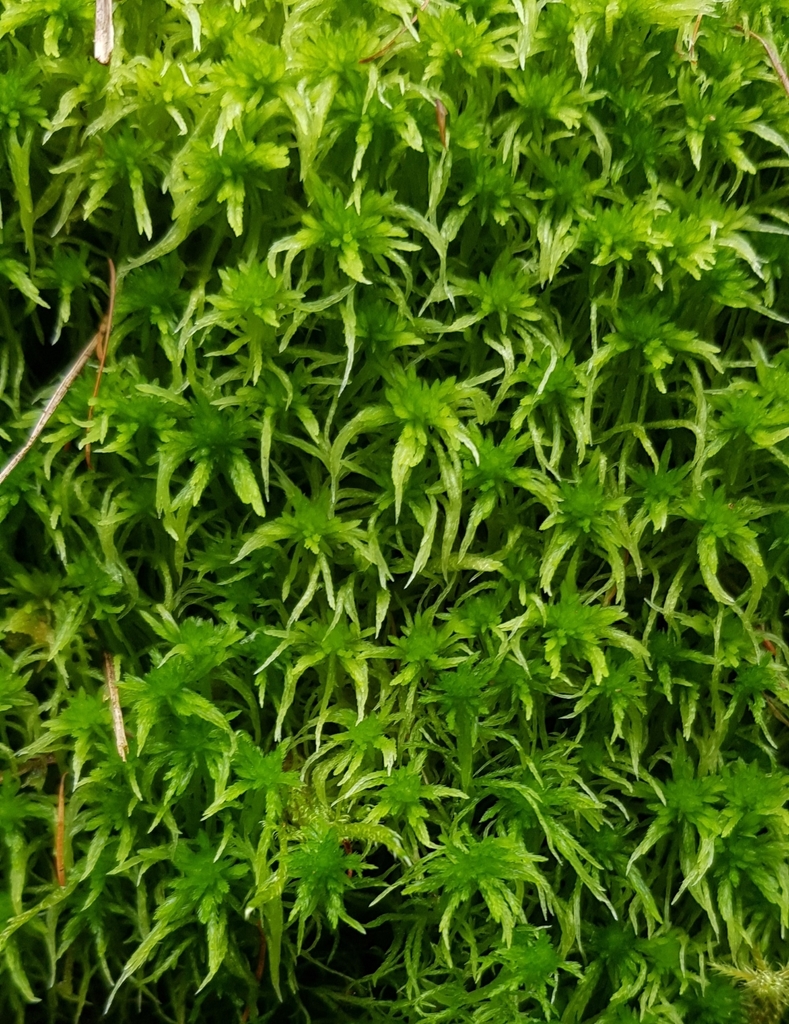
Fringed Bogmoss
Sphagnum fimbriatum
Sphagnum fimbriatum, the fringed bogmoss, is a peat moss found in temperate regions worldwide, from the Arctic to New Zealand and along the Andes. William Wilson formally described the species in 1846. Plants measure up to 10 cm (4 in) tall, varying from slender to moderately robust forms. It forms loose carpets or soft mounds in wetlands and is identified by its stem leaves with fringed upper margins. The stem leaves distinguish it from other Sphagnum species, including its close relative S. girgensohnii which has rectangular stem leaves fringed only at the tip.
The species grows in various environments but favours damp woodlands and partially shaded wetlands, where it initiates bog formation. It prefers moderately nutrient-rich conditions but tolerates pollutants and saline environments. As a pioneer species, it colonises new or disturbed sites through abundant spore production and effective vegetative reproduction. The species hosts nitrogen-fixing bacteria from the order Rhizobiales, contributing to wetland nutrient cycles. It forms peat deposits and supports wetland succession by modifying soil conditions and facilitating the establishment of other species.
From the article Sphagnum fimbriatum on Wikipedia (CC BY-SA), quoted section by section
Description
Sphagnum fimbriatum ranges from small and slender to moderately robust in size. The plant lacks metallic lustre when dry, and its colour varies from bright green to yellowish-brown or brown. Individual stems typically reach 80–120 mm (3.1–4.7 in) in length, with plants becoming notably larger and more compact in Arctic regions. When fully developed, individual plants typically reach about 10 cm (4 in) in height. The plant displays small, distinctive head-like structures (capitula) with noticeable protruding stem buds, and its colour varies from bright green to pale yellowish-green. The species characteristically forms either loose carpets or soft raised mounds (sods) in its habitat. The species shows considerable morphological variation across its range. Plants in southern lowland regions tend to be more slender, with branch leaves typically less than 1.7 mm in length, whilst populations in northern and montane regions display more robust forms. Plants collected from South America, particularly Argentina, tend to be more robust with larger stem leaves than those from similar climatic conditions in the Northern Hemisphere, though they remain morphologically and genetically part of the same species.
Stem and branch structure. The plant's branches grow in clusters (fascicles) that are moderately spaced along the stem. …
Range & habitat
Sphagnum fimbriatum typically grows in moderately nutrient-rich (mesotrophic) wetland environments, where it forms soft, raised mounds (hummocks) or loose carpets in partially shaded conditions. The species is particularly characteristic of young wetland stages in succession, being among the first Sphagnum species to colonise new sites. These early successional habitats typically have thin peat layers and fluctuating hydrological conditions, making them more sensitive to weather variations than established peatlands with thicker peat accumulation. The species shows a particular preference for damp woodland habitats, especially those dominated by willow (Salix) or birch (Betula) trees, often growing alongside purple moor-grass (Molinia). It can also thrive in more exposed locations, such as along grassy stream banks, drainage ditches, lake edges, and in nutrient-balanced fenland communities. The species is particularly effective at colonising bare soil surfaces, including disturbed habitats, and shows a distinct preference for establishing itself in sites with low phosphate content. Whilst S. fimbriatum commonly grows in pure stands, it may also be found growing alongside other bog-moss species. Common associates include the blunt-leaved bog-moss (S. palustre), spreading-leaved bog-moss (S. squarrosum), and fine bog-moss (S. angustifolium). …
Wikipedia: “Habitat”
What it does
Sphagnum fimbriatum colonises wetland habitats as a pioneer species. It grows in moderately calcareous waters and tolerates pollutants, including heavy metals and salt levels up to 300 milligrammes per litre of chloride. S. fimbriatum often grows in nutrient-rich (minerotrophic) conditions uncommon for Sphagnum species. When grown under forest canopies or in minerotrophic rich fens, it shows relatively low productivity compared to other Sphagnum species, which may reflect suboptimal growth conditions such as low light, constrained water availability, or high pH in these habitats. Success in its pioneer role appears linked to specific genetic adaptations that improve its colonisation ability, competitive capacity, and vegetative growth, particularly in northern regions. In temperate regions, S. fimbriatum is typically found in the shade of Betula spp. and Salix spp. in fen carr, in flushed zones in woodland, or in the central zone of valley mires, where water pH may range from 6–7 and calcium concentrations reach around 1 milliequivalent per litre. Unlike other Sphagnum species, S. fimbriatum tolerates higher pH and calcium levels, though combined high levels of both reduce growth. However, the combination of both high pH and high calcium concentration can significantly reduce its growth. …
Wikipedia: “Ecology”
How it is grown
Like other Sphagnum species, S. fimbriatum can be used both as a decorative ornamental plant and as a growing substrate for other species in horticulture. When used as a growing medium, it can be employed either pure or mixed with peat. Studies have shown that while it performs well for growing some ornamental plants like Tagetes (marigolds), it may inhibit seed germination in certain species. When mixed with peat in proportions up to 75%, it can actually improve plant growth compared to pure peat substrates. The species shows distinct chemical properties from other Sphagnum mosses when used as a growing medium, containing notably higher levels of soluble potassium. However, these chemical differences can lead to chlorosis (yellowing of leaves) in some plants grown in pure S. fimbriatum substrate, suggesting its optimal use may be as part of a mixed growing medium rather than alone. The species has gained increasing attention as a potential sustainable alternative to traditional peat in horticultural growing media. Under cultivation, S. fimbriatum and other Sphagnum species typically achieve annual yields of 3–6 tonnes of dry mass per hectare.
Wikipedia: “Horticultural applications”
Where it lives
Recorded sightings
—
geo-referenced records in GBIF, from museums, herbaria and field observers.
Drag the globe to turn it. Dots are where records exist, not a range map; darker means more records.
In the stacks
Searching the stacks…
Every page naming Sphagnum fimbriatum in the Biodiversity Heritage Library →
This page is assembled live from iNaturalist, GBIF, Wikipedia, the Source Library and the Internet Archive. It is not yet part of the hand-edited codex. iNaturalist taxon 132823.