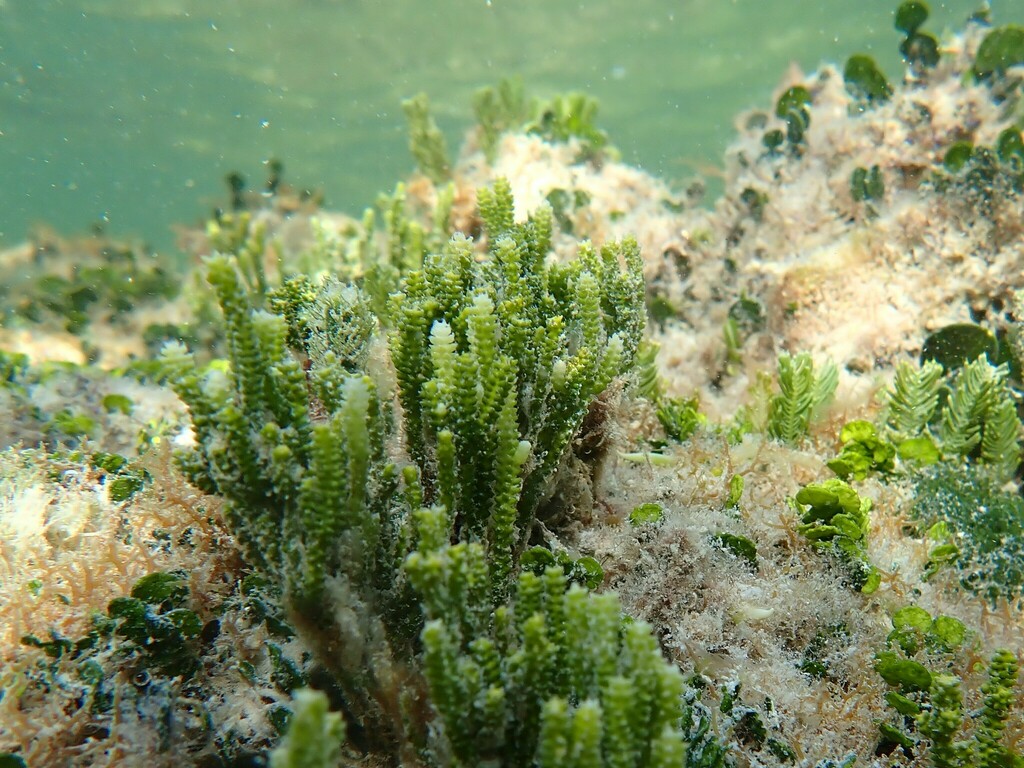
cactus tree alga
Caulerpa cupressoides
Caulerpa cupressoides, commonly known as cactus tree alga, is a species of seaweed in the Caulerpaceae family. Green alge of Caulerpa genus are salty and pungent in style and are consumed by several marine cultures around the world.
From the article Caulerpa cupressoides on Wikipedia (CC BY-SA), quoted section by section
Description
The plant has runners that are overlaid by sand rising up to thick stalks that split into heavy upright branches that are in turn lined with rows of short think branchlets. The length can vary from 2 to 25 centimetres (0.8 to 9.8 in) with a tall slender habit to a short bushy habit. It is a coenocytic species that grows well in shallow protected areas with sandy bottoms.
Range & habitat
It is found around much of the world including the Americas between Florida and Brazil including most of the islands of the Caribbean. Both coasts of Africa as far south as South Africa and many of the islands in Atlantic, Indian and Pacific Oceans. Found through much of Asia and in Australia it is found in Queensland and in Western Australia along the coast in a large area extending from around Perth then north through the Mid West and Pilbara coasts and into the Kimberley region
Wikipedia: “Distribution”
In medicine
Caulerpa genus consists of species that are resistant to herbivorous fishes due to its high content of sesquiterpenes and other phytochemicals that act as a chemical defense against herbivorous fishes. These chemical compounds are researched in order to find new compounds that can be used as antiviral, antimicrobial, cytotoxic, immunostimulatory, anti-obesity, cardioprotective, hepatoprotective and hypolipidemic medications.
Sulfated polysaccharides. The sulfated polysaccharides were detected in Caulerpa cupressoides var. flabellata, collected from Nísia Floresta in Brazil. These unique polysaccharides had anticoagulant, antioxidant, and immunostimulatory activities, which suggest potential biomedical applications. However, polysaccharides extracted from these species did exhibit dose-dependent anticoagulant activities in the intrinsic and extrinsic pathways.
Lectins. Seaweeds are rich sources of lectins, which are glycoproteins of nonimmune origin that bind reversibly to specific mono or oligosaccharides, without exerting any enzymatic activity on these carbohydrates. Lectins, carbohydrate-binding proteins, are known as anti-nociceptive and anti-inflammatory agents, had been detected in Caulerpa cupressoides var. lycopodium, collected from Pacheco in Brazil. …
Wikipedia: “Biomedical potential”
Where it lives
Recorded sightings
—
geo-referenced records in GBIF, from museums, herbaria and field observers.
Drag the globe to turn it. Dots are where records exist, not a range map; darker means more records.
In the stacks
Searching the stacks…
Every page naming Caulerpa cupressoides in the Biodiversity Heritage Library →
This page is assembled live from iNaturalist, GBIF, Wikipedia, the Source Library and the Internet Archive. It is not yet part of the hand-edited codex. iNaturalist taxon 131266.