- Animals
- ›Arthropods
- ›Crustaceans
- ›Typical Crustaceans
- ›Malacostracans
- ›Decapods, Isopods, and allies
- ›Decapods and Krill
- ›Decapods
- ›Crabs, Lobsters, Shrimps, and Allies
- ›Caridean Shrimps
- ›Palaemonoidea
- ›palaemonid shrimps
- ›Palaemon
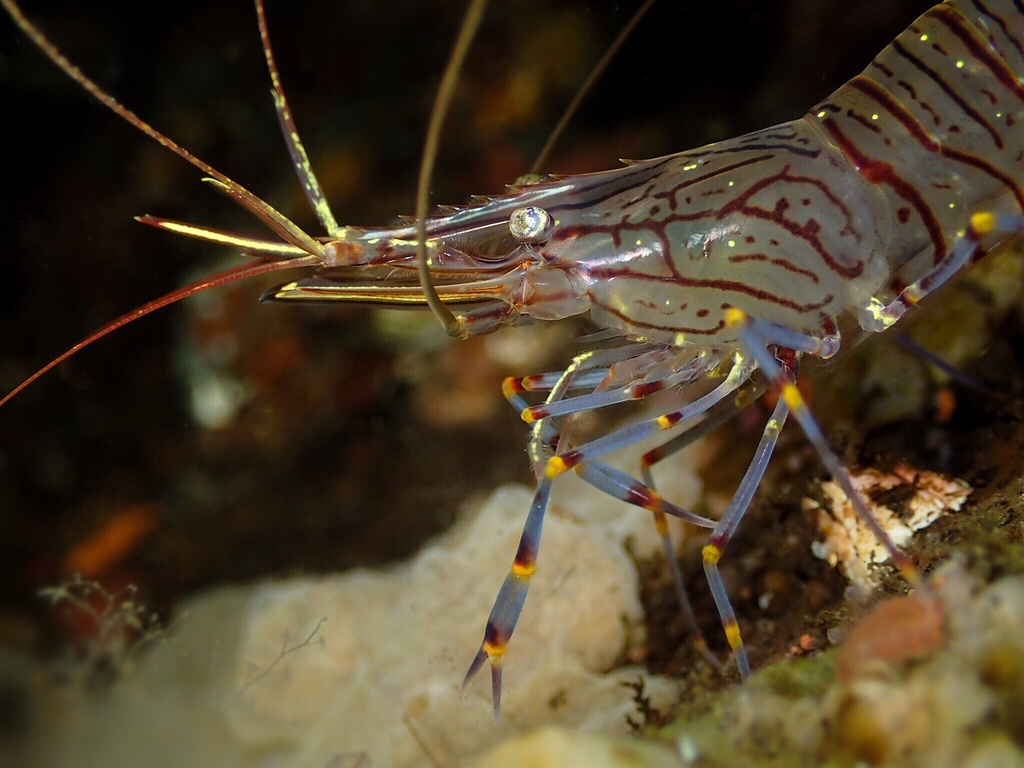
Common Prawn
Palaemon serratus
Palaemon serratus, also called the common prawn, is a species of shrimp found in the Atlantic Ocean from Denmark to Mauritania, and in the Mediterranean Sea and Black Sea.
From the article Palaemon serratus on Wikipedia (CC BY-SA), quoted section by section
Description
Palaemon serratus may be distinguished from other species of shrimp by the rostrum, which curves upwards, is bifurcated at the tip and has 6–7 teeth along its upper edge, and 4–5 teeth on the lower edge. Other species may have a slightly curved rostrum, but then the teeth on its dorsal surface continue into the distal third, which is untoothed in P. serratus. P. serratus is pinkish brown, with reddish patterns, and is typically 100 millimetres (3.9 in) long, making it the largest of the native shrimp and prawns around the British Isles. Palaemon serratus is one of the few invertebrates to have its hearing studied in detail; it is sensitive to frequencies between 100 Hz and 3 kHz, with an acuity similar to that of generalist fish. While the hearing range of a P. serratus individual changes as it grows, all are capable of hearing tones at 500 Hz.
What it does
Individuals live for 3–5 years in groups in rocky crevices at depths of up to 40 metres (130 ft). Females grow faster than males, and the population is highly seasonal, with a pronounced peak in the autumn. They are preyed upon by a variety of fish, including species of Mullidae, Moronidae, Sparidae and Batrachoididae. P. serratus can sometimes be found with a prominent bulge in its carapace over its gills. This is caused by the presence of an isopod parasite, such as Bopyrus squillarum.
Wikipedia: “Ecology”
Where it lives
Recorded sightings
—
geo-referenced records in GBIF, from museums, herbaria and field observers.
Drag the globe to turn it. Dots are where records exist, not a range map; darker means more records.
In the stacks
Searching the stacks…
Every page naming Palaemon serratus in the Biodiversity Heritage Library →
This page is assembled live from iNaturalist, GBIF, Wikipedia, the Source Library and the Internet Archive. It is not yet part of the hand-edited codex. iNaturalist taxon 130385.