- kelp, diatoms, and allies
- ›Ochrophyta
- ›brown algae
- ›Fucophycidae
- ›Fucoids
- ›Sargassum and Allies
- ›Sargassum
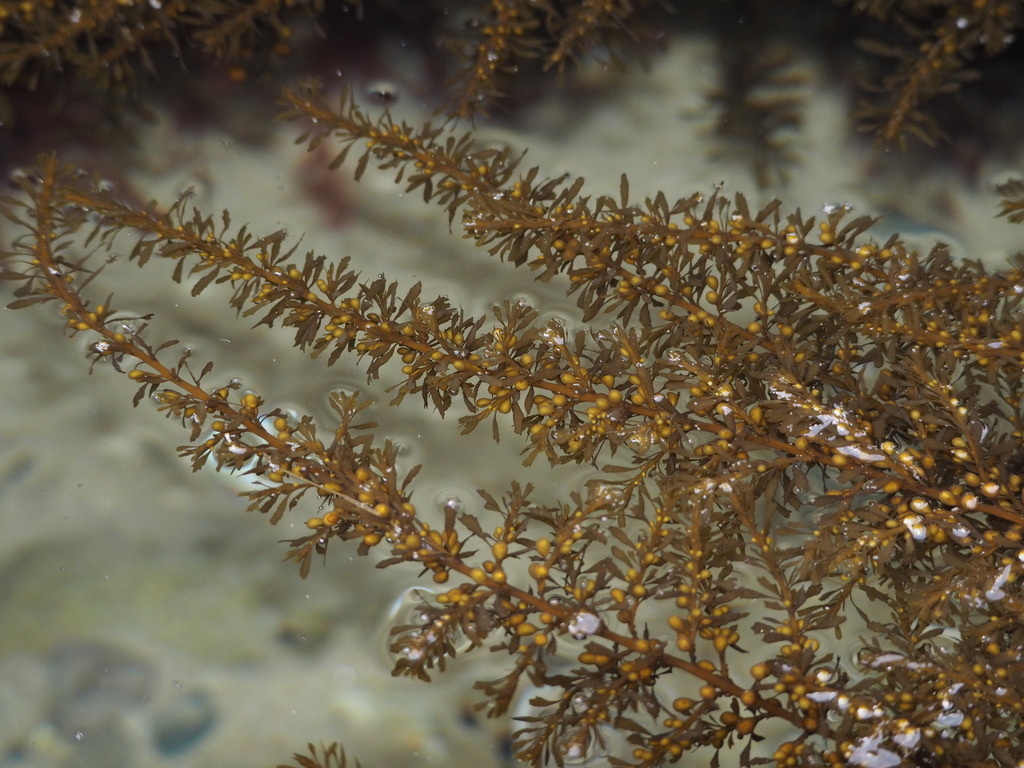
Japanese Wireweed
Sargassum muticum
Sargassum muticum, commonly known as Japanese wireweed or japweed, is a large brown seaweed of the genus Sargassum. It is native to the Western Pacific Ocean from coasts of China, South Korea, Japan, and southern Russia. During the mid-1900s, S. muticum was introduced to the Eastern Pacific Ocean, Atlantic Ocean, and the Mediterranean Sea. In some non-native habitats, it is an invasive species due to its high growth rate and efficient dispersal.
From the article Sargassum muticum on Wikipedia (CC BY-SA), quoted section by section
Description
Sargassum muticum is a brown seaweed, normally brown to yellowish with a length up to 10 m. It is an autotroph that uses energy from sunlight. The photosynthesis is facilitated thanks to aerial vesicles which allow the seaweed to rise to the water's surface. Sargassum muticum is composed of two distinct parts: a perennial part, which contains the holdfast and one or more short main axes; and an annual part: the secondary axes, which develop on the main axis, whose growth is unlimited and whose size is variable. There are three types of ramifications: laterals with foliaceous expansions called fronds, laterals with fronds and aerocysts and laterals with fronds, aerocysts and reproductive organs called receptacles. In winter, only the perennial part persists (5 cm). In summer, the lateral part is in maximum development of 2–3 meters to 10 meters.
Range & habitat
Sargassum muticum grows from half-tide to infralittoral areas (to a depth of 10 m). It is fixed on solid substrates like rocks, stones, shells. It is highly tolerant towards temperature and salinity variations. The optimal temperature is between 17 and 20 °C but it tolerates 0 and 30 °C.
Wikipedia: “Habitat”
What it does
The mode of reproduction is both sexual and asexual. S. muticum reaches sexual maturity in the summer when gamete production takes place in receptacles. The species is monoecious, i.e. an individual is capable of producing male and female gametes. Its cycle of development is monogenic (i.e. only one generation is present during its life cycle). At the level of fertilization: male gametes are dispersed in seawater while female gametes remain in the receptacle where fertilization takes place). Development is also done at the receptacle and then once at the stage of seedling, the latter is detached for fixation on a new support and form a new individual. This species can also reproduce asexually, but this has never been observed in temperate environments.
Wikipedia: “Reproduction”
At the table
There are some potential uses for Sargassum muticum. In agriculture, algae are used as sources of nitrate and potash for fertilization. It is also used in aquaculture as feed for juvenile sea cucumbers.
Water treatment. the cell walls of S. muticum contain alginates and fucoidans. The association of both molecules forms a bigger molecule and this one can be a flocculant. This process can be a method to catch organic matter present in sewage. This flocculant, rich in proteins and oligoelements, is easily biodegradable and could be used for fertilizer. Previous studies have shown that Sargassum muticum is able to carry out the biosorption of heavy metals like cadmium, chlorophenolic compounds, and nickel.
Antifouling. Secondary metabolites produced by marine algae could be an interesting alternative antifouling agent. Previous studies have shown the potential of hydrocarbon and fatty acid compounds in antifouling activities, compounds such as galactolipids and palmitic acid, 1-tetradecene or 1-hexadecene. Moreover, the peak production of antifouling compounds is during the spring.
Source of pharmaceutical compounds. Antioxidant compounds: Sargassum muticum is rich in antioxidant compounds such as phenolic compounds (cathechins, phlorotannins, quercetins), pigments (fucoxanthin) and vitamins(vitamin C, K, E in the form of alpha-tocophérol and gamma-tocopherol). …
Wikipedia: “Uses”
Where it lives
Recorded sightings
—
geo-referenced records in GBIF, from museums, herbaria and field observers.
Drag the globe to turn it. Dots are where records exist, not a range map; darker means more records.
In the stacks
Searching the stacks…
Every page naming Sargassum muticum in the Biodiversity Heritage Library →
This page is assembled live from iNaturalist, GBIF, Wikipedia, the Source Library and the Internet Archive. It is not yet part of the hand-edited codex. iNaturalist taxon 130177.