- Plants
- ›Mosses
- ›Peat mosses and allies
- ›Peat mosses and allies
- ›peat moss family
- ›Sphagnum
- ›Acutifolia
- ›Acutifolia
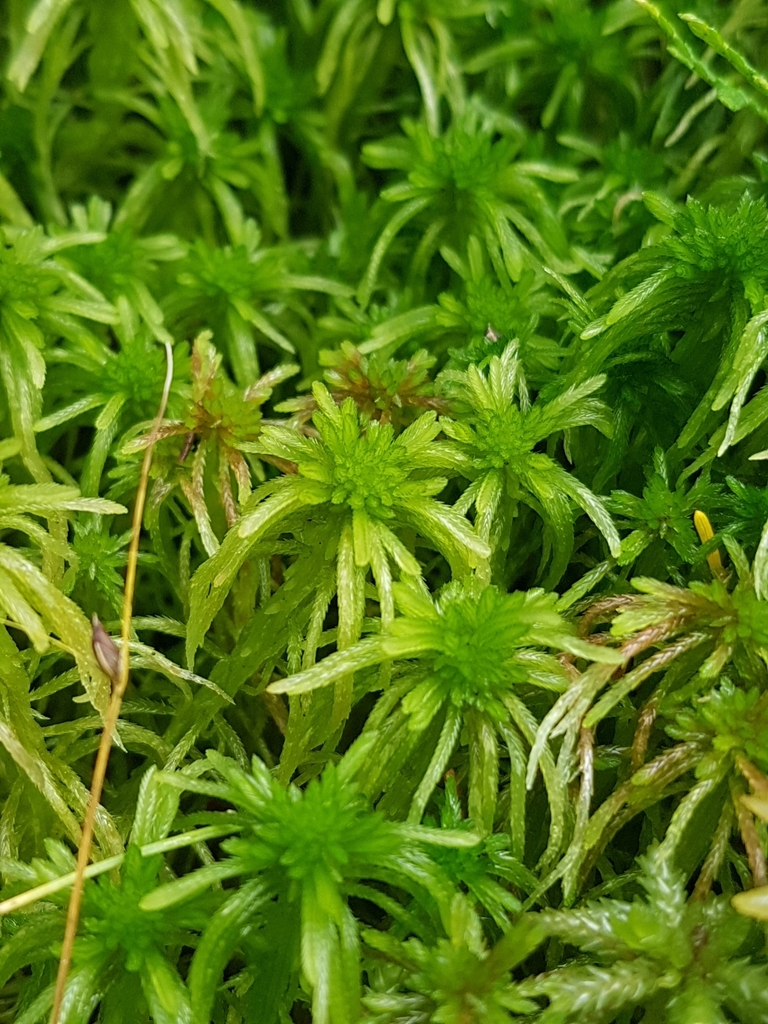
Girgensohn's Peatmoss
Sphagnum girgensohnii
Sphagnum girgensohnii, commonly known as Girgensohn's bogmoss, Girgensohn's sphagnum or common green peat moss, is a species of peat moss with a Holarctic and Indo-Malesian distribution. First described by Edmund Russow in 1865, it is a relatively robust moss species characterised by its green to straw-coloured appearance and distinctive branching pattern. The species typically grows in shaded, damp woodlands and on the edges of mires, forming loose mats particularly under birch and willow trees, and can be found from sea level to elevations of 2,200 m (7,200 ft). While it shows a mainly northern distribution pattern and is especially abundant in subarctic regions, it occurs throughout Europe from Portugal to Russia, being more common in upland areas. Despite facing threats from habitat degradation and land-use changes, S. girgensohnii is assessed by the IUCN as Least Concern due to its extensive range and stable populations, though it receives legal protection under various national and international frameworks, including the EU Habitats Directive.
From the article Sphagnum girgensohnii on Wikipedia (CC BY-SA), quoted section by section
Description
Sphagnum girgensohnii is a relatively robust species of peat moss. The plant typically appears in shades of green to straw-coloured, with stems ranging from pale green to light brown. Unlike some related species, it never develops red colouration. At the top of each plant is a cluster of branches (known as the capitulum) that often takes on a yellowish-brown hue. The plant's stem is fairly thick, measuring between 0.6 and 1.0 mm in diameter. It is protected by an outer layer (cortex) made up of 2–3 layers of transparent cells, each containing a distinctive large pore that can be observed even under basic magnification. The branches grow in clusters of three (occasionally four) at intervals along the stem. Each cluster typically contains two spreading branches that can grow exceptionally long—often exceeding 25 mm—and one or two hanging branches that appear pale and cylindrical. Near the plant's top, these spreading branches become shorter and slightly club-shaped. The leaves found on the stem are upright and pressed close to it, measuring 0.8–1.3 mm in length. They have a distinctive shape that is roughly rectangular or tongue-like, often appearing slightly pinched in the middle (described technically as 'lyrate'). …
Range & habitat
Sphagnum girgensohnii typically inhabits shaded environments where the peat layer is relatively thin and where there is notable influence from mineral-rich water. Rather than occurring in deep peat bogs, it favours damp woodland settings, grassy hillsides, and the edges of ditches. The species is particularly common along the margins of mires, especially in areas where fen woodland has developed. It characteristically grows above the water table, forming loose, scattered clumps or mats, often beneath birch (Betula) or willow (Salix) trees. The species shows considerable habitat flexibility, being found in wet depressions in swamps and dwarf shrub heaths, in addition to its typical woodland habitats. In its northernmost range, the species shows greater habitat flexibility, extending into more open mire environments. It becomes particularly abundant in subarctic peatlands dominated by cotton grass (Eriophorum), where it frequently grows alongside another peat moss species, Sphagnum russowii. While primarily considered a subalpine species, it can be found from sea level to well above the tree line, reaching elevations of up to 2,200 m (7,200 ft) above sea level.
The species has a wide distribution across the Northern Hemisphere. …
Wikipedia: “Distribution and habitat”
Where it lives
Recorded sightings
—
geo-referenced records in GBIF, from museums, herbaria and field observers.
Drag the globe to turn it. Dots are where records exist, not a range map; darker means more records.
In the stacks
Searching the stacks…
Every page naming Sphagnum girgensohnii in the Biodiversity Heritage Library →
This page is assembled live from iNaturalist, GBIF, Wikipedia, the Source Library and the Internet Archive. It is not yet part of the hand-edited codex. iNaturalist taxon 129775.