Channelled Wrack
Pelvetia canaliculata
Pelvetia canaliculata, the channelled wrack, is a very common brown alga (Phaeophyceae) found on the rocks of the upper shores of Europe. It is the only species remaining in the monotypic genus Pelvetia. In 1999, the other members of this genus were reclassified as Silvetia due to differences of oogonium structure and of nucleic acid sequences of the rDNA.
From the article Pelvetia on Wikipedia (CC BY-SA), quoted section by section
Description
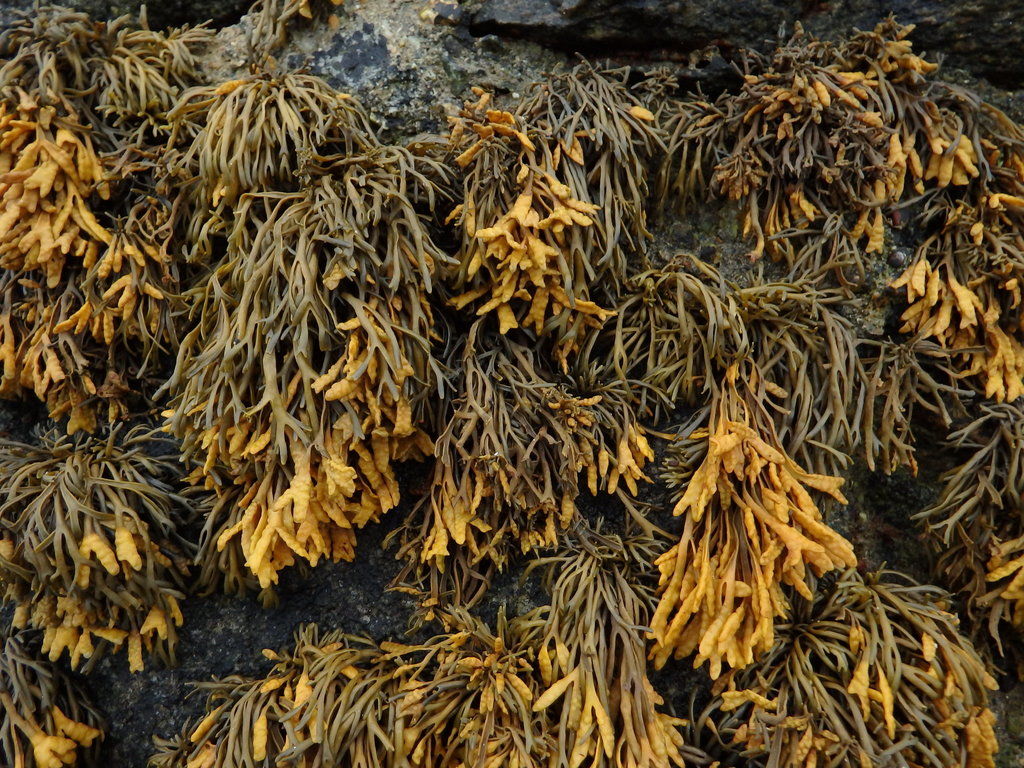
Pelvetia grows to a maximum length of 15 centimetres (6 in) in dense tufts, the fronds being deeply channeled on one side: the channels and a mucus layer help prevent the seaweed drying (desiccation) when the tide is out. It is irregularly dichotomously branched with terminal receptacles, and is dark brown in color. Each branch is of uniform width and without a midrib. The receptacles are forked at the tips. It is distinguished from other large brown algae by the channels along the frond. It has no mid-rib, no air-vesicles and no cryptostomata. It forms the uppermost zone of algae on the shore growing at or above high-water mark. The reproductive organs form swollen, irregularly shaped receptacles at the end of the branches. The conceptacles are hermaphrodite and borne within the receptacles at the apices.
Range & habitat
Pelvetia canaliculata is common on the Atlantic shores of Europe from Iceland to Spain, including Norway, Ireland, Great Britain, the Netherlands, France and Portugal. In Ireland, collection of Pelvetia canaliculata (Irish: dúlamán) has been recorded as a source of sustenance during times of famine. A popular Irish folk song, Dúlamán, describes events transpiring between two people who collected the seaweed as a profession.
Wikipedia: “Distribution”
What it does
Both sexes occur in the same plant, the reproductive structures develop at the apices. The receptacles are swollen during the summer and are yellowish-green at maturity.
Wikipedia: “Reproduction”
Where it lives
Recorded sightings
—
geo-referenced records in GBIF, from museums, herbaria and field observers.
Drag the globe to turn it. Dots are where records exist, not a range map; darker means more records.
In the stacks
Searching the stacks…
Every page naming Pelvetia canaliculata in the Biodiversity Heritage Library →
This page is assembled live from iNaturalist, GBIF, Wikipedia, the Source Library and the Internet Archive. It is not yet part of the hand-edited codex. iNaturalist taxon 129756.