- Animals
- ›Molluscs
- ›Gastropods
- ›Heterobranchs
- ›Euthyneura
- ›Tectipleura
- ›Eupulmonata
- ›Common Land Snails and Slugs
- ›Helicina
- ›Arionoidei
- ›Roundback Slugs and Allies
- ›Roundback Slugs
- ›Arion
- ›Carinarion
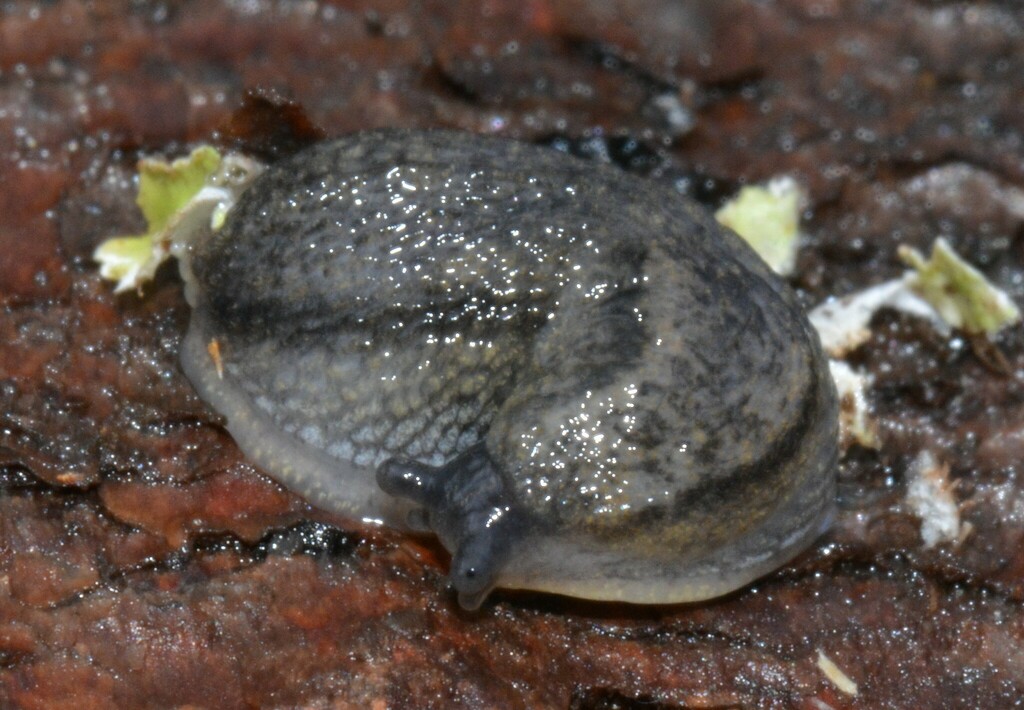
Brown-banded Arion
Arion circumscriptus
Arion circumscriptus, common name brown-banded arion, is a species of air-breathing land slug, a terrestrial pulmonate gastropod mollusk in the family Arionidae.
It is commonest in woodland, occurring across most of Europe, except for more southern regions, and is also widespread in North America. It has been argued that A. circumscriptus is best considered a colour morph of Arion fasciatus.
From the article Arion circumscriptus on Wikipedia (CC BY-SA), quoted section by section
Description
Like with other Arion species, the pneumostome lies in the anterior half of the mantle, and the back is round in cross-section rather than with a keel. However, the subgenus Carinarion is distinguished by a row of paler tubercles along the midline of the back, giving the impression of a keel; this is less prominent in adults. Another feature of Carinarion is that the cross-section is bell-shaped, with splayed-out rather than inward-curving sides. The overall colour of A. circumscriptus is a monochrome dark grey (sometimes with a tinge of blue or brown), with a darker dorsal band and a darker lateral band along each side, the one on the right running above the pneumostome. The flanks below are paler. The sole is white or pale grey, and the mucus colourless, or sometimes pale yellow. Length reaches 40 mm, or some say up to 50 mm. Several characters have been proposed to distinguish the species within Carinarion, but note the evidence that they should better all be considered colour morphs of one species (see Taxonomy section). Arion fasciatus is distinguished by reaching a larger size and by the yellow or orange flush below the lateral band (which disappears in alcohol), but the other two Carinarion species may also show faint yellow coloration. Dark flecks on the mantle distinguish A. circumscriptus from A. silvaticus and A. fasciatus, and the flanks of A. …
Wikipedia: “Description and identification”
Range & habitat
Arion circumscriptus is most typical of broadleaved woods in temperate climates, occurring in the litter layer, under dead wood and under bark; it sometimes also occurs in other habitats of cultivated land, such as roadsides and waste ground. It is only occasional in gardens and not considered a pest. It occurs up to an altitude of 1300 m in Switzerland. The species is widespread and common across North-West, Central and Eastern Europe, including southern Scandinavia (naturally to 62° in Sweden, further north still in gardens; also in Iceland). To the east it occurs in Ukraine and as far as the Vyatka river basin and north Caucasus in Russia. But it is absent in southern Europe (e.g. in the Iberian Peninsula and Greece; only present in northern part of Italy). In the Czech Republic re-identifications have led to it being considered much less common than once thought. In contrast, there has been a real decline in Austria, where it has been assessed as vulnerable. As an introduction, A. circumscriptus is widespread in the U.S.A. and Canada on both sides of the continent, spreading from gardens into natural habitats.
Wikipedia: “Habitat and distribution”
What it does
A study in southern England found that adults were present from January to July, with some of these maturing only as late as May; later maturing adults were smaller than those maturing earlier in the year. Few individuals were found above ground over the dry summer months, but otherwise immature animals of a wide range of sizes were present throughout the year. In late summer and autumn many immature animals were already of adult mass. The life cycle was predominantly annual, but some animals may have taken 18 months to mature. The life cycle appears similar in a study in Moscow gardens, although slightly delayed there by the Russian winter. A study in Michigan grassland also found adults most abundant in spring and summer. Arion circumscriptus reproduces predominantly by self-fertilization, leading to inbred genetic strains, but the presence of rare heterozygotes demonstrates that mating does occasionally result in outcrossing. The incidence of outcrossing is higher in Central Europe than in North-west Europe.
Wikipedia: “Life cycle”
Where it lives
Recorded sightings
—
geo-referenced records in GBIF, from museums, herbaria and field observers.
Drag the globe to turn it. Dots are where records exist, not a range map; darker means more records.
In the stacks
Searching the stacks…
Every page naming Arion circumscriptus in the Biodiversity Heritage Library →
This page is assembled live from iNaturalist, GBIF, Wikipedia, the Source Library and the Internet Archive. It is not yet part of the hand-edited codex. iNaturalist taxon 129206.