- Animals
- ›Echinoderms
- ›sea urchins and sea cucumbers
- ›Sea Urchins, Sand Dollars, and Heart Urchins
- ›sea urchins
- ›Carinacea
- ›Echinacea
- ›Camarodonta
- ›Echinidea
- ›Odontophora
- ›Echinometridae
- ›Echinometra
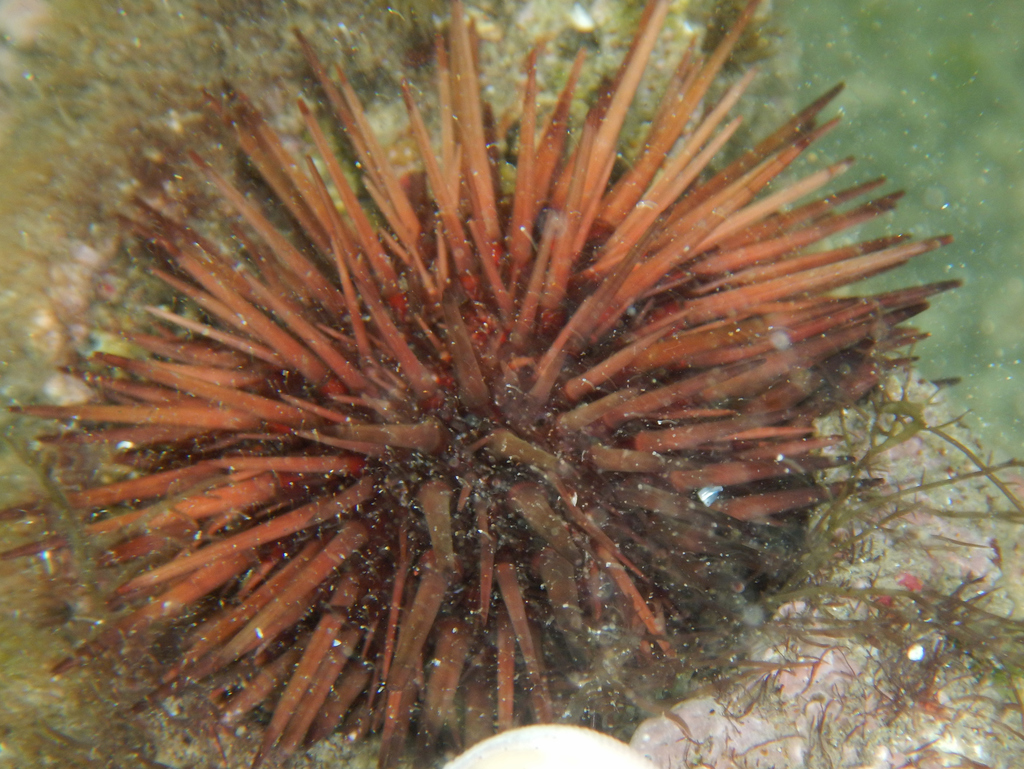
Reef Urchin
Echinometra viridis
Echinometra viridis, the reef urchin, is a species of sea urchin in the family Echinometridae. It is found on reefs in very shallow parts of the western Atlantic Ocean and the Caribbean Sea.
From the article Echinometra viridis on Wikipedia (CC BY-SA), quoted section by section
Description
The reef urchin has an elliptical reddish brown test (shell) covered with medium length spines. These are greenish in colour with paler bases and darker, often violet, tips. This urchin grows to a diameter of 5 centimetres (2.0 in) with the longest spines being 3 centimetres (1.2 in). It looks very similar to the rock-boring urchin Echinometra lucunter, but the dark tips and the greater length of the spines are distinctive.
Range & habitat
The reef urchin is found on reefs in the Caribbean Sea from southern Florida to Venezuela at depths down to about 15 metres (49 ft). It is not as common as the rock-boring urchin and seems to be absent from the West Indies to the east of the Virgin Islands.
Wikipedia: “Distribution”
What it does
The reef urchin is an important grazer on fleshy algae in the Caribbean area. Its abundance is reduced by predation by fish, especially the jolthead porgy (Calamus bajonado), the queen triggerfish (Balistes vetula), the ocean triggerfish (Canthidermis sufflamen) and the hogfish (Lachnolaimus maximus). Because of this predation, the reef urchin avoids open reef flats and in these locations there is an overgrowth of fleshy algae. It is unable to take over the algal controlling role of the black sea urchin (Diadema antillarum) which is subject to great fluctuations in population.
== References ==
Wikipedia: “Ecology”
Where it lives
Recorded sightings
—
geo-referenced records in GBIF, from museums, herbaria and field observers.
Drag the globe to turn it. Dots are where records exist, not a range map; darker means more records.
In the stacks
Searching the stacks…
Every page naming Echinometra viridis in the Biodiversity Heritage Library →
This page is assembled live from iNaturalist, GBIF, Wikipedia, the Source Library and the Internet Archive. It is not yet part of the hand-edited codex. iNaturalist taxon 128200.