- Fungi Including Lichens
- ›Basidiomycete Fungi
- ›Higher Basidiomycetes
- ›Mushrooms, Bracket Fungi, Puffballs, and Allies
- ›Agaricomycetidae
- ›Common Gilled Mushrooms and Allies
- ›Pluteineae
- ›amanita mushrooms and allies
- ›Amaniteae
- ›Amanita
- ›Amanitina
- ›Validae
- ›Amanita flavoconia
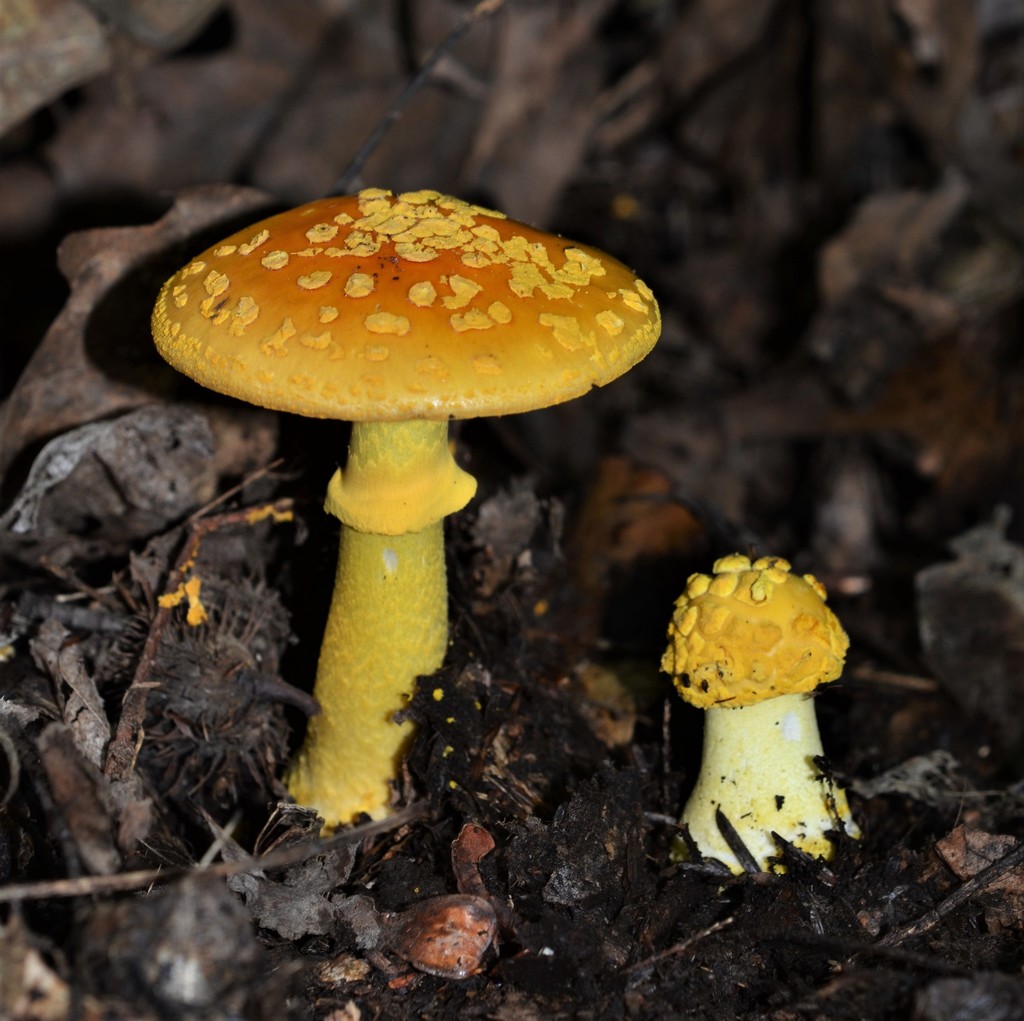
Yellow Patches
Amanita flavoconia
Amanita flavoconia, commonly known as yellow patches, yellow wart, orange amanita, yellow-dust amanita or the American yellow dust amanita, is a species of mushroom in the family Amanitaceae. It has an orangish-yellow cap with yellowish-orange patches or warts, a yellowish-orange annulus, and a white to orange stem. Common and widespread throughout eastern North America, it grows on the ground in broad-leaved and mixed forests, especially in mycorrhizal association with hemlock.
From the article Amanita flavoconia on Wikipedia (CC BY-SA), quoted section by section
Description
The cap is initially ovoid in shape, but in maturity becomes convex and eventually flattened. Orange to bright yellow-orange in color, it reaches diameters of 3 to 9 centimetres (1 to 3+1⁄2 inches). Young specimens are covered with chrome yellow warts that may be easily rubbed off or washed away with rain. The cap surface is smooth and sticky (viscid) beneath the warts; the edge of the cap is striate, reflecting the arrangement of the gills underneath. The flesh is white. The gills are barely free from the stem, and packed close together. They are white or tinged yellow on the edges, and initially covered with a yellowish partial veil. The stem is typically 5.5 to 11.5 cm (2 to 4+1⁄2 in) long by 0.7 to 1.4 cm (1⁄4 to 1⁄2 in) thick, equal or slightly tapered upward from a small rounded bulb at the base. Its color may range from white to yellowish orange, and the surface may be smooth, or covered with small flakes. The base of the stem usually has chrome yellow flakes of universal veil material adhering loosely to the bulb, or in the soil around the base. The partial veil leaves a skirt-like ring, (annulus) on the upper stem. The spore print is white. Campbell and Petersen published a detailed description of the characteristics of A. flavoconia grown in culture. …
Range & habitat
A common mycorrhizal mushroom, A. flavoconia grows solitarily or in groups on the ground in the summer to the fall, in broad-leaved and mixed woods. Noted for preferring hemlock, it is also associated with high elevation red spruce forests. In North America, A. flavoconia has a wide distribution and has been collected from several locations, including Ontario, Canada; the United States (Iowa), and Mexico. It has been described as "of the most common and widespread species of Amanita in eastern North America."
Wikipedia: “Distribution and habitat”
At the table
As the edibility of this species is unknown, it should not be consumed, and a number of its relatives are quite poisonous.
Wikipedia: “Edibility”
Where it lives
Recorded sightings
—
geo-referenced records in GBIF, from museums, herbaria and field observers.
Drag the globe to turn it. Dots are where records exist, not a range map; darker means more records.
In the stacks
Searching the stacks…
Every page naming Amanita flavoconia in the Biodiversity Heritage Library →
This page is assembled live from iNaturalist, GBIF, Wikipedia, the Source Library and the Internet Archive. It is not yet part of the hand-edited codex. iNaturalist taxon 125389.