- Animals
- ›Arthropods
- ›Chelicerates
- ›Arachnids
- ›Harvestmen
- ›Eupnoan Harvestmen
- ›Phalangioidea
- ›Sclerosomatid Harvestmen
- ›Leiobuninae
- ›Leiobunum
- ›Leiobunum vittatum
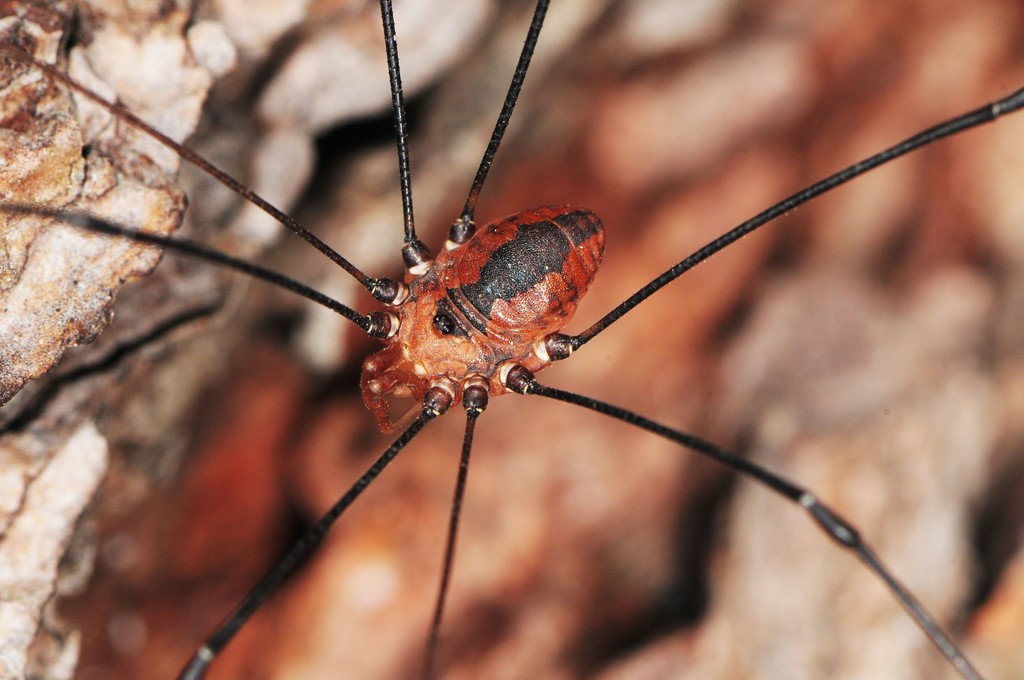
Banded Harvestman
Leiobunum vittatum
Leiobunum vittatum, commonly known as the eastern harvestman, is a species of harvestman in the family Sclerosomatidae. It is native to North America and belongs to the Leiobunum vittatum species group.
The species has been studied in research on defensive chemistry, locomotor biomechanics, phylogenetics, and mating behavior.
From the article Leiobunum vittatum on Wikipedia (CC BY-SA), quoted section by section
Description
Leiobunum vittatum is a long-legged harvestman with a comparatively small, oval body. Adult males are approximately 5–7 mm long, while females are about 7–8.5 mm long. Both sexes typically possess a conspicuous dark central dorsal marking extending from the posterior abdomen toward and across the ocularium. Dark patellae and dark bands near the distal ends of the tibiae are also useful identification features. Males have distinctive elongated pedipalps. The palpal femur is long and curved, and the proximal portion of the palpal tibia bears long spine-like tubercles. Females are generally larger and more rounded posteriorly than males. Identification of females within the L. vittatum group can be more difficult because closely related species may share similar external coloration and proportions.
Range & habitat
Leiobunum vittatum is distributed in eastern and central North America. The species was formally documented from Minnesota in a 2017 survey of the state's harvestmen. The study reported seven harvestman species not previously recorded from Minnesota, including L. vittatum, and noted that the state's harvestman fauna had historically been poorly documented.
Wikipedia: “Distribution”
What it does
Mating in L. vittatum includes distinct pre-copulatory and copulatory stages. Interactions may begin with a physical struggle in which the male attempts to grasp the female with his pedipalps and establish a mating embrace. Experimental observations found that males with shorter pedipalps were more successful at securing females during the initial struggle. Later stages of mating involve tactile interactions between the sexes. Females can resist mating attempts, including by positioning the body against the substrate in a way that restricts access to the genital opening. Comparative research on leiobunine harvestmen has examined these structures and behaviors in the context of sexual conflict and evolutionary changes in mating systems.
Wikipedia: “Reproduction and mating behavior”
Where it lives
Recorded sightings
—
geo-referenced records in GBIF, from museums, herbaria and field observers.
Drag the globe to turn it. Dots are where records exist, not a range map; darker means more records.
In the stacks
Searching the stacks…
Every page naming Leiobunum vittatum in the Biodiversity Heritage Library →
This page is assembled live from iNaturalist, GBIF, Wikipedia, the Source Library and the Internet Archive. It is not yet part of the hand-edited codex. iNaturalist taxon 121465.