- Animals
- ›Arthropods
- ›Chelicerates
- ›Arachnids
- ›Spiders
- ›Typical Spiders
- ›Entelegyne Spiders
- ›Orbweavers and Allies
- ›Orbweavers
- ›Typical Orbweavers
- ›Araneus
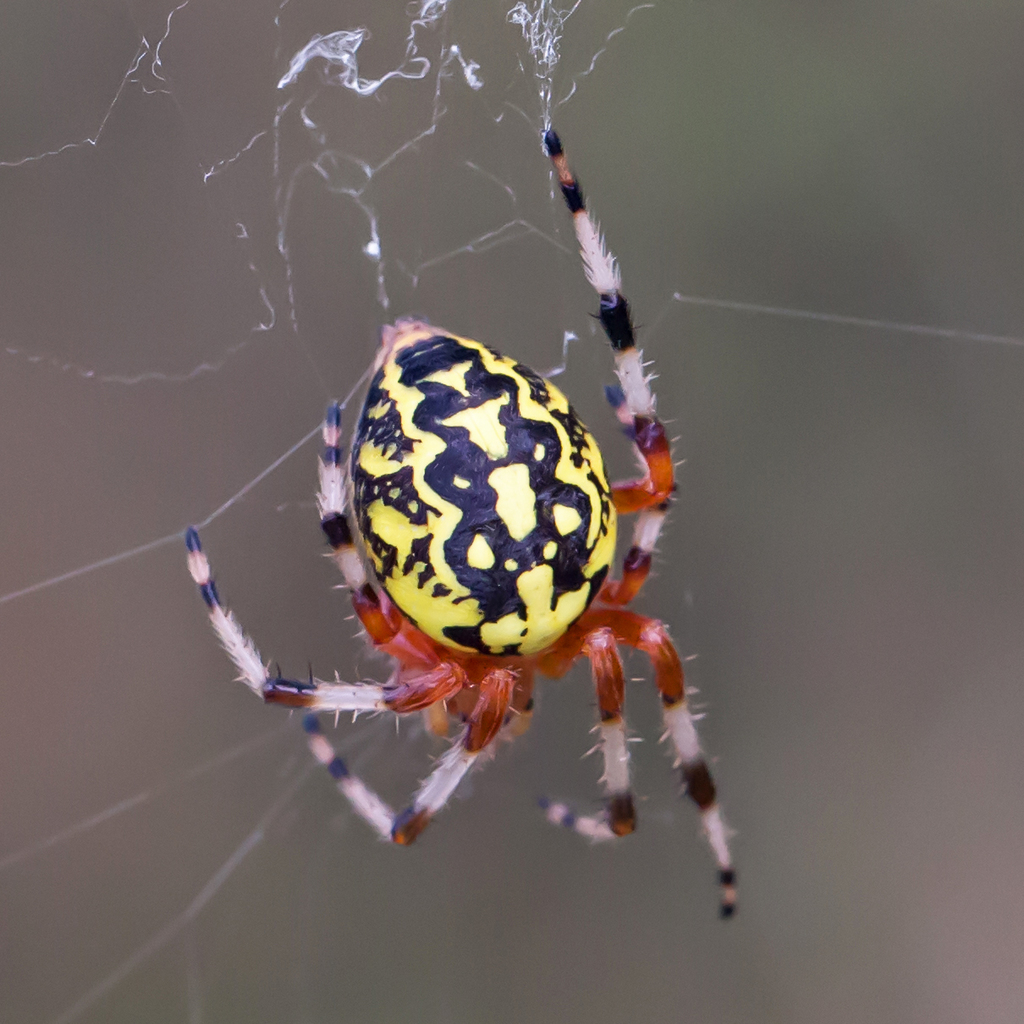
Marbled Orbweaver
Araneus marmoreus
Araneus marmoreus, commonly called the marbled orb-weaver, is a species of spider belonging to the family Araneidae. It is sometimes also called the pumpkin spider from the resemblance of the female's inflated abdomen to an orange pumpkin. It has a Holarctic distribution.
From the article Araneus marmoreus on Wikipedia (CC BY-SA), quoted section by section
Description
Adult female marbled orbweavers have a body length of up to 14 mm or more, with a very large oval, sub-spherical abdomen. Adult males are smaller, with a body length of up to 7 mm. Two main color forms are found. A. marmoreus var. marmoreus has an orange abdomen with brown to black marbling. It usually has a distinct folium with dark edging. A. marmoreus var. pyramidatus has a much paler abdomen, with a single dark, often reddish-brown, mark at the rear However, the species can have a wide range of colorations and folium patterns. Var. pyramidatus is more common in Europe, while var pyramidatus is uncommon in North America. The cephalothorax is commonly yellow to burnt-orange with a central dark line and dark lines down either side. The femurs are often red in color with black and white banding beginning on the tibia, metatarsus, and tarsus. The legs may instead have a light brown banded pattern. The venter has a black band enclosed by white brackets. Egg cocoons, which contain several hundred eggs, are generally deposited in October and are constructed of white silk formed in a flattened sphere. Immature spiders emerge from the cocoons in spring. Adults are seen from midsummer until the first hard freeze of fall.
Webs. The webs are found in trees, shrubs and tall weeds, and grasses in moist, wooded settings and can frequently be found along the banks of streams. …
Range & habitat
Araneus marmoreus has a Holarctic distribution, being found from North America through Europe to Japan. In North America, it is found throughout all of Canada to Alaska, the northern Rockies, from North Dakota to Texas, and then east to the Atlantic.
Wikipedia: “Distribution”
Where it lives
Recorded sightings
—
geo-referenced records in GBIF, from museums, herbaria and field observers.
Drag the globe to turn it. Dots are where records exist, not a range map; darker means more records.
In the stacks
Searching the stacks…
Every page naming Araneus marmoreus in the Biodiversity Heritage Library →
This page is assembled live from iNaturalist, GBIF, Wikipedia, the Source Library and the Internet Archive. It is not yet part of the hand-edited codex. iNaturalist taxon 120183.