- Animals
- ›Echinoderms
- ›Sea Stars and Brittle Stars
- ›Sea Stars
- ›Forcipulatacean Sea Stars
- ›Forcipulatidan Sea Stars
- ›Asteriid Sea Stars
- ›Asterias
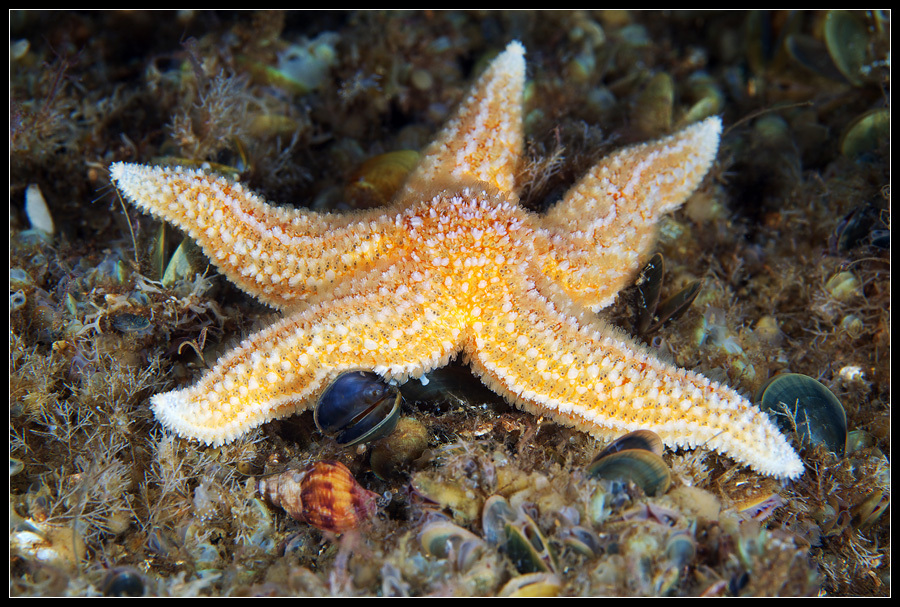
Common Sea Star
Asterias rubens
The common starfish, common sea star or sugar starfish (Asterias rubens) is the most common and familiar starfish in the north-east Atlantic. Belonging to the family Asteriidae, it has five arms and usually grows to between 10–30 cm across, although larger specimens (up to 52 cm across) are known. The common starfish is usually orange or brownish in color, and sometimes violet; specimens found in deeper waters are pale. The common starfish is found on rocky and gravelly substrates where it feeds on mollusks and other benthic invertebrates.
From the article Common starfish on Wikipedia (CC BY-SA), quoted section by section
Description
The common starfish normally has five arms, broad at their base and gradually tapering to a point at their tips, which are often turned up slightly. There is a line of short white spines running along the centre of the aboral (upper) surface of the arms with low, soft mounds called papulae on either side. The oral (lower) surfaces of the arms have rows of small tube feet, used in locomotion and feeding. The starfish is usually orange or brick red on the aboral surface and paler on the oral surface but can also be purple or pale brown. Individuals from deep water are usually paler. It grows to a maximum diameter of about 52 centimetres (20 in) but a more normal size is 10 to 30 cm (4 to 12 in).
Range & habitat
The common starfish is native to the northeastern Atlantic Ocean and its range extends from Norway and Sweden, through the North Sea, round the coasts of Britain, France, Spain and Portugal and southwards along the coasts of Africa to Senegal. It is largely absent from the Mediterranean Sea. It is also known from the western Atlantic where it occurs between Labrador and Florida and the Gulf of Mexico. It is capable of surviving in brackish water.
Wikipedia: “Distribution”
What it does
The common starfish feeds on a variety of benthic organisms. These include bivalve molluscs, polychaete worms, barnacles, gastropod molluscs, other echinoderms and carrion. When feeding on a mollusc such as a mussel, it attaches its tube feet to each shell valve and exerts force to separate them slightly. Even a gap of just 1 mm (0.04 in) is sufficient for the starfish to insert a fold of its stomach, secrete enzymes and start digesting the mollusc body. When the contents are sufficiently liquid, it brings its stomach back to its rightful position with the food inside. The common starfish has a well-developed sense of smell and can detect the odour of prey species such as the common mussel (Mytilus edulis) and crawl towards it. It can also detect the odour of the predatory common sunstar (Crossaster papposus), which eats other starfish, and take evasive action.
The common starfish is dioecious, which means that each individual is either male or female. In the spring, the females release their eggs into the sea. A moderate sized starfish is estimated to be able to produce 2.5 million eggs. The males shed their sperm and fertilisation takes place in the water column. The larvae are planktonic and drift for about 87 days before settling on the seabed and undergoing metamorphosis into juveniles. Common starfish are believed to live for about seven to eight years. …
Wikipedia: “Ecology”
Where it lives
Recorded sightings
—
geo-referenced records in GBIF, from museums, herbaria and field observers.
Drag the globe to turn it. Dots are where records exist, not a range map; darker means more records.
In the stacks
Searching the stacks…
Every page naming Asterias rubens in the Biodiversity Heritage Library →
This page is assembled live from iNaturalist, GBIF, Wikipedia, the Source Library and the Internet Archive. It is not yet part of the hand-edited codex. iNaturalist taxon 120138.