 NL·0185
Herbarium of the Nature Library
- Name
- Cladonia rangiferina
- Family
- Cladoniaceae
- Native to
- Circumpolar Arctic and boreal regions; also high mountains further south
- Habitat
- Tundra, Boreal forest, Heath
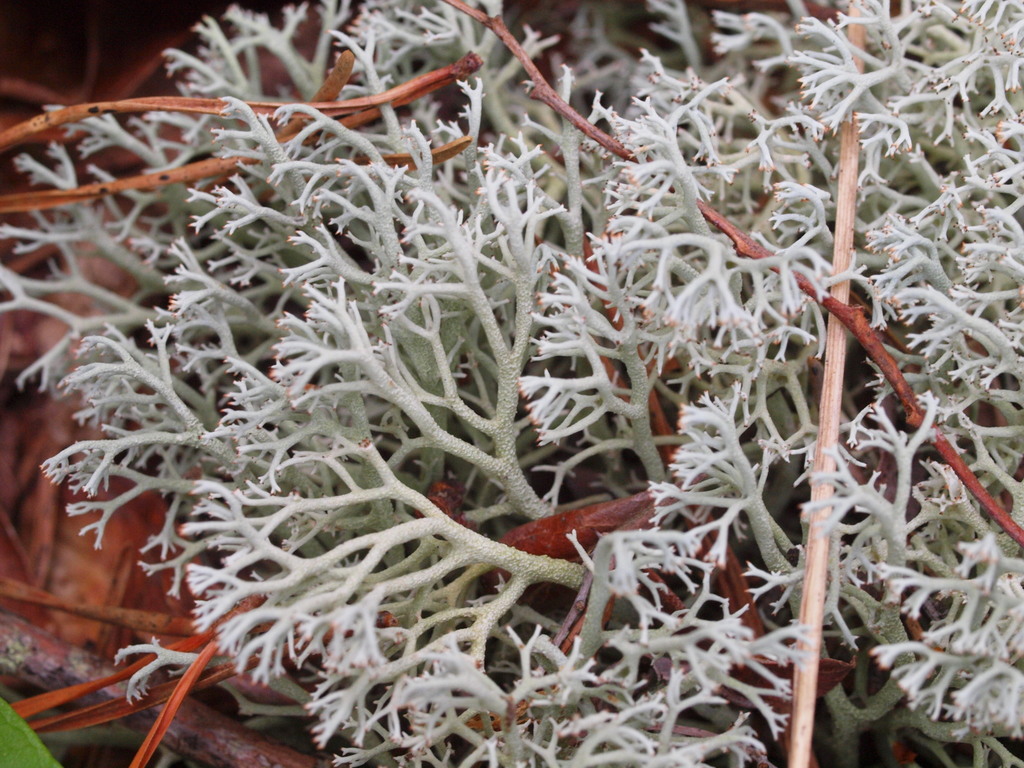
Reindeer lichen
Cladonia rangiferina
Also calledYagel (Russian) · Poronjäkälä (Finnish) · Renlav (Swedish) · Caribou moss (English)
A pale grey, finely branched lichen that carpets huge areas of tundra and boreal forest floor. It is the main winter food of reindeer and caribou, which smell it beneath the snow. It grows only a few millimetres a year, so overgrazed carpets take decades to recover.
Cladonia rangiferina, also known as reindeer cup lichen, reindeer lichen or grey reindeer lichen, is a light-coloured fruticose, cup lichen species in the family Cladoniaceae. It grows in both hot and cold climates in well-drained, open environments. Found primarily in areas of alpine tundra, it is extremely cold-hardy. Wikipedia
What it can do
- iCan make up most of the winter diet of reindeer and caribou
- iiGrows only about 3–5 mm a year
- iiiProduces atranorin and fumarprotocetraric acid; its lichen acids make it hard for most animals to digest
- ivSurvives freezing and drying, reviving when moistened
At the table
Eatenwhole thallus (after leaching and boiling)
Famine food for people, eaten only after soaking in water or wood-ash lye and boiling to remove bitter lichen acids. Raw lichen causes stomach upset. Lichens accumulate radioactive fallout and heavy metals; reindeer herders in Scandinavia were affected by Chernobyl caesium in 1986 through lichen.
In the medicine cabinet
| Tradition | Use |
|---|---|
| Indigenous Arctic and Subarctic peoples (e.g. Cree, Dene) | Decoctions taken for colds, fevers and joint pain |
| Scandinavian folk medicine | Boiled for coughs and diarrhoea |
Weight of evidence
Traditional. Long historical use; little or no modern clinical evidence.
Active compounds
atranorin, fumarprotocetraric acid
Fruiting body & spores
Spores
Mainly reproduces by fragments; rarely produces brown apothecia with colourless, one-celled ascospores
- Dispersal
- Fragments broken off by trampling animals, wind and water
Where it lives
Recorded sightings
—
geo-referenced records in GBIF, from museums, herbaria and field observers.
Native range
Circumpolar Arctic and boreal regions; also high mountains further south
Drag the globe to turn it. Dots are where records exist, not a range map; darker means more records.
In the old herbals & bestiaries
No plate in the Source Library names this exact species, so these show its closest relatives as the old naturalists drew them: same genus, or the same kind of plant. Click a plate to read the page it came from, with translation.

François Le Vaillant — Histoire naturelle des promerops et des guêpiers (1807)
Relative · François Le Vaillant · 1807 · p.375

Jean Baptiste Audebert — Histoire naturelle des colibris (1802)
Relative · Jean Baptiste Audebert · 1802 · p.270

Illustrations of Fungi which Grow in Bavaria and the Palatinate around Ratisbon, Vols 1–2
Relative · Jacob Christian Schaeffer; C.H. Persoon (ed.) · 1800 · p.396

Illustrations of Fungi which Grow in Bavaria and the Palatinate around Ratisbon, Vols 3–4
Relative · Jacob Christian Schaeffer; C.H. Persoon (ed.) · 1800 · p.178

Illustrations of Fungi which Grow in Bavaria and the Palatinate around Ratisbon, Vols 3–4
Relative · Jacob Christian Schaeffer; C.H. Persoon (ed.) · 1800 · p.283

François Le Vaillant — Histoire naturelle des promerops et des guêpiers (1807)
Relative · François Le Vaillant · 1807 · p.87

Latin Herbal with German Synonyms
Relative · 1486 · p.312

Commentaries on the Six Books of Dioscorides on Medical Matter
Relative · Pietro Andrea Mattioli · 1563 · p.622

History of Rare Plants
Relative · Carolus Clusius · 1601 · p.626

Latin Herbal
Relative · 1484 · p.311
In the stacks
Searching the stacks…
Every page naming Cladonia rangiferina in the Biodiversity Heritage Library →
Marginalia
Sámi reindeer herding has followed the lichen pastures for centuries. Indigenous Arctic peoples ate the half-digested lichen from caribou stomachs. After Chernobyl in 1986, radioactive caesium in lichen-fed reindeer forced Sweden and Norway to cull herds.
Curiosity
Despite the name 'reindeer moss', it is not a moss but a fungus partnered with green algae.
Kinship


Photographs: iNaturalist contributors under the licences shown. Records: GBIF.org. Historical plates: Source Library (CC BY-SA 4.0; originals public domain). Summary text: Nature Library editors and Wikipedia (CC BY-SA). Medicinal and edibility notes are historical and educational, not advice. iNaturalist taxon 119778.