 NL·0184
Herbarium of the Nature Library
- Name
- Cantharellus cibarius
- Family
- Cantharellaceae
- Native to
- Europe and northern Asia; North American 'cibarius' records mostly belong to related species (e.g. C. californicus, C. formosus, C. flavus)
- Habitat
- Temperate forest, Boreal forest, Beech and oak woodland, Pine heath
Golden chanterelle
Cantharellus cibarius
Also calledGirolle (French) · Pfifferling (German) · Lisichka (Russian) · Kurka (Polish) · Kantarell (Swedish) · Ji you jun 鸡油菌 (Chinese)
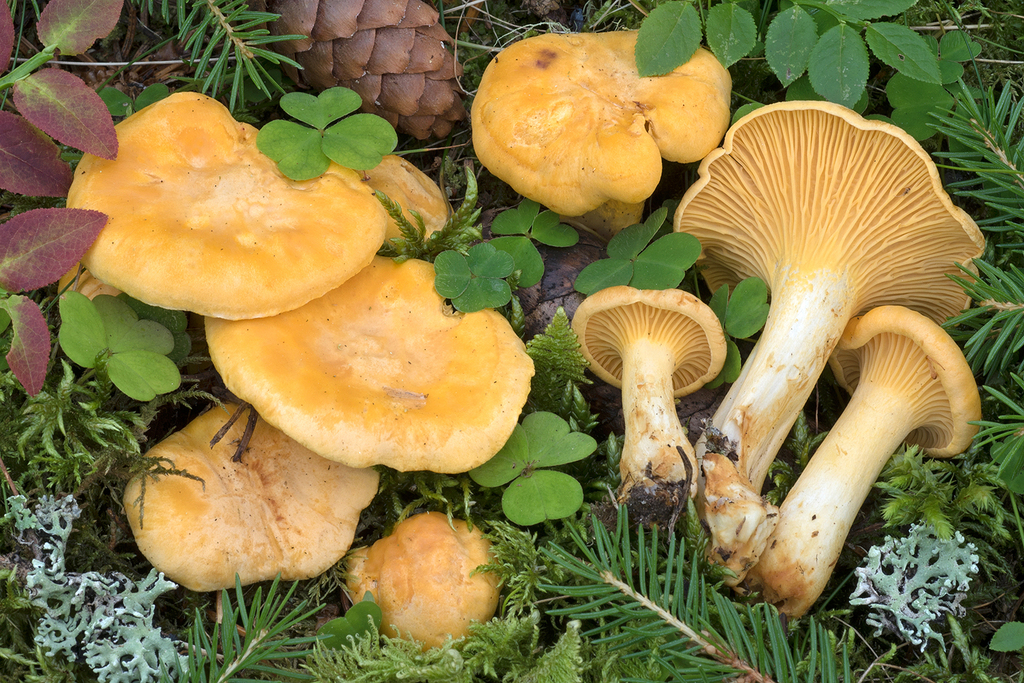
An egg-yolk-yellow, apricot-scented woodland mushroom and one of the most prized wild edibles in Europe. Instead of true gills it has blunt, forking ridges that run down the stem, a key identification feature.
Cantharellus cibarius is the golden chanterelle, the type species of the chanterelle genus Cantharellus. It is also known as girolle. Wikipedia
What it can do
- iEctomycorrhizal with beech, oak, birch, pine and spruce; it has never been reliably cultivated
- iiIts false gills are blunt, forked ridges, not true blade-like gills
- iiiHighly resistant to insect larvae, so it rarely turns maggoty
- ivCan keep fruiting from the same spot for decades
At the table
Eatenwhole fruiting body (cooked)
Excellent cooked. Dangerous lookalikes: the jack-o'-lantern (Omphalotus olearius in Europe, O. illudens in North America), which has true, sharp gills, grows in clusters on wood and causes severe vomiting; the false chanterelle (Hygrophoropsis aurantiaca), which has thin, true forked gills; and orange webcaps (Cortinarius species, including deadly C. orellanus and C. rubellus) with rusty spore prints. Check for blunt ridges, solid pale flesh and a pale spore print.
Fruiting body & spores
Spores
Spore print pale yellow to pinkish-cream; spores ellipsoid, smooth, about 8–11 × 4.5–6 µm
- Dispersal
- Wind-borne basidiospores shed from the ridged underside
Where it lives
Recorded sightings
—
geo-referenced records in GBIF, from museums, herbaria and field observers.
Native range
Europe and northern Asia; North American 'cibarius' records mostly belong to related species (e.g. C. californicus, C. formosus, C. flavus)
Drag the globe to turn it. Dots are where records exist, not a range map; darker means more records.
In the old herbals & bestiaries
Woodcuts and engravings matched from the Source Library’s scanned books by name. Plates marked “relative” show a close kin rather than this exact species. Click a plate to read the page it came from, with translation.

Illustrations of Fungi which Grow in Bavaria and the Palatinate around Ratisbon, Vols 1–2
Jacob Christian Schaeffer; C.H. Persoon (ed.) · 1800 · p.179

Illustrations of Fungi which Grow in Bavaria and the Palatinate around Ratisbon, Vols 3–4
Jacob Christian Schaeffer; C.H. Persoon (ed.) · 1800 · p.122

Iconography of the Mushrooms of Paulet
J.H. Léveillé; plates by Paulet · 1855 · p.228
In the stacks
Searching the stacks…
Every page naming Cantharellus cibarius in the Biodiversity Heritage Library →
Marginalia
Pickled and dried chanterelles have long been a winter staple in Baltic and Slavic households. Lithuania and Poland still export them by the tonne, and a large share of Europe's girolles comes from Eastern European foragers.
Curiosity
DNA studies since 2011 have shown that North America's 'golden chanterelles' are several separate species; true Cantharellus cibarius is essentially a European mushroom.
Kinship


Fact-checked: 1 correction made to this sheet. Photographs: iNaturalist contributors under the licences shown. Records: GBIF.org. Historical plates: Source Library (CC BY-SA 4.0; originals public domain). Summary text: Nature Library editors and Wikipedia (CC BY-SA). Medicinal and edibility notes are historical and educational, not advice. iNaturalist taxon 47347.