- Animals
- ›Molluscs
- ›Gastropods
- ›Heterobranchs
- ›Euthyneura
- ›Tectipleura
- ›Eupulmonata
- ›Common Land Snails and Slugs
- ›Helicina
- ›Helicoidei
- ›Helicoidea
- ›Helix Snails
- ›Helicinae
- ›Thebini
- ›Theba
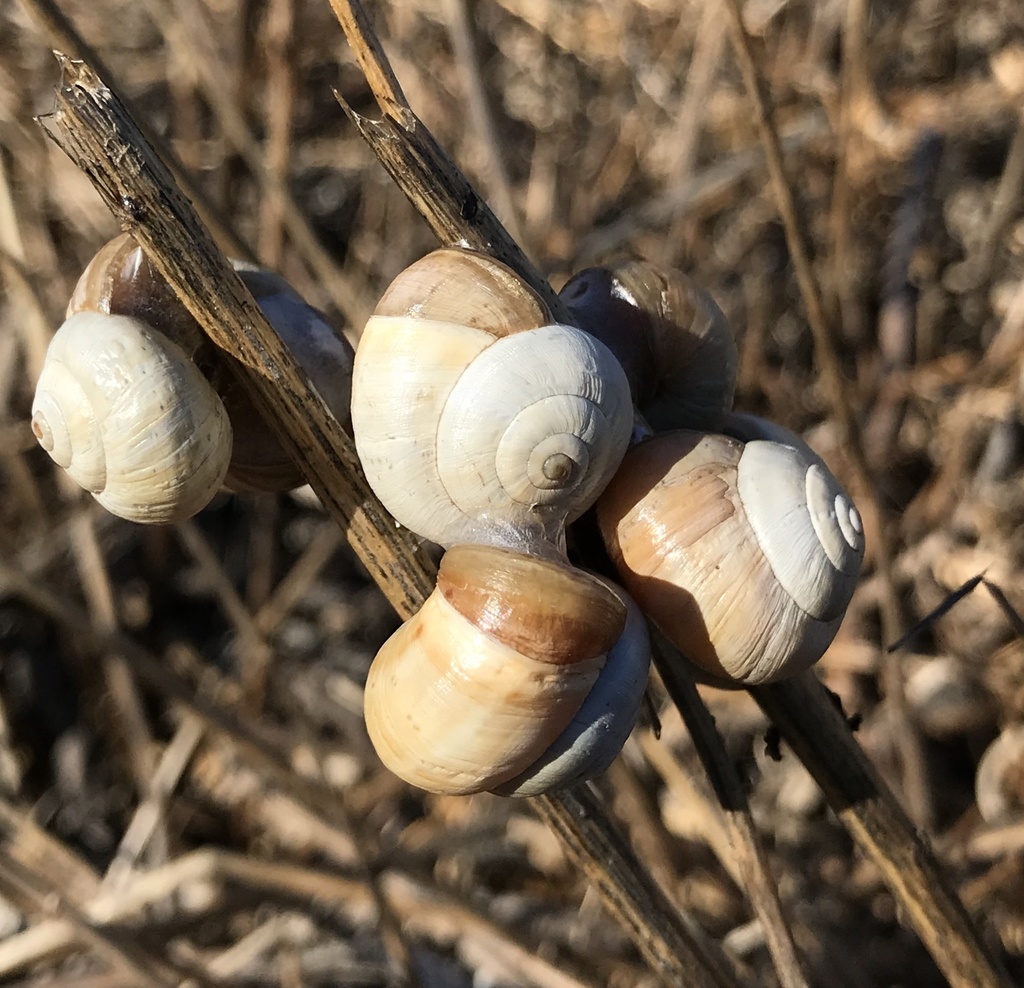
White Italian Snail
Theba pisana
Theba pisana, common names the white garden snail, sand hill snail, white Italian snail, Mediterranean coastal snail, and simply just the Mediterranean snail, is an edible species of medium-sized, air-breathing land snail, a terrestrial pulmonate gastropod mollusk in the family Helicidae, the typical snails.
This species is native to the Mediterranean region, but it has become an invasive species in many other countries. Theba pisana is a well-known agricultural pest in numerous parts of the world. The shell color varies from white to yellow-brown with light brown spiral markings.
From the article Theba pisana on Wikipedia (CC BY-SA), quoted section by section
Description
The shell background color is a creamy white. Different individuals may have shells with varying degrees of pale to dark brown markings. The markings, when present, may be in the form of uninterrupted spiral bands, spiral dotted lines, or small radial smudges. The shell can be found in various colour variants, but is basically yellow or white with dark color bands or spots and often a dark bluish grey apex. The shells of juveniles are sharply keeled, however the keel is not present on the final adult whorl. The aperture often has a lip that is light reddish on the inside, and the lip margin is only reflected at columellar side. The umbilicus is narrow and half covered by the reflected columellar margin. The apex has a characteristic size in the eastern Mediterranean when compared with other species, where there are no other Theba species. The umbilicus is also rarely seen in other species. Juveniles of Eobania vermiculata have a considerably larger apex. The width of the shell is 12–25 mm, but in Greece the adult shells are usually below 15 mm in width. The height of the shell is 9–20 mm. The visible soft parts are very light yellowish with dark colour bands running from the sides to the upper tentacles; the tentacles are very long. This snail is sometimes confused with Cernuella virgata, a species with a much smaller and less inflated shell.
Range & habitat
The species is native to the Mediterranean region. The type locality is Italy. The distribution of T. pisana includes the Mediterranean region and adjacent Atlantic coasts from central Morocco to north western Europe:
Morocco Portugal In Spain occasionally also in the interior. It is introduced to Menorca. - A subspecies, T. pisana arietina, from coastal habitats in Spain and Portugal, is on the Red List as Endangered. Italy Malta Greece Israel Egypt Algeria Belgium Central Atlantic islands The species has been introduced to numerous other areas, including:
southwestern England and south Wales, Great Britain: - introduced since at least the 1700s eastern and southern Ireland - introduced since at least the 1700s and it is still spreading along frost-free coastal localities. Netherlands - non-indigenous the United States in California parts of Africa Asia southeastern Australia, southwestern Australia and Tasmania South Africa - It was introduced into South Africa prior to 1881. It has invaded the fynbos biome in South Africa. Given the very high densities that T. pisana can attain at some sites, plus their apparently not particular feeding habits, their potential impact on the vegetation is cause for concern and should be further investigated. In many of these places T. …
Wikipedia: “Distribution”
What it does
Theba pisana usually lives in coastlands, in or near sandy habitats. In hot climates it aestivates often directly exposed to the sun, attached to grasses, shrubs or succulent plants, fence posts, tall weeds, and so on. It is common near beaches. In dunes it can live on nearly bare sand that is poorly fixed in place by grasses. In colder regions the snails do not aestivate, but they do climb on plants in dry weather. This snail does not survive serious winter frosts. Theba pisana is often associated with two other land snail species Cochlicella acuta and Cernuella virgata, but it can live slightly deeper inside pure sandy habitats, and is usually more common than Cochlicella acuta. It is one of the most common snails in coastal regions from south Portugal to Greece. In South Africa, a study showed that these snails were most abundant along roadsides; densities decreased dramatically with distance from roads. The snails were observed to be living on a variety of endemic and introduced plant species; these snails appear to be able to eat an unusually wide range of different food sources. Theba pisana is also a significant pest of citrus, vines, legume crops and cereals in South Africa. In Australia, it feeds on a range of agricultural plants. Most T. pisana snails have an annual life cycle, breeding in summer and autumn, but a few also take 2 years to mature. In aestivating T. …
Wikipedia: “Ecology”
Where it lives
Recorded sightings
—
geo-referenced records in GBIF, from museums, herbaria and field observers.
Drag the globe to turn it. Dots are where records exist, not a range map; darker means more records.
In the stacks
Searching the stacks…
Every page naming Theba pisana in the Biodiversity Heritage Library →
This page is assembled live from iNaturalist, GBIF, Wikipedia, the Source Library and the Internet Archive. It is not yet part of the hand-edited codex. iNaturalist taxon 119608.