- Animals
- ›Echinoderms
- ›Sea Stars and Brittle Stars
- ›Sea Stars
- ›Valvatacean Sea Stars
- ›Valvatidan Sea Stars
- ›Cushion Stars, Carpet Stars, and Allies
- ›Aquilonastra
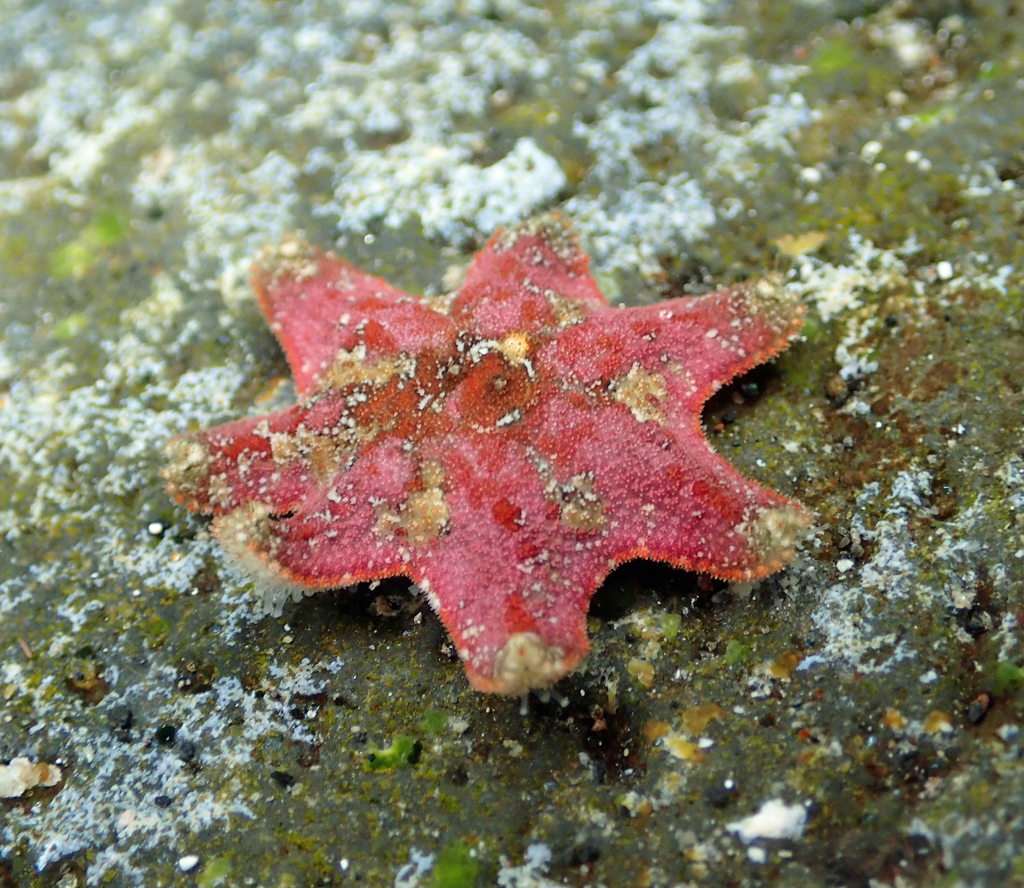
Aquilonastra conandae
Aquilonastra conandae is a species of starfish from the family Asterinidae found near the Mascarene Islands in the Indian Ocean. It is known for its asexual reproduction and is fissiparous. It is a small starfish, discrete and camouflaged, and occurs in coral reefs in the surf zone of large waves. The species was described in 2006 by Australian marine biologists P. Mark O'Loughlin and Francis Winston Edric Rowe, and gets its name from Chantal Conand.
From the article Aquilonastra conandae on Wikipedia (CC BY-SA), quoted section by section
Description
It is a very small starfish, less than 2 cm (0.79 in), with seven or eight short, rounded arms, often irregular in length. This is due to its potential of regeneration, but also to its ability to reproduce through fissiparity. The arms measure 5 mm (0.20 in) in length, and the starfish has multiple madreporites and a single spine on the interradial plates. Solitary papules are present on the top of the starfish. Spikes are present and are rough, granular, and crystalline, and are conical and prominent on the arms. It has an irregular pattern of colours, showing a grey-beige background with granular patterns of reddish or greenish.
Range & habitat
This species was first spotted at Réunion Island (south-tropical Indian Ocean) at the breakers on a coral reef at a section known as the "Watering Hole" (south of La Saline les Bains), where it is abundant. It was later identified in all the Mascarenes (mainly Mauritius and Rodrigues), where it occurs between the surface and 10 m (33 ft) but more often on the reef front and rocky cliffs, but also on volcanic flows.
Wikipedia: “Distribution”
What it does
A. conandae reproduces by fission in addition to sexual reproduction, which takes place at the beginning of the summer. The gonopores (genital openings) are located on the upper side, and the observed sex ratio is 52 males per 93 females, but some specimens are hermaphrodites.
Wikipedia: “Ecology and behaviour”
Where it lives
Recorded sightings
—
geo-referenced records in GBIF, from museums, herbaria and field observers.
Drag the globe to turn it. Dots are where records exist, not a range map; darker means more records.
In the stacks
Searching the stacks…
Every page naming Aquilonastra conandae in the Biodiversity Heritage Library →
This page is assembled live from iNaturalist, GBIF, Wikipedia, the Source Library and the Internet Archive. It is not yet part of the hand-edited codex. iNaturalist taxon 1165758.