- Animals
- ›Molluscs
- ›Gastropods
- ›Heterobranchs
- ›Euthyneura
- ›Tectipleura
- ›Eupulmonata
- ›Common Land Snails and Slugs
- ›Helicina
- ›Pupilloidei
- ›Chrysalis Snails and Allies
- ›Chrysalis Snails
- ›Pupilla
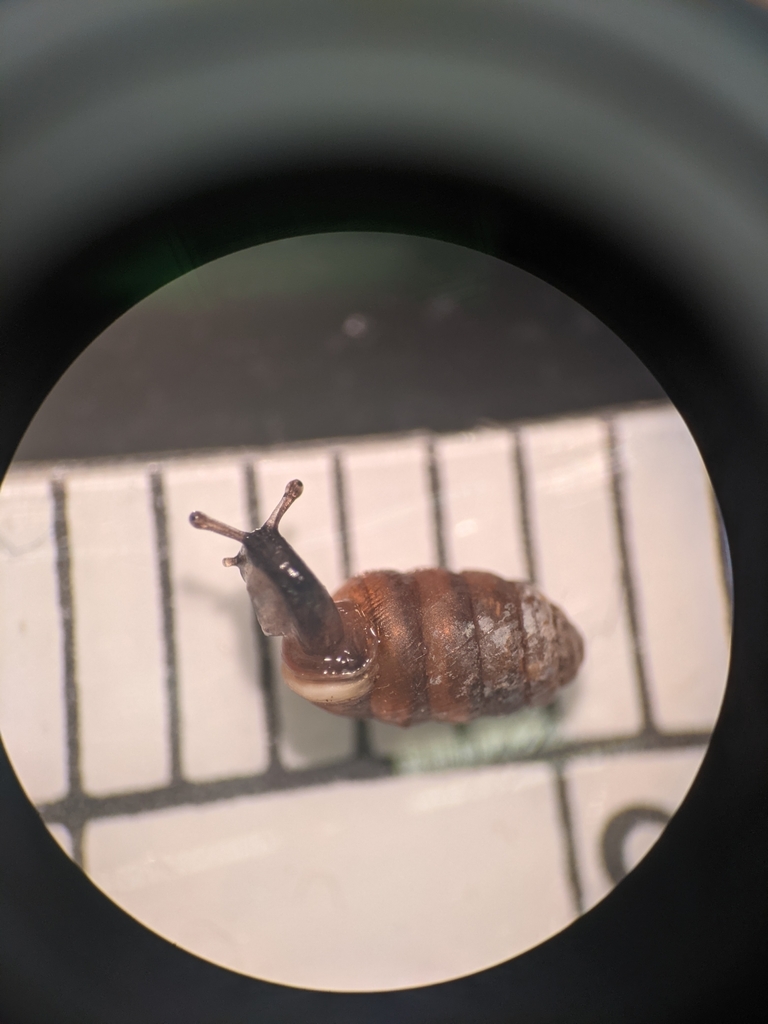
Moss Chrysalis-snail
Pupilla muscorum
Pupilla muscorum, commonly known as the Moss Chrysalis snail or widespread column, is a species of minute air-breathing land snail, a terrestrial pulmonate gastropod mollusk or micromollusk in the family Pupillidae.
From the article Pupilla muscorum on Wikipedia (CC BY-SA), quoted section by section
Description
The shell is usually light brown, varies from reddish brown to horny grey, weakly striated or almost smooth, 5–6.5 weakly convex whorls, suture not very deep (deep suture is presented in Pupilla sterrii – see picture below), aperture usually with well-developed lip, cervical callus strongly developed, like a dam, parietal tooth usually present, palatal tooth sometimes too. Pupilla muscorum differs from Pupilla pratensis with which it lives sympatrically, in its thicker, smaller and more slender shell, lighter and more variable colour and stronger apertural lip. The animal of Pupilla muscorum is small, elliptical, dark with lighter sides and foot, upper tentacles not very long, lower tentacles very short. Extant populations of P. muscorum are practically identical in shape to their ancestors, indicating that they have tracked their ecological niches over time. The height of the shell is 3.0–4.0 mm. The width of the shell is 1.65–1.75 mm (shell diameter does not vary much).
Range & habitat
This species of land snail occurs in the Northern Hemisphere including almost all of Europe. It is recorded as present in countries and islands including:
Great Britain. It is threatened by disturbance due to intensification of land use of old calcareous grasslands in Britain. Ireland lower concern in Austria. Vulnerable in Vorarlberg. lower concern in Germany, decreasing (4R) in Bavaria. Czech Republic Slovakia Ukraine and Crimea Pakistan Michigan, USA Utah, USA Vermont, USA
Wikipedia: “Distribution”
What it does
Pupilla muscorum lives in dry meadows, sand dunes, in open and sunny habitats. Calciphile. In Portugal it is found under stones, dead leaves and in mosses. In Britain it is frequent in sheep-grazed calcareous grasslands. In the Alps in up to 2,400 m (7,870 ft), in Bulgaria 1,200 m (3,940 ft). Ovoviviparous, the species is able to hibernate with its eggs, and can then release eggs with partly grown embryos during more favourable seasons.
Wikipedia: “Ecology”
Where it lives
Recorded sightings
—
geo-referenced records in GBIF, from museums, herbaria and field observers.
Drag the globe to turn it. Dots are where records exist, not a range map; darker means more records.
In the stacks
Searching the stacks…
Every page naming Pupilla muscorum in the Biodiversity Heritage Library →
This page is assembled live from iNaturalist, GBIF, Wikipedia, the Source Library and the Internet Archive. It is not yet part of the hand-edited codex. iNaturalist taxon 111372.