- Animals
- ›Molluscs
- ›Gastropods
- ›Heterobranchs
- ›Euthyneura
- ›Tectipleura
- ›Sea Butterflies
- ›Sea Angels
- ›Clionoidea
- ›Clionidae
- ›Clione
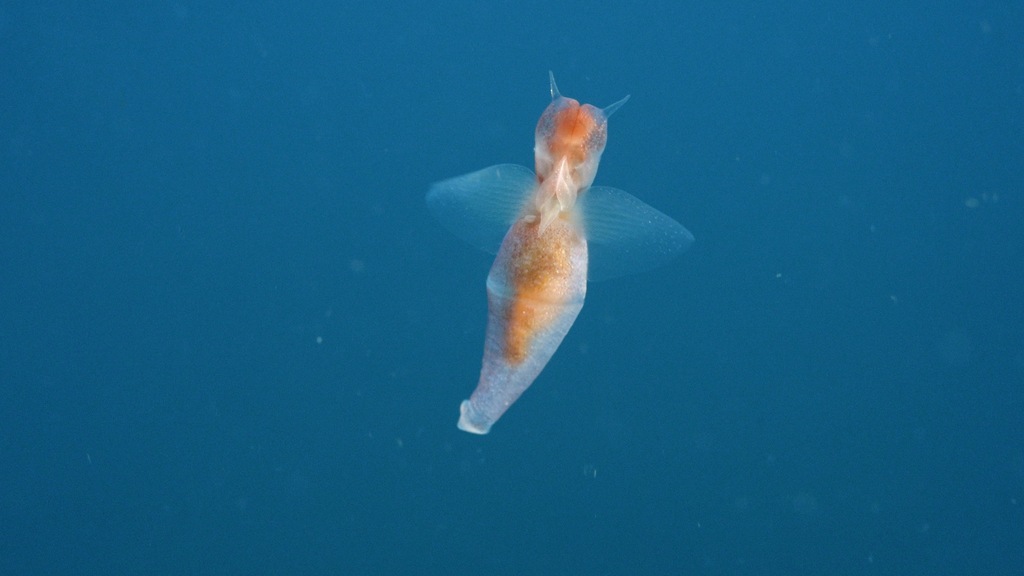
Clione antarctica
Clione antarctica is a species of "sea angel", a sea slug, a pelagic marine gastropod mollusk in the family Clionidae, the "sea angels".
From the article Clione antarctica on Wikipedia (CC BY-SA), quoted section by section
Range & habitat
The distribution of Clione antarctica is within the Southern Hemisphere, in the polar waters of Antarctica.
Wikipedia: “Distribution”
What it does
Clione antarctica is an important component of polar ecosystems. It preys upon Limacina antarctica It is itself eaten by the medusa Diplulmaris antarctica. C. antarctica has a large lipid storage capacity: up to 5% of its wet mass. It is able to survive without food for about six months by utilizing these lipid storage reserves. Clione antarctica lays eggs in the spring. This species defends itself from predators by synthesizing an ichthyodeterrent (a chemical that deters fishes); this is a previously unknown molecule called pteroenone. The sea angel acts as a "guest" for the hyperiid amphipod Hyperiella dilatata, which takes advantage of the protection provided by the gastropod's icthyodeterrent.
Wikipedia: “Ecology”
Where it lives
Recorded sightings
—
geo-referenced records in GBIF, from museums, herbaria and field observers.
Drag the globe to turn it. Dots are where records exist, not a range map; darker means more records.
In the stacks
Searching the stacks…
Every page naming Clione antarctica in the Biodiversity Heritage Library →
This page is assembled live from iNaturalist, GBIF, Wikipedia, the Source Library and the Internet Archive. It is not yet part of the hand-edited codex. iNaturalist taxon 1044710.