- Animals
- ›Arthropods
- ›Crustaceans
- ›Typical Crustaceans
- ›Malacostracans
- ›Decapods, Isopods, and allies
- ›Decapods and Krill
- ›Decapods
- ›Crabs, Lobsters, Shrimps, and Allies
- ›Spiny and Slipper Lobsters
- ›Spiny Lobsters
- ›Jasus
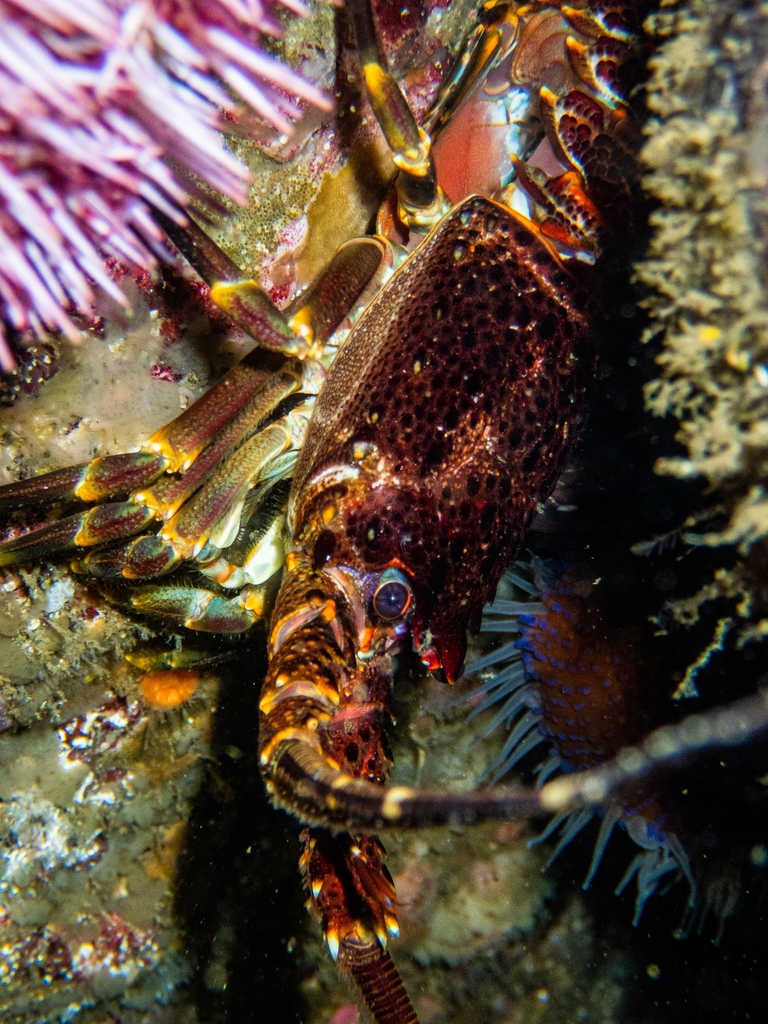
Cape Rock Lobster
Jasus lalandii
Jasus lalandii, the Cape rock lobster or West Coast rock lobster or South African rock lobster, is a species of spiny lobster found off the coast of Southern Africa. It is not known whom the specific epithet lalandii commemorates, although it may the French naturalist and taxonomer Pierre Antoine Delalande.
From the article Jasus lalandii on Wikipedia (CC BY-SA), quoted section by section
Description
Orange to red-brown, with long antennae extending from the front of the head. Tail fan orange, blue and green. Thorax spiny. Eyes black and stalked.
Range & habitat
Jasus lalandii occurs in shallow waters from Cape Cross, Namibia to Algoa Bay, South Africa, straddling the Cape of Good Hope. It may be found as deep as 46 metres (150 ft) and is usually found on rocky bottoms.
Wikipedia: “Distribution”
What it does
Generally found on rocky reefs, where it prefers the shelter of crevices. Often seen in groups with antennae protruding from the shelter. Swims backward in emergencies using the tail, but generally crawls around on the reef. Its predators include seals, sharks and large fish. It is susceptible to low oxygen levels in the water which may cause mass strandings.
Feeding. Jasus lalandii is a generalist predator and scavenger of mussels, sea urchins, abalone, barnacles, among other thing. When both abalone and sea urchins are available, rock lobsters preferentially feed on abalone. Which could be due to the higher calorific value of the sea urchins. In its choice for sea snails it selects prey below the critical size as attacking these prey is likely to involve the least risk. Small prey sea snails are opened by cracking the whole shell, while larger individuals are cracked sequentially by chipping parts of the shell until the muscular foot can be extracted. This indicates that overall J. lalandii optimizes the energetic returns from feeding while minimizing the risk involved.
Wikipedia: “Ecology”
At the table
It is called crayfish (Afrikaans: kreef) and is often braaied, particularly in the coastal areas along its range, however overfishing has depleted stocks.
Wikipedia: “Culinary use”
Where it lives
Recorded sightings
—
geo-referenced records in GBIF, from museums, herbaria and field observers.
Drag the globe to turn it. Dots are where records exist, not a range map; darker means more records.
In the stacks
Searching the stacks…
Every page naming Jasus lalandii in the Biodiversity Heritage Library →
This page is assembled live from iNaturalist, GBIF, Wikipedia, the Source Library and the Internet Archive. It is not yet part of the hand-edited codex. iNaturalist taxon 103603.