- Animals
- ›Arthropods
- ›Crustaceans
- ›Typical Crustaceans
- ›Malacostracans
- ›Decapods, Isopods, and allies
- ›Decapods and Krill
- ›Decapods
- ›Crabs, Lobsters, Shrimps, and Allies
- ›Crayfishes and Lobsters
- ›Parastacoidea
- ›Southern Hemisphere Crayfishes
- ›Euastacus
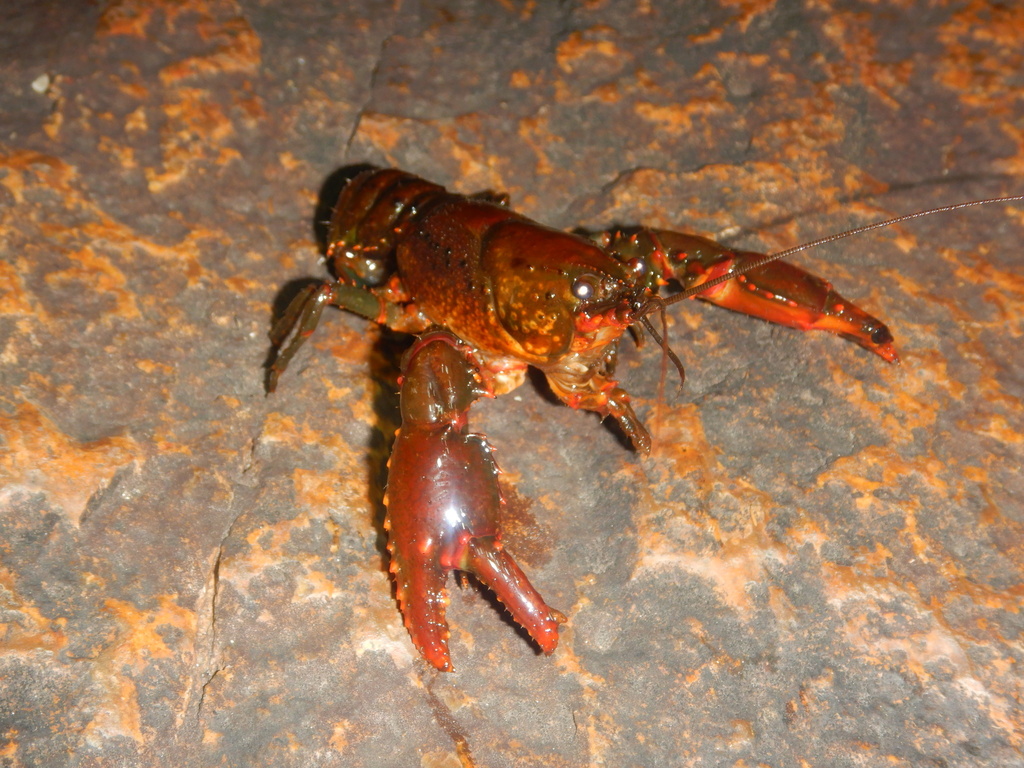
Euastacus yanga
Euastacus yanga, also known as the variable spiny cray, is a freshwater crayfish endemic to south eastern Australia.
From the article Euastacus yanga on Wikipedia (CC BY-SA), quoted section by section
Description
The maximum recorded size was 61.2 mm (2.41 in) OCL (Occipital Carapace Length) which is used to measure the species' size. The rostrum is short and in individuals over 50 mm (2.0 in) OCL usually does not reach the base of the third antenna segment. In those measuring 20–140 mm (0.79–5.51 in) OCL the rostrum is to the base or midpoint of that segment and, in some under 20 mm (0.79 in), goes to the end of the third segment. The cephalon is spiny on most organisms but less so on specimens under 20 mm (0.79 in) OCL. In southern populations the spines are larger and more numerous. Their thorax has up to 20 spines on each side in one or two irregular rows although this is usually absent on smaller individuals (under 20 mm (0.79 in) OCL). The spines are generally longer and sharper in southern populations. The tubercles are moderately to densely distributed on specimens over 30 mm (1.2 in) OCL, very sparse to moderately on smaller examples, occasionally absent. Their abdomen has one, or very occasionally, two, dorsal-lateral spines on somite 1 of individuals over 20 mm (0.79 in) OCL. Dorsal spine often present on somite 1, especially on larger specimens. Somite 2 has three to seven (very occasionally two) in lateral line 1, often absent on smaller specimens. Somites 3-5 of larger specimens, over 30 mm (1.2 in) OCL and most over 20 mm (0.79 in), have a single spine in line 1. …
Range & habitat
The variable spiny cray is found in New South Wales from the Robertson to Bundanoon area in the Southern Highlands south to just inside the Victorian border near Genoa. E. Yanga is the third most widely distributed Euastacus species behind E. armatus and E. spinifer.
Wikipedia: “Distribution”
What it does
Berried females (those that are carrying eggs) have been collected in late October through November. The eggs are burgundy with white patches where the developing embryo was located and each female carries 43 to 164.
Wikipedia: “Lifecycle/Reproduction”
Where it lives
Recorded sightings
—
geo-referenced records in GBIF, from museums, herbaria and field observers.
Drag the globe to turn it. Dots are where records exist, not a range map; darker means more records.
In the stacks
Searching the stacks…
Every page naming Euastacus yanga in the Biodiversity Heritage Library →
This page is assembled live from iNaturalist, GBIF, Wikipedia, the Source Library and the Internet Archive. It is not yet part of the hand-edited codex. iNaturalist taxon 100657.