 NL·0209
Herbarium of the Nature Library
- Name
- Tuber melanosporum
- Family
- Tuberaceae
- Native to
- Mediterranean Europe on calcareous soils: southern France, northern and central Spain, Italy; cultivated in Australia, New Zealand, Chile, USA
- Habitat
- Mediterranean woodland, Oak and hazel orchards, Calcareous scrub
Périgord black truffle
Tuber melanosporum
Also calledTruffe noire du Périgord (French) · Tartufo nero pregiato (Italian) · Trufa negra (Spanish) · Black diamond (English)
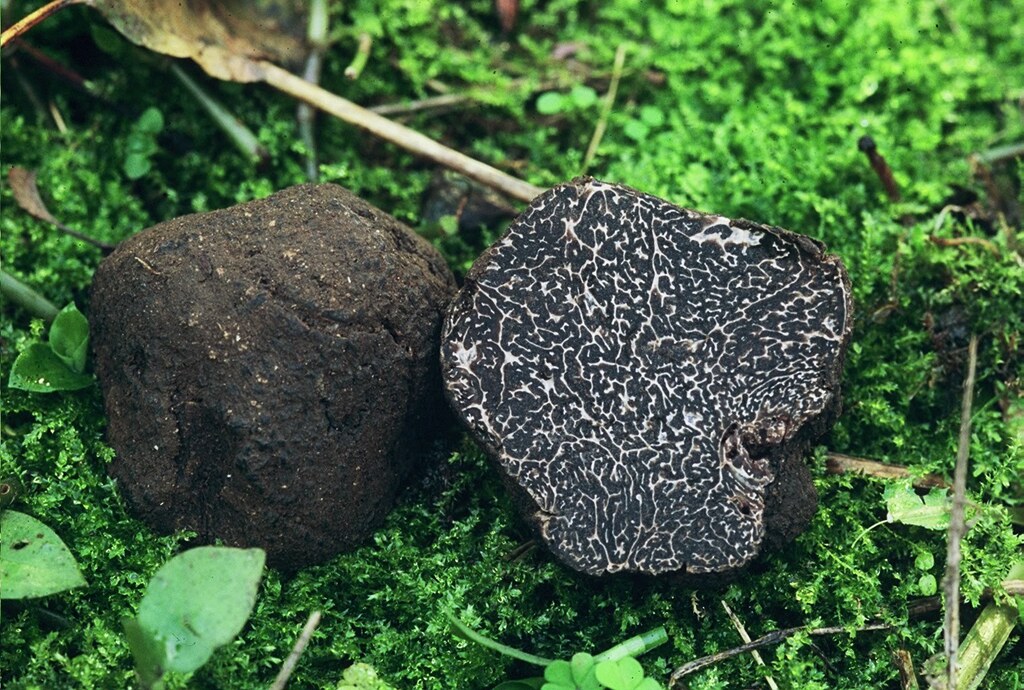
An underground, warty black fruiting body of an oak and hazel partner fungus. Its marbled flesh has an intense aroma that can sell for well over €1,000 a kilo. Since its spores cannot travel on the wind, it relies on its smell to lure mammals that dig it up and spread them.
Tuber melanosporum, commonly called black truffle, Périgord truffle or French black truffle, is a species of truffle native to Southern Europe. It is one of the most expensive edible fungi in the world. In 2013, the truffle cost between 1,000 and 2,000 euros per kilogram. Wikipedia
What it can do
- iForms ectomycorrhizae with oak (Quercus ilex, Q. pubescens) and hazel
- iiCreates 'brûlés', bare patches around host trees where it suppresses competing plants
- iiiReleases volatile compounds including dimethyl sulphide that animals can smell through soil
- ivHas two mating types and needs both to fruit, a finding (2011) now used in managing plantations
At the table
Eatenwhole fruiting body (raw shaved or lightly heated)
Prized edible. Lookalikes: earthballs (Scleroderma), toxic and hard, with dark purplish-black spore masses but no marbling; and underground Elaphomyces. Cheaper Chinese truffles (Tuber indicum) are sold fraudulently as Périgord truffles. Cut to check the fine white marbling and strong aroma.
Fruiting body & spores
Spores
Spores (not seeds) dark brown, ellipsoid, densely spiny (echinulate), about 25–45 × 20–35 µm, held 1–6 in sac-like asci inside the marbled flesh; no spore print, since it fruits underground
- Dispersal
- Eaten and dispersed by wild boar, rodents and other mammals drawn by its scent
How to cultivate it
Hardiness (USDA zones)
Roughly USDA 6–9 (mild winters, warm summers). Survives winters down to about -23 °C.
- Light
- Full sun on the orchard floor
- Water
- Summer irrigation in drought
- Soil
- Free-draining, calcareous, pH 7.5–8.3
- Propagation
- Oak or hazel seedlings inoculated with truffle in a nursery
- To harvest
- First truffles typically 5–10 years after planting
- Climates
- Mediterranean, Temperate
- 1Lime the soil to pH 7.5–8.3 and ensure excellent drainage
- 2Plant certified inoculated oak or hazel seedlings at about 4–6 m spacing
- 3Keep the ground weed-free and irrigate during summer drought
- 4From about year 5, hunt mature truffles in winter (December–March) with a trained dog
Where it lives
Recorded sightings
—
geo-referenced records in GBIF, from museums, herbaria and field observers.
Native range
Mediterranean Europe on calcareous soils: southern France, northern and central Spain, Italy; cultivated in Australia, New Zealand, Chile, USA
Drag the globe to turn it. Dots are where records exist, not a range map; darker means more records.
In the old herbals & bestiaries
Woodcuts and engravings matched from the Source Library’s scanned books by name. Plates marked “relative” show a close kin rather than this exact species. Click a plate to read the page it came from, with translation.

Book of Herbs
Hieronymus Bock (Tragus) · 1546 · p.626

Compendium of Materia Medica
李時珍 · 1596 · p.29

History of Rare Plants
Carolus Clusius · 1601 · p.454

The Ambonese Herbal, Vol. 4
Georg Eberhard Rumphius · 1743 · p.366

Histoire des Champignons de la France, Vol 2
Pierre Bulliard · 1791 · p.331

Coloured Figures of English Fungi or Mushrooms
James Sowerby · 1797 · p.842

Kinpu: An Illustrated Manual of Fungi (vol. 1)
Sakamoto Kōnen · 1835 · p.13

Illustrated Compendium of Materia Medica (Vol. 6)
吳其濬 · 1848 · p.63

Illustrated Compendium of Materia Medica (Vol. 18)
吳其濬 · 1848 · p.99

Complete Treatise on Agricultural Administration
Xu Guangqi · 1909 · p.723
In the stacks
Searching the stacks…
Every page naming Tuber melanosporum in the Biodiversity Heritage Library →
Marginalia
Brillat-Savarin called the truffle 'the diamond of the kitchen' in 'Physiologie du goût' (1825). The first truffle plantations began in Vaucluse in the early 1800s, when Joseph Talon planted acorns from truffle-producing oaks.
Curiosity
Truffle pigs were traditionally used because truffle aroma includes androstenol, a pig sex pheromone. Dogs are now preferred because they don't eat the find.
Kinship


Fact-checked: 1 correction made to this sheet. Photographs: iNaturalist contributors under the licences shown. Records: GBIF.org. Historical plates: Source Library (CC BY-SA 4.0; originals public domain). Summary text: Nature Library editors and Wikipedia (CC BY-SA). Medicinal and edibility notes are historical and educational, not advice. iNaturalist taxon 120281.