- kelp, diatoms, and allies
- ›dinoflagellates and allies
- ›Myzozoa
- ›dinoflagellates
- ›Dinophyceae
- ›Gonyaulacales
- ›Ceratiaceae
- ›Tripos
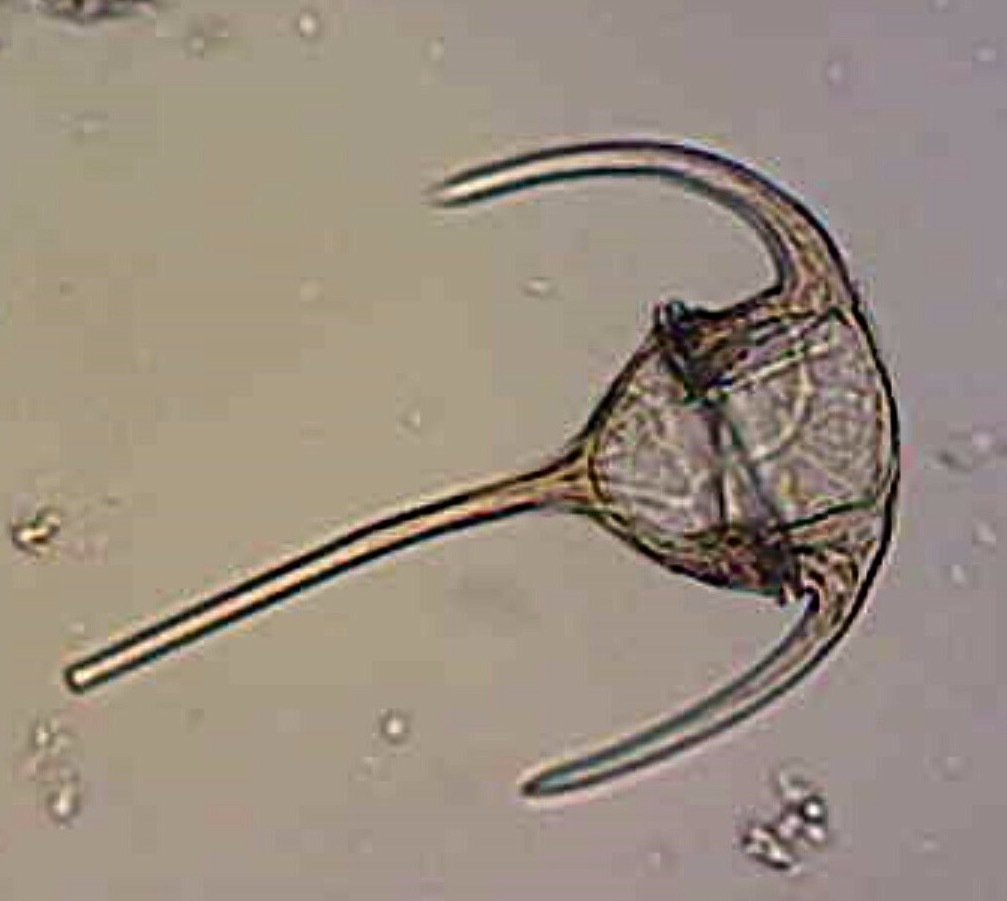
Tripos muelleri
Tripos muelleri is a species of dinoflagellates of the genus Tripos.
From the article Tripos muelleri on Wikipedia (CC BY-SA), quoted section by section
Description
This chromist is easy to recognize and identify among all the phytoplankton, because of its three horns in a pitchfork arrangement. The horn in the middle is called the apical horn, and it is used as a flagellum. The other two horns are called lateral horns, and they are solely used as an aid for flotation.
Wikipedia: “Anatomy”
Range & habitat
This species lives along all the phytoplankton on the ocean surface worldwide, where it is one of the dominant species. Despite this, it is usually solitary, although during reproduction season, several individuals may congregate, all of their apical horns join. This occurs when a cell divides, so that the daughter cells remain together, linked in short chains. This particular species may sometimes be parasitized by other chromists or protists.
Wikipedia: “Habitat”
In human culture
Tripos species were originally classified under the genus Ceratium, however they were reclassified to the new genus Neoceratium in 2009 following a ribosomal RNA sequencing study. However, since the name Neoceratium was preceded by an older name Tripos, all names were transferred to Tripos.
== References ==
Wikipedia: “History”
Where it lives
Recorded sightings
—
geo-referenced records in GBIF, from museums, herbaria and field observers.
Drag the globe to turn it. Dots are where records exist, not a range map; darker means more records.
In the stacks
Searching the stacks…
Every page naming Tripos muelleri in the Biodiversity Heritage Library →
This page is assembled live from iNaturalist, GBIF, Wikipedia, the Source Library and the Internet Archive. It is not yet part of the hand-edited codex. iNaturalist taxon 549896.