- Animals
- ›Arthropods
- ›Crustaceans
- ›Typical Crustaceans
- ›Malacostracans
- ›Decapods, Isopods, and allies
- ›Decapods and Krill
- ›Decapods
- ›Crabs, Lobsters, Shrimps, and Allies
- ›Spiny and Slipper Lobsters
- ›Spiny Lobsters
- ›Jasus
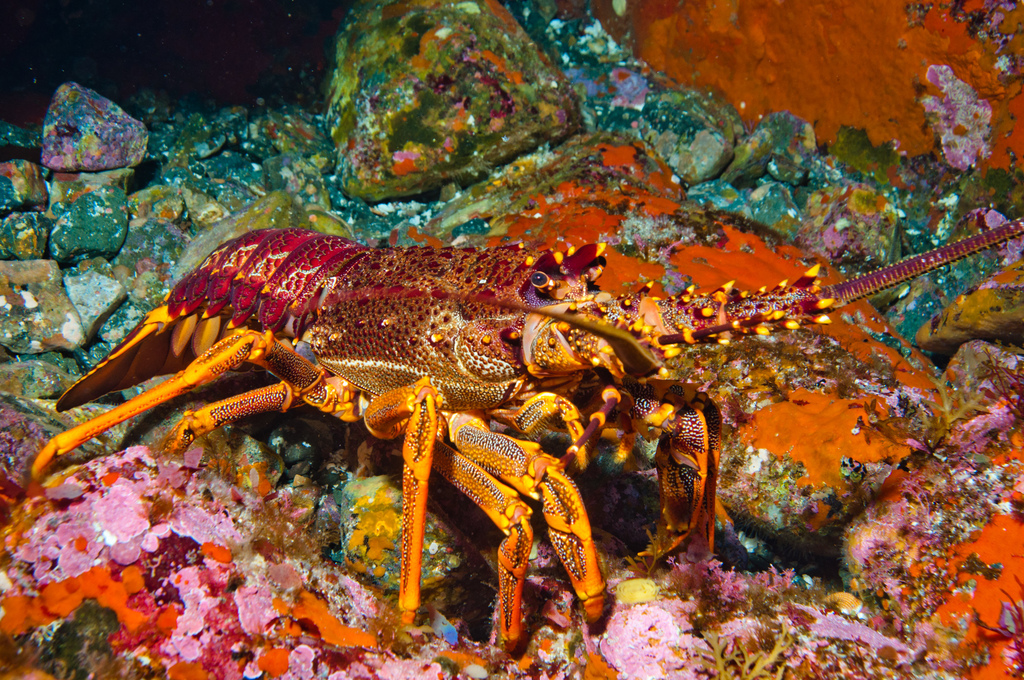
Southern Rock Lobster
Jasus edwardsii
Jasus edwardsii, the southern rock lobster, red rock lobster, or spiny rock lobster, is a species of spiny lobster found throughout coastal waters of southern Australia and New Zealand including the Chatham Islands. It is commonly called crayfish in Australia and New Zealand and kōura in Māori. They resemble lobsters, but lack the large characteristic pincers on the first pair of walking legs.
Spiny rock lobsters are carnivorous, leaving their rock cover to venture out to feed during the night. They live in and around reefs at depths ranging from 5–200 metres (16–660 ft) deep at the continental shelf. They can be dark red and orange above with paler yellowish abdomens or grey-green brown with the paler underside. The more tropical animals tend to have the brighter colours. Adult carapaces can grow up to 230 millimetres (9.1 in) in length and can often exceed 8 kilograms (18 lb) in underfished areas.
From the article Jasus edwardsii on Wikipedia (CC BY-SA), quoted section by section
Range & habitat
Jasus edwardsii is found around most of the coast of New Zealand, including the three main islands, the Three Kings Islands, the Chatham Islands, the Snares Islands, the Bounty Islands, the Antipodes Islands and the Auckland Islands. This last locality is the southernmost place where spiny lobsters occur in the world. In Australia, J. edwardsii is found around the southern coast, from central New South Wales to southern Western Australia, including Tasmania.
Wikipedia: “Distribution”
What it does
Adults are sexually mature at between 7 and 11 years, mating occurs during late summer and autumn. Eggs develop on females, which carry between 100,000 and 500,000 eggs which are fertilised and held below the tail on hairs on the female's abdomen. The eggs develop here for 3 to 5 months. Eggs then metamorphose into naupliosoma larva which leave the female and are free swimming plankton which migrate towards the surface where they moult into a phyllosoma larva. The rock lobster has among the longest larval development known for any marine creature. The phyllosoma (Greek for "leaf-like") larvae spend between 9 months to 2 years in oceanic waters before metamorphosing to the post larval stage, known as the puerulus, which then swims towards the coast to settle.
Wikipedia: “Life cycle”
At the table
Jasus edwardsii is prized by consumers in Oceania, China and South-East Asia for its sweet, succulent flesh. Like true lobster, it can be served boiled, steamed, grilled or raw. A$250 million worth are harvested every year in Australia alone.
Wikipedia: “As food”
In human culture
The potential for Jasus edwardsii to become an aquaculture species in New Zealand is high. Although not commercially farmed yet, this species of lobster has a wild seed stock available and already some commercial companies are harvesting and on growing this seed stock. The National Institute of Water and Atmospheric Research (NIWA) has reared individuals from egg to adult, showing that it is possible to grow this species in captivity, although it takes between 200 and 400 days to reach maturity. This species is also a potential aquaculture species in Australia. There is already a well established export of wild rock lobster from Australia, especially Southern Australia which currently lands just over 3000 tonnes a year. An aquaculture of this species would serve to bulk up the wild catch and add value with high quality grown lobsters. South Australia currently does have limited aquaculture of Jasus edwardsii, keeping legal sized individuals from the fishery in cages in Kangaroo Island to make them available in the off season, ensuring a year-round supply to market, although no aquaculture from juveniles or eggs is done yet.
Food. NIWA used primarily brine shrimp to feed the juvenile lobsters, but little is known about a preferred food source. Chopped up mussel flesh has been used previously in Japan. …
Wikipedia: “Aquaculture”
Where it lives
Recorded sightings
—
geo-referenced records in GBIF, from museums, herbaria and field observers.
Drag the globe to turn it. Dots are where records exist, not a range map; darker means more records.
In the stacks
Searching the stacks…
Every page naming Jasus edwardsii in the Biodiversity Heritage Library →
This page is assembled live from iNaturalist, GBIF, Wikipedia, the Source Library and the Internet Archive. It is not yet part of the hand-edited codex. iNaturalist taxon 103601.