- Animales
- ›Cordados
- ›Vertebrados
- ›Reptiles
- ›Lagartos y serpientes
- ›Serpientes y culebras
- ›Víboras y parientes
- ›Víboras del Viejo Mundo
- ›Bitis
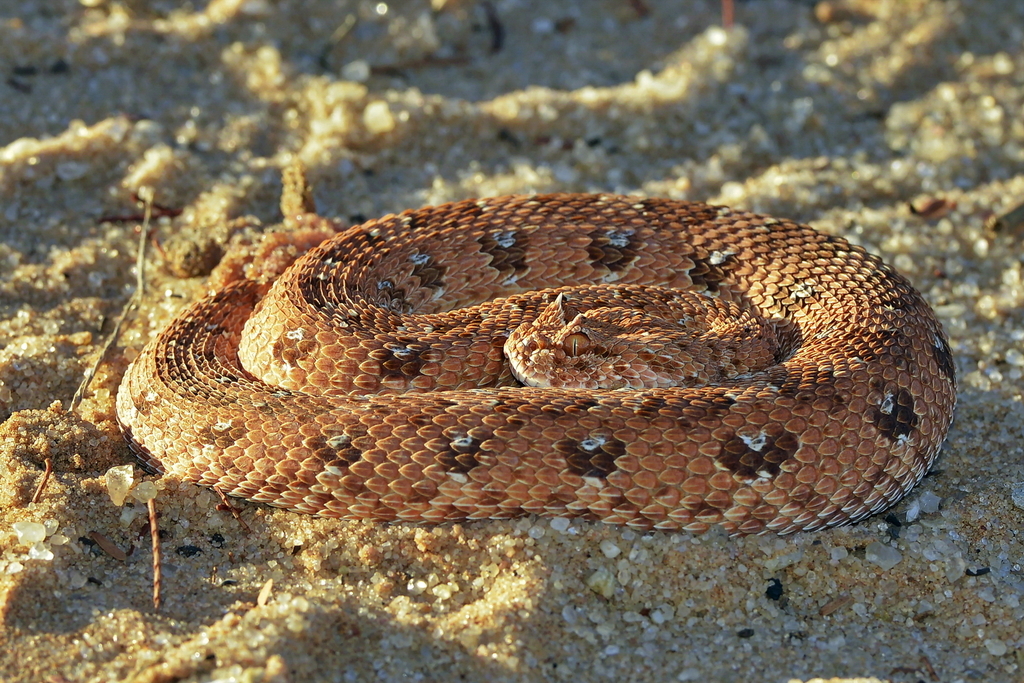
Víbora Cornuda Africana
Bitis caudalis
The horned adder (Bitis caudalis) is a viper species. It is found in the arid region of southwest Africa, in Angola, Botswana, Namibia; South Africa, and Zimbabwe. It is easily distinguished by the presence of a single, large horn-like scale over each eye. No subspecies are currently recognized. Like all other vipers, it is venomous.
Del artículo Horned adder de Wikipedia (CC BY-SA), citado sección por sección
Descripción
A short, stout little viper, it usually averages 30–40 cm (12–15.5 in) in total length (body + tail). The largest specimen reported being seen is a female from southern Botswana measuring 51.5 cm (20.3 in) total length.
Wikipedia: «Description»
Distribución y hábitat
The snake is found in far arid regions of southwest Africa: southwest Angola, Namibia, across the Kalahari Desert of southern Botswana, into northern Transvaal and southwestern Zimbabwe. In South Africa, it is found from the Northern Cape province south to the Great Karoo. Its type locality is given as "... the sandy districts north of the Cape Colony..." [South Africa].
Wikipedia: «Geographic range»
Toxicidad
Bites are assumed to be rare and no epidemiological data is available. Little information is available regarding the toxicity and amount of venom produced. Spawls and Branch (1995) reported an average yield of 85 mg of wet venom, while Christensen (1971) offered an LD50 value of 1.2 mg/kg IV. Other research has found the LD50 to be between 0.15 and 0.22 mg/kg Based on this LD50 value, Spawls and Branch (1995) estimated about 300 mg of this venom would be required to kill an adult. They regarded this venom as one of the weakest of the genus, although the tests are conducted solely on mice, which might have a different reaction from humans to the venom. On the other hand, an older report by the U.S. Navy (1965, 1991) suggested it is highly toxic and a number of deaths have occurred as a result. According to Broadley and Cock (1975), envenomation symptoms in humans include swelling, severe pain, nausea, vomiting and shock. Blisters and necrotic ulcers may form around the bite site. The National Antivenom and Vaccine Production Centre in Riyadh, Saudi Arabia, produces a polyvalent antivenin that includes a paraspecific antibody that protects against bites from this species. According to the U.S. Navy (1965, 1991), polyvalent antivenins produced by SAIMR and the Pasteur Institute are said to be effective, while Mallow et al. …
Wikipedia: «Venom»
Dónde vive
Avistamientos registrados
—
registros georreferenciados en GBIF, de museos, herbarios y observadores de campo.
Arrastra el globo para girarlo. Los puntos marcan dónde hay registros, no un mapa de distribución; más oscuro significa más registros.
En los depósitos
Buscando en los depósitos…
Todas las páginas que nombran Bitis caudalis en la Biodiversity Heritage Library →
Esta página se compone en directo a partir de iNaturalist, GBIF, Wikipedia, la Source Library y el Internet Archive. Aún no forma parte del códice editado a mano. Taxón 95802 de iNaturalist.