- Animales
- ›Insectos, arácnidos y crustáceos
- ›Quelicerados
- ›Arañas, alacranes, ácaros y parientes
- ›Arañas
- ›Arañas verdaderas
- ›Entelegynae
- ›Arañas tejedoras
- ›Arañas tejedoras de cuerpo alargado
- ›Tetragnathinae
- ›Tetragnatha
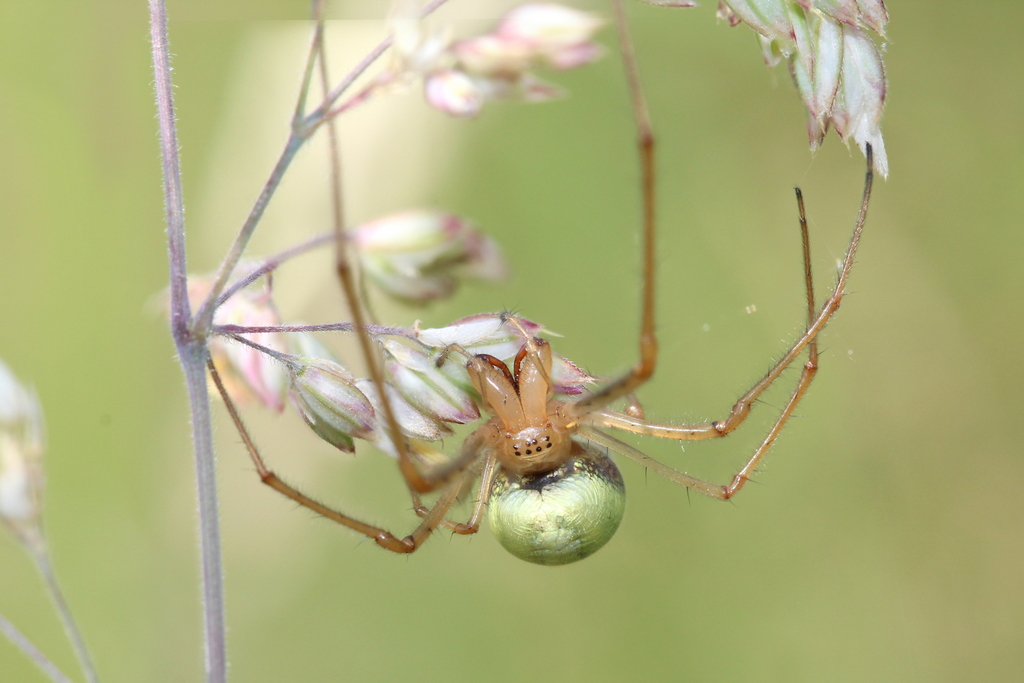
Tetragnatha montana
Tetragnatha montana, commonly known as the silver stretch spider, is a species of long-jawed orb weaver from the family Tetragnathidae that has a Palearctic distribution. It preys mostly on flies and mosquitoes. The name silver stretch spider refers to its shiny metallic colour and its habit of extending its legs into a stick like shape.
Del artículo Tetragnatha montana de Wikipedia (CC BY-SA), citado sección por sección
Descripción
The female Tetragnatha montana is larger than the male with a body length of 7–13 mm compared to the male's 6–8 mm. The male has a paracymbium (a genital appendage arising from the base of the cymbium) with a mostly hook-shaped lateral process. In the female, the epigyne has straight or convex posterior margin of epigynal plate. The prosoma is yellow-brown and the sternum is dark brown to black. It has yellow-brown chelicerae, with a small round tubercle adjacent to the dorsal tooth of the male chelicerae. The legs are yellow-brown and the opisthosoma is silver on the dorsal surface with an elongated, silver-white leaf shape outlined in gold with golden wavy borders along the margins and black lines that can sometimes be quite thick with a brown ventral surface. The male has very similar markings on the abdomen to the female but it is a darker, reddish-gold and the colour contrasts are less noticeable than those on the female, and the white or silvery areas are much less extensive. The male's ventral side is brown, with undulating borders and a darker band running along it. The legs differ significantly between the sexes in their length, colour and shape, those of the female being brown, beige or yellow-brown in colour, while those of the male are darker. …
Wikipedia: «Description»
Distribución y hábitat
T. montana is widespread throughout a large part of the Palearctic from Western Europe to East Asia and is the most frequently occurring species of Tetragnatha in many parts of Europe. as far north as southern Norway and south to Iran. In Great Britain it is widespread in the south, becoming localised in the north. T. montana webs are found on trees, bushes and low vegetation in a variety of mostly lowland habitats. The webs may be found close to water but it is less closely associated with wetland habitats than its congener Tetragnatha extensa.
Wikipedia: «Distribution and habitat»
Lo que hace
The adults of T. montana appear in the open from May to September although the first to appear as early as February. Their main prey is flies and mosquitoes. These are caught in the spider's orb-web, which is an upright web formed of threads radiating from a central point, crossed by radial links that spiral in from the margin, between branches and stems on trees, bushes and low vegetation. The spider sits stretched out, near the web, waiting for the prey, difficult to detect due to the stick like shape adopted. If an insect flies into the web it is caught in the silk and the spider bites it injecting venom which liquifies the prey's internal organs. The spider then wraps the insect in silk like a parcel and stores it close to the web. The spider then repairs the web. When T. montana is at rest, or when it is alarmed it adopts the distinctive elongated posture used by species within the genus Tetragnatha, stretching their two pairs of front legs out beyond the head and the rear pair extending backwards. This together with their drab colouration and thin bodies, can be an effective camouflage. One study showed that mosquitoes formed over 60% of the food items of T. …
Wikipedia: «Behaviour»
Dónde vive
Avistamientos registrados
—
registros georreferenciados en GBIF, de museos, herbarios y observadores de campo.
Arrastra el globo para girarlo. Los puntos marcan dónde hay registros, no un mapa de distribución; más oscuro significa más registros.
En los depósitos
Buscando en los depósitos…
Todas las páginas que nombran Tetragnatha montana en la Biodiversity Heritage Library →
Esta página se compone en directo a partir de iNaturalist, GBIF, Wikipedia, la Source Library y el Internet Archive. Aún no forma parte del códice editado a mano. Taxón 319829 de iNaturalist.