- Animales
- ›Insectos, arácnidos y crustáceos
- ›Hexápodos
- ›Insectos
- ›Insectos alados
- ›Mariposas y polillas
- ›Polillas búho
- ›Polillas Búho
- ›Noctuinae
- ›Prodeniini
- ›Spodoptera
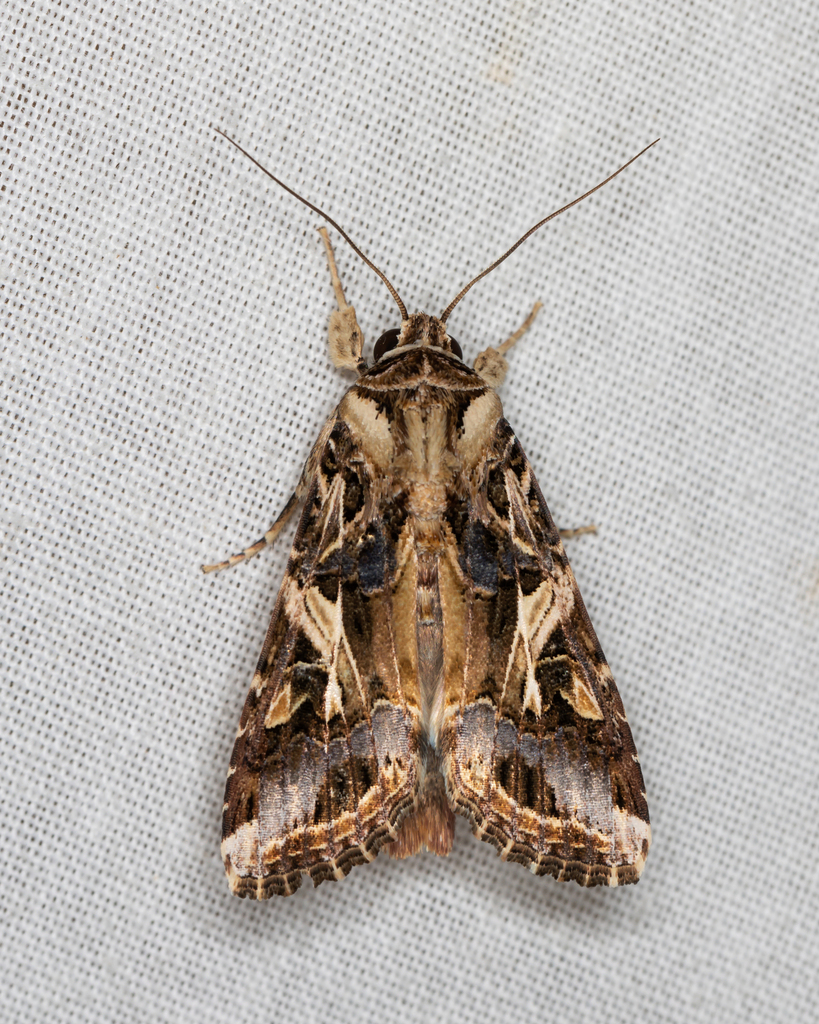
Gusano oriental de la hoja
Spodoptera litura
Spodoptera litura, otherwise known as the tobacco cutworm or cotton leafworm, is a nocturnal moth in the family Noctuidae. S. litura is a serious polyphagous pest in Asia, Oceania, and the Indian subcontinent that was first described by Johan Christian Fabricius in 1775. Its common names reference two of the most frequent host plants of the moth. In total, 87 species of host plants that are infested by S. litura are of economic importance. The species parasitize the plants as larvae through vigorous eating patterns, oftentimes leaving the leaves completely destroyed. The moth destroys economically important agricultural crops and decreases yield in some plants completely. Their potential impact on the many different cultivated crops, and subsequently the local agricultural economy, has led to serious efforts to control the pests.
S. litura is often confused with its close relative, Spodoptera littoralis. These two species are hard to discriminate between because the larvae and adult forms are identical. Inspecting the genitalia is the most certain way to tell the two species apart.
Del artículo Spodoptera litura de Wikipedia (CC BY-SA), citado sección por sección
Descripción
There are slight but obvious differences in morphology between males and females of S. litura that allow for the easy differentiation of the two sexes. Male forewing length is 14–17 millimetres (1⁄2–5⁄8 in) while female forewing length is slightly larger and measures 15–18 millimetres (5⁄8–3⁄4 in). The orbicular spot on the forewing is also more pronounced in the males.
Wikipedia: «Morphology»
Distribución y hábitat
S. litura is the most common in South Asia. However, its natural range extends from the Oriental and Australasian areas to parts of the Palearctic region as well. The countries with the most widespread population of S. litura include but are not limited to China, Indonesia, India, Japan, and Malaysia. The range of S. litura has also extended into non-indigenous regions through international trade. Moths in their egg, larvae, or pupae stages can be present in the soil, flower, or vegetation that are being transported across various regions. Pupae especially can be moved long distances, provided that they are not crushed, because of the relatively long pupation period.
Wikipedia: «Range»
Lo que hace
Although the length of a life cycle varies slightly throughout the different regions, a typical S. litura will complete 12 generations every year. Each generation lasts about a month, but temperature causes slight variations: life cycles in the winter tend to be slightly more than one month, and life cycles in the summer tend to be less than a full month.
Egg. Eggs are spherical and slightly flattened. Each individual egg is around 0.6 mm in diameter with an orange-brown or pink color. These eggs are laid on the surface of leaves in big batches, with each cluster usually containing several hundred eggs. Females have a typical fecundity of 2000 to 2600 eggs. However, experiments have shown that high temperatures and low humidity are inversely related to fecundity. When laid, the egg batches are covered with hair scales provided by the female, which gives off a golden brown color. Egg masses are 4–7 millimetres (5⁄32–35⁄128 in) in total diameter, and eggs will hatch 2–3 days after being laid.
Larva. Larvae body length ranges from 2.3 millimetres (23⁄256 in) to 32 millimetres (1+1⁄4 in). The larva is variable in color based on age. Younger larvae tend to be a lighter green while older ones develop to a dark green or brown color. A bright yellow stripe along the dorsal surface is a characteristic feature of the larvae. The larvae also have no hair. …
Wikipedia: «Life cycle»
En la mesa
Regulation of macro nutrient input differs between males and females. Experimental results show that when S. litura are presented with two nutritionally complementary diet options, one rich in protein and a second rich in carbohydrates, females tend to consume more protein than males while no differences in carbohydrates exist. Body utilization of the macro nutrients differed as well. Females were very efficient at converting the protein consumed into body growth and mass, reflecting the bodily requirements to produce eggs. Males, on the other hand, were more efficient at depositing lipid from ingested carbohydrates. This fits in well with the migration patterns associated with mating. Males usually go out to find females during mating season, so the lipid deposits are thought to be energy reserves that will help the males in preparation for the migration.
Wikipedia: «Differences in food regulation»
Escuchar
Buscando grabaciones de campo…
Dónde vive
Avistamientos registrados
—
registros georreferenciados en GBIF, de museos, herbarios y observadores de campo.
Arrastra el globo para girarlo. Los puntos marcan dónde hay registros, no un mapa de distribución; más oscuro significa más registros.
En los depósitos
Buscando en los depósitos…
Todas las páginas que nombran Spodoptera litura en la Biodiversity Heritage Library →
Esta página se compone en directo a partir de iNaturalist, GBIF, Wikipedia, la Source Library y el Internet Archive. Aún no forma parte del códice editado a mano. Taxón 124875 de iNaturalist.