- Animales
- ›Cordados
- ›Vertebrados
- ›Peces con aletas radiadas
- ›Acanthomorpha
- ›Lophiiformes
- ›Ceratioidei
- ›Linophrynidae
- ›Linophryne
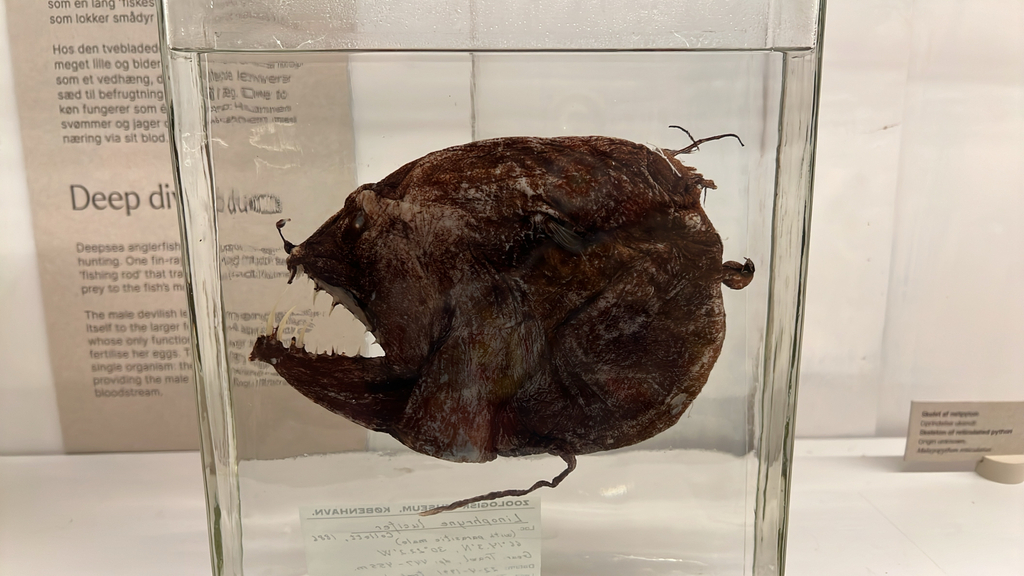
Linophryne lucifer
Linophryne lucifer, one of the species known as the bearded anglerfish, is a species of marine ray-finned fish belonging to the family Linophrynidae, the leftvents, a group of deep water anglerfishes. This species, the type of genus Linophryne, is found in the North Atlantic Ocean.
Del artículo Linophryne lucifer de Wikipedia (CC BY-SA), citado sección por sección
Descripción
Linophryne lucifer, like other deep sea anglerfishes is sexually dimorphic. The metamorphosed females are distinguished from those of related species having an illicium which has a length equivalent to between 10% and 30% of the standard length. This is tipped with an esca which has a short conical projection at its tip which has between 2 and 8 thick filaments on it. There is another small appendage to the rear of the escal pore. The hyoid barbel has a length that is equivalent to between 40% and 75% of the standard length and has two blade shape appendages towards its tip, these have a length of between 6% and 17% of the standard length. The barbel appendages have a few photophores at their tips. The males are sexual parasites and have well-developed sphenotic spines. The maximum published standard length for a female of this species is 27.5 cm (10.8 in), while for a male it is 2.9 cm (1.1 in).
Wikipedia: «Description»
Distribución y hábitat
Linophryne lucifer is found in the North Atlantic Ocean which has been collected from the costs of Madeira, Newfoundland and Iceland. It is a bathypelagic species that has been recorded at depths between 0 and 1,000 m (0 and 3,281 ft), typically between 300 and 600 m (980 and 1,970 ft).
Wikipedia: «Distribution and habitat»
En la cultura humana
Linophryne lucifer is the type species of the genus Linophryne, an name which prefixes linos, which means "net", an allusion Collett did not explain when he proposed the genus, with phryne, meaning "toad". The prefix may be a reference to the sac like mouth hanging off the trunk, which in the holotype contained a lanternfish, like a fisherman's keep net. The second part phryne is commonly used in the names of anglerfish genera. Its use may date as far back as Aristotle and Cicero, who referred to anglerfishes as "fishing-frogs" and "sea-frogs," respectively, possibly because of their resemblance to frogs and toads. The specific name, lucifer, means "light bearer", an allusion to the hyoid barbel, Collett correctly suspected that the barbel is phosphorescent in life, although it is more properly called bioluminescent. The name "forkbarbelthroat" was coined by D. E. McAllister in his 1990 book A List of the Fishes of Canada, being one of many common names he conceived in the book (French: gorge à barbe fourchue). These common names were subsequently used in the Encyclopedia of Canadian Fishes by Brian W. Coad. In a review of Coad's book, Erling Holm remarked that many of the names coined by Mcallister differed significantly from the standard set by Robins et al., deemed widely accepted, and promoted by the Committee on Names of Fishes. …
Wikipedia: «Etymology»
Dónde vive
Avistamientos registrados
—
registros georreferenciados en GBIF, de museos, herbarios y observadores de campo.
Arrastra el globo para girarlo. Los puntos marcan dónde hay registros, no un mapa de distribución; más oscuro significa más registros.
En los depósitos
Buscando en los depósitos…
Todas las páginas que nombran Linophryne lucifer en la Biodiversity Heritage Library →
Esta página se compone en directo a partir de iNaturalist, GBIF, Wikipedia, la Source Library y el Internet Archive. Aún no forma parte del códice editado a mano. Taxón 104635 de iNaturalist.