- Fungi Including Lichens
- ›Basidiomycete Fungi
- ›Higher Basidiomycetes
- ›Mushrooms, Bracket Fungi, Puffballs, and Allies
- ›Hymenochaetales
- ›Hymenochaetaceae
- ›Fuscoporia
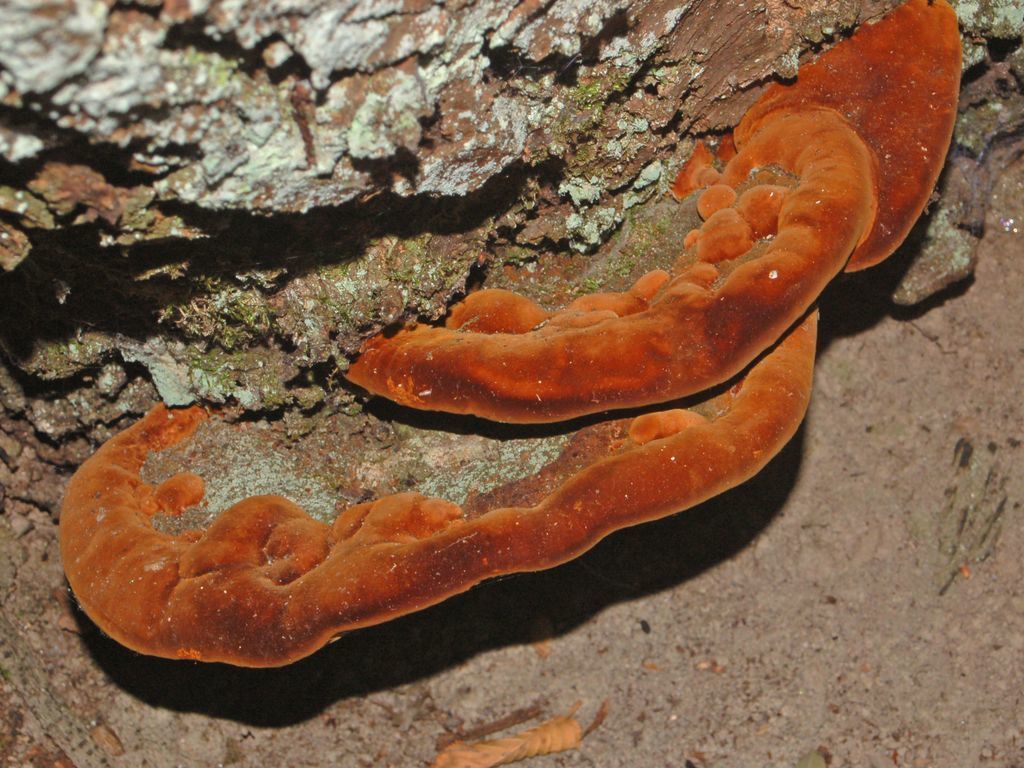
Tufted Bracket
Fuscoporia torulosa
Fuscoporia torulosa, the tufted bracket, is a species of bracket fungus in the genus Fuscoporia, family Hymenochaetaceae. A wood-decay fungus, it causes a white rot of heartwood in dead and living hardwood trees in Europe, and in coniferous trees in North America.
From the article Fuscoporia torulosa on Wikipedia (CC BY-SA), quoted section by section
Description
The fruiting bodies of this species are semicircular or shell-shaped, with dimensions of 12–30 centimetres (4+1⁄2–12 in) broad by 4–10 cm (1+1⁄2–4 in) long. The brackets are typically 1–3 cm (1⁄2–1 in) thick, although it can be considerably thicker at the point of the broad attachment to the tree. Ryvarden and Gilbertson give maximum fruiting body dimensions of 46 cm (18 in) wide by 28 cm (11 in) long by 11 cm (4+1⁄2 in) thick. The fruiting body margin is rounded, and sometimes wavy, felt-like or tomentose on the flattened upper surface, which is typically orange-brown to rusty-brown in color. The color of the lower pore-bearing surface is cinnamon-, rust-, or olivaceous-brown, and there are 5 to 6 pores per millimetre.
Microscopic features. Basidiospores are ovoid or ellipsoid, hyaline, smooth, with dimensions of 4–6 × 3–4 μm. The basidia are club-shaped, 4-spored, with dimensions of 14–16 × 5–6 μm.
Modern identification techniques. Production of visible fruiting bodies by F. torulosa does not happen until long after the tree has been initially infected, as it takes some time for the fungal mycelia to colonize the host. For this reason it often escapes detection until it is too late to save the tree. …
Range & habitat
Although its preferred host is Quercus, Fuscoporia torulosa has been reported growing on a variety of hardwood trees: Acer, Arbutus, Calluna, Castanea, Celtis, Ceratonia, Cercis, Cistus, Citrus, Cornus, Crataegus, Cydonia, Erica, Eucalyptus, Euonymus, Fagus, Fraxinus, Grevillea, Helianthemum, Juglans, Laurus, Malus, Melaleuca, Morus, Myrtus, Olea, Ostrya, Parrotia, Phillyrea, Pistacia, Pittosporum, Populus, Prunus, Punica, Pryus, Robinia, Rosa, Salix, Spartium, Ulex, Ulmus, Viburnum, Vitis, and more rarely, conifers like Cedrus, Cupressus, Larix, Picea, and Pinus. Recently, F. torulosa has been reported as infecting more than 160 species of plants; most of these infections results in the plant's premature death.
Wikipedia: “Habitat and distribution”
Where it lives
Recorded sightings
—
geo-referenced records in GBIF, from museums, herbaria and field observers.
Drag the globe to turn it. Dots are where records exist, not a range map; darker means more records.
In the stacks
Searching the stacks…
Every page naming Fuscoporia torulosa in the Biodiversity Heritage Library →
This page is assembled live from iNaturalist, GBIF, Wikipedia, the Source Library and the Internet Archive. It is not yet part of the hand-edited codex. iNaturalist taxon 995149.