- Fungi Including Lichens
- ›Basidiomycete Fungi
- ›Higher Basidiomycetes
- ›Mushrooms, Bracket Fungi, Puffballs, and Allies
- ›Agaricomycetidae
- ›Common Gilled Mushrooms and Allies
- ›Agaricineae
- ›puffballs
- ›Apioperdon
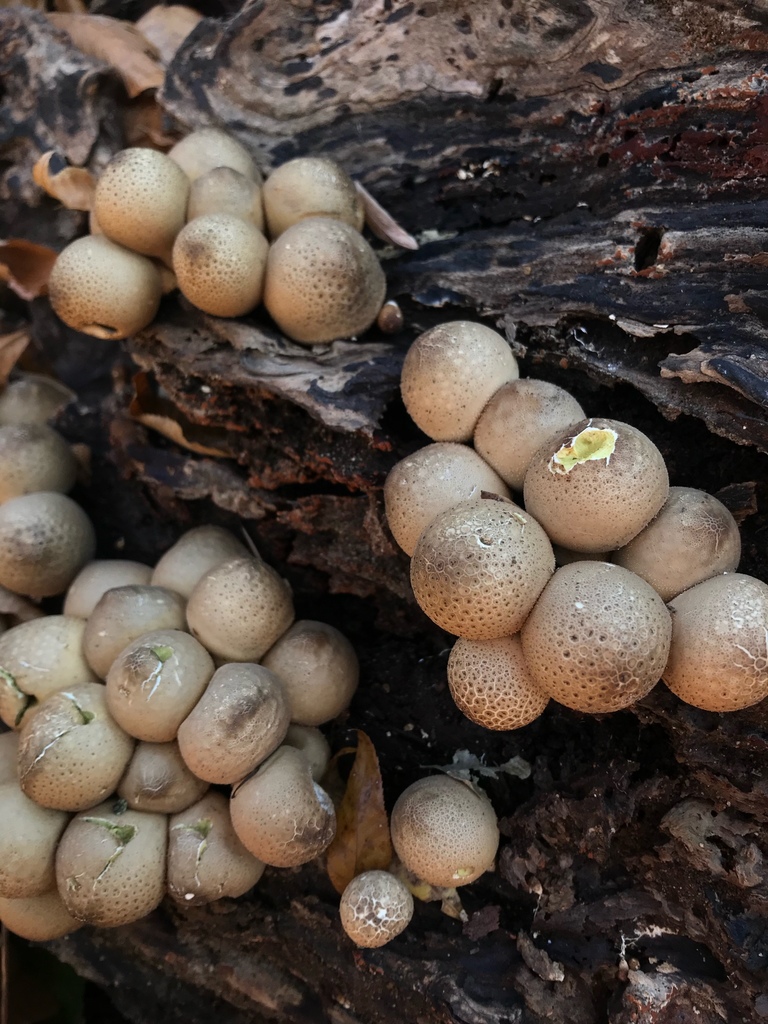
Pear-shaped Puffball
Apioperdon pyriforme
Apioperdon pyriforme commonly known as the pear-shaped puffball or stump puffball, is a saprobic fungus present throughout much of the world. Emerging in autumn, this puffball is common and abundant on decaying logs of both deciduous and coniferous wood. It is considered a choice edible when still immature and the inner flesh is white. It is often called Lycoperdon pyriforme, but was transferred to Apioperdon in 2017 based on phylogenetic and morphological differences. It is the...
From the article Apioperdon on Wikipedia (CC BY-SA), quoted section by section
Description
The fruit body of the pear-shaped puffball measures up to 3 centimetres (1+1⁄4 in) wide and 6 cm (2+1⁄4 in) tall. They are often pear-shaped as the name suggests, but they may also be nearly spherical. When very young they are covered in small white spines that typically fall off before maturity. A small developing pore may be visible at the top, while the sterile base of the mushroom is small and appears to be pinched in. Colour ranges from nearly white to yellowish brown with the darker shades developing with age, though the base remains white. The central pore ruptures at late maturity to allow the wind and rain to disperse the spores. The base is attached to the wood by means of rhizomorphs (thick, cord-like strands of mycelium).
The gleba, or inner spore mass, is white when young, but it becomes greenish-yellow to dark olive-brown with age. The spores measure 3 to 4.5 μm and are round, smooth and a dark olive-brown in colour.
Similar species. The closely related common puffball, Lycoperdon perlatum is a similar-appearing species, as are the poisonous, unrelated common earthball, Scleroderma citrinum and other species of Scleroderma.
Range & habitat
It can be found throughout Europe from July to December. In western North America, it appears from fall to winter. It grows on decaying wood.
Wikipedia: “Distribution and habitat”
At the table
The fungus is a choice edible when still immature and the inner flesh is white. Additionally, one guide says that the puffballs are edible when densely fruited. They can be used fresh, or cut into thin slices for drying, which can then be pulverized for use as a flavoring powder. Caution should be used as similar-looking species in Scleroderma (such as S. citrinum) are poisonous.
Wikipedia: “Edibility”
Where it lives
Recorded sightings
—
geo-referenced records in GBIF, from museums, herbaria and field observers.
Drag the globe to turn it. Dots are where records exist, not a range map; darker means more records.
In the old herbals & bestiaries


In the stacks
Searching the stacks…
Every page naming Apioperdon pyriforme in the Biodiversity Heritage Library →
This page is assembled live from iNaturalist, GBIF, Wikipedia, the Source Library and the Internet Archive. It is not yet part of the hand-edited codex. iNaturalist taxon 972793.