- Fungi Including Lichens
- ›Ascomycete Fungi
- ›Sac Fungi and Lichens
- ›Common Lichens
- ›Shield Lichens, Sunburst Lichens, Rosette Lichens, and Allies
- ›Peltigerales
- ›Pannariaceae
- ›Pannaria
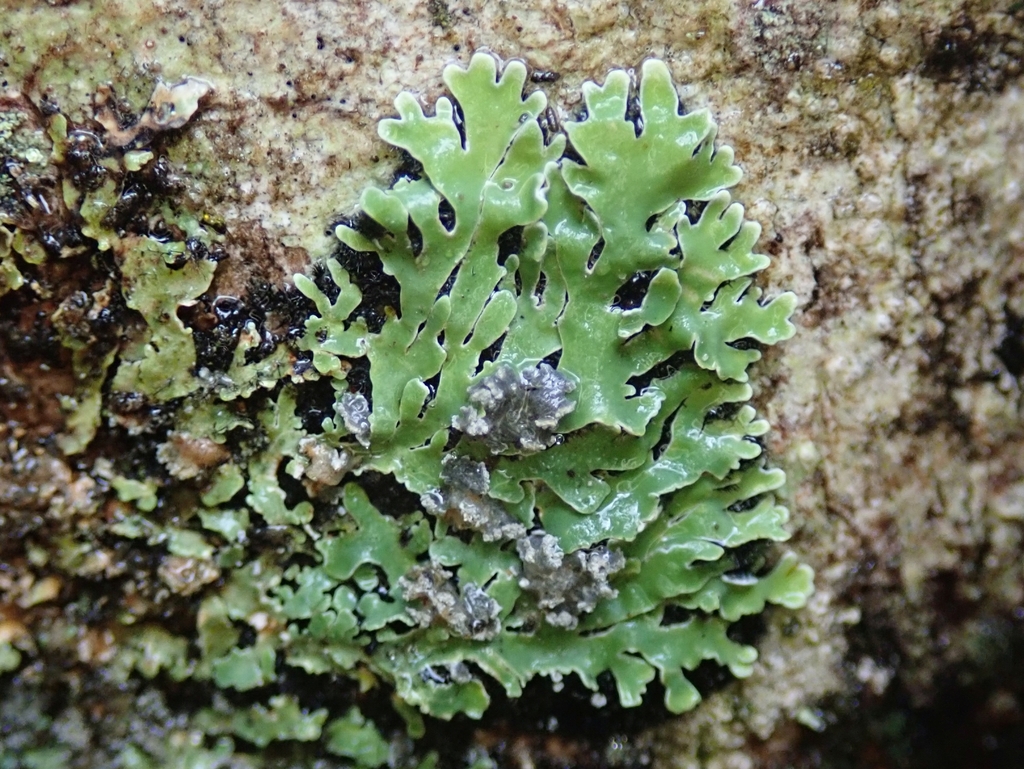
Pannaria durietzii
Pannaria durietzii is a species of corticolous (bark-dwelling), foliose lichen in the family Pannariaceae. Primarily found in New Zealand, it has also been reported in southeastern Australia and Tasmania, and southern Chile, indicating a broader southern hemisphere distribution.
From the article Pannaria durietzii on Wikipedia (CC BY-SA), quoted section by section
Description
The lichen forms a rosette-shaped thallus (body) that typically reaches 2–5 cm in diameter, though it can grow up to 5 cm across. Multiple thalli sometimes merge to create larger, irregular patches. The thallus is firmly attached to its substrate, with lobed edges and a distinctive blue-black fuzzy layer of root-like structures (rhizines) underneath that anchor it in place. This dark layer sometimes extends beyond the main body as a visible border (prothallus). The upper surface is flat or slightly concave, smooth and somewhat shiny, ranging in colour from greenish-brown to yellowish. The lobes at the thallus edges are 2–3.5 mm wide and radiate outward, while the central lobes are smaller and often overlap each other. In shaded conditions, the lobes may grow more spread apart. Pannaria durietzii cephalodia, which contain blue-green algae (Nostoc). These appear as pale brown to flesh-coloured bumps up to 1 mm wide, usually forming near the lobe edges. The cephalodia produce a powdery, blue-grey granular substance (soredia) that helps the lichen reproduce vegetatively. These granules initially form on the underside and edges of the cephalodia but eventually spread to cover their entire surface. Fruiting bodies (apothecia) are rare, occurring in less than 5% of specimens. …
Range & habitat
Pannaria durietzii is primarily found in New Zealand, with a widespread distribution across both the North and South Islands, as well as several offshore islands. In the North Island, it has been recorded in the South Auckland region (Kuratau) and various ranges in the Wellington area, including the Kaimanawa, Ruahine, Tararua, and Remutaka Ranges. On the South Island, the species is present in diverse locations. It has been observed in Nelson (St Arnaud Range, West Bay, Lake Rotoiti), Westland (Stillwater, Haast), Canterbury (Lewis Pass, Arthur's Pass, Governor's Bush), Otago (Haast Pass, Lake Hāwea, Olivine Valley, Routeburn Valley), and Southland (Milford Sound, Cascade Cove, Dusky Sound, Lake Te Anau, Lake Manapouri, Wilmot Pass). The lichen's range extends to several New Zealand subantarctic islands. It has been documented on Stewart Island (Butterfield's Beach, Glory Cove, Port Pegasus), the Auckland Islands (Laurie Harbour, Ranui Cove, Terror Cove, Rose Island, Ewing Island, Enderby Island), and Campbell Island (Mt Lyall, Mt Dumas, Mt Honey). The species can be found growing on tree bark, and rarely on rocks or dead wood. It prefers relatively open woodlands and clearings rather than dense forest, typically in areas with annual rainfall between 200 and 250 cm. It is absent from the wettest regions of New Zealand's Fiordland. Beyond New Zealand, P. …
Wikipedia: “Distribution”
Where it lives
Recorded sightings
—
geo-referenced records in GBIF, from museums, herbaria and field observers.
Drag the globe to turn it. Dots are where records exist, not a range map; darker means more records.
In the stacks
Searching the stacks…
Every page naming Pannaria durietzii in the Biodiversity Heritage Library →
This page is assembled live from iNaturalist, GBIF, Wikipedia, the Source Library and the Internet Archive. It is not yet part of the hand-edited codex. iNaturalist taxon 950570.