- Fungi Including Lichens
- ›Basidiomycete Fungi
- ›Higher Basidiomycetes
- ›Mushrooms, Bracket Fungi, Puffballs, and Allies
- ›Agaricomycetidae
- ›Common Gilled Mushrooms and Allies
- ›Marasmiineae
- ›Physalacriaceae
- ›Desarmillaria
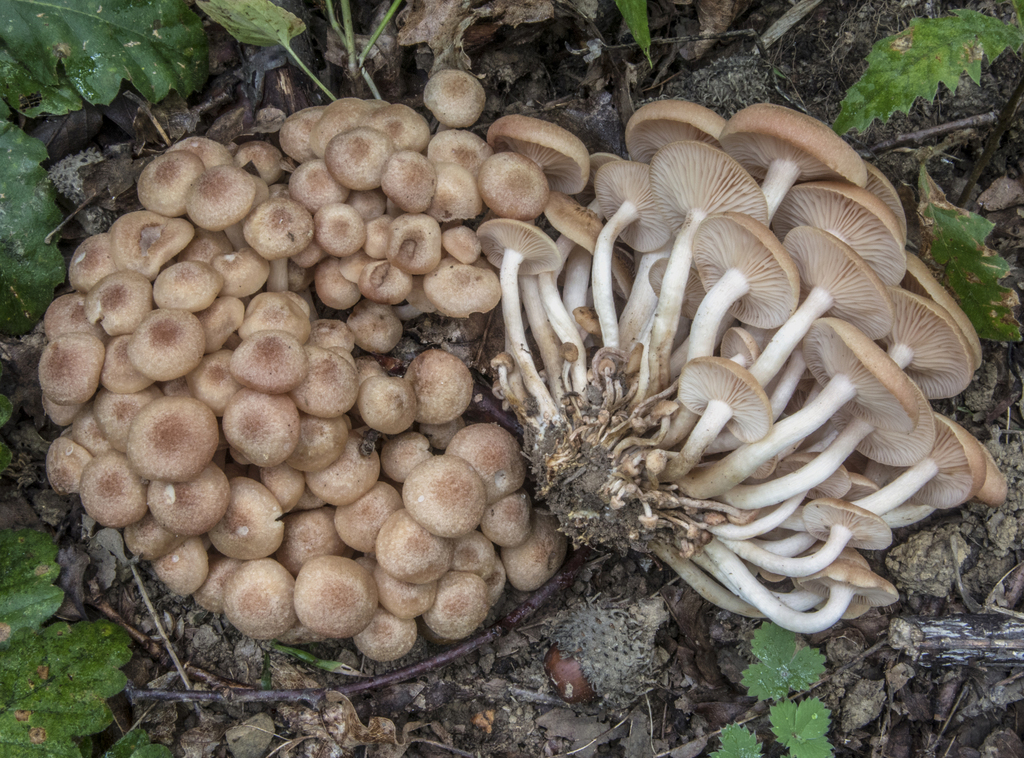
ringless honey fungus
Desarmillaria tabescens
Armillaria tabescens (also known as ringless honey mushroom) is a species of fungus in the family Physalacriaceae. It is a plant pathogen. The mycelium of the fungus is bioluminescent.
From the article Desarmillaria tabescens on Wikipedia (CC BY-SA), quoted section by section
Range & habitat
Armillaria tabescens is found in warm and dry regions, so, in Europe, it tends to be in southern areas. It has also been found in altitudes ranging from sea level to 1,300 metres (4,300 ft). Studies in Europe have found that it exists in south-east England, France, Hungary, Italy, Portugal, Greece and, rarely, Germany and Switzerland. In Japan, it is very rare; only one isolate of Armillaria tabescens was found out of 59 sites surveyed. Armillaria tabescens grows quickly at 28–30 °C (82–86 °F) and more slowly at 5 °C (41 °F). If the soil is moist, fruiting bodies are abundant. It is the first to fruit in September, compared to Armillaria mellea and Armillaria gallica. The fruiting bodies can be seen even earlier if the season has been exceptionally wet. Armillaria tabescens grows poorly on sand and produces shorter rhizomorphs. Rhizomorphs are threadlike structures in fungi that are made up of hyphae. Hyphae are branching structures that release enzymes to absorb nutrients from the host. The pleasing fungus beetles Tritoma atriventris, Tritoma angulata, Tritoma biguttata, Tritoma erythrocephala and Tritoma humeralis have been recorded feeding on Armillaria tabescens.
Wikipedia: “Distribution and ecology”
At the table
The species can be cooked and eaten, even being regarded as choice, but has been reported to cause upset stomachs. Armillaria tabescens additionally contains small levels of antioxidants which have been studied for possible use as protection against lipid peroxidation and free radical damage.
Wikipedia: “Edibility”
Where it lives
Recorded sightings
—
geo-referenced records in GBIF, from museums, herbaria and field observers.
Drag the globe to turn it. Dots are where records exist, not a range map; darker means more records.
In the stacks
Searching the stacks…
Every page naming Desarmillaria tabescens in the Biodiversity Heritage Library →
This page is assembled live from iNaturalist, GBIF, Wikipedia, the Source Library and the Internet Archive. It is not yet part of the hand-edited codex. iNaturalist taxon 895035.